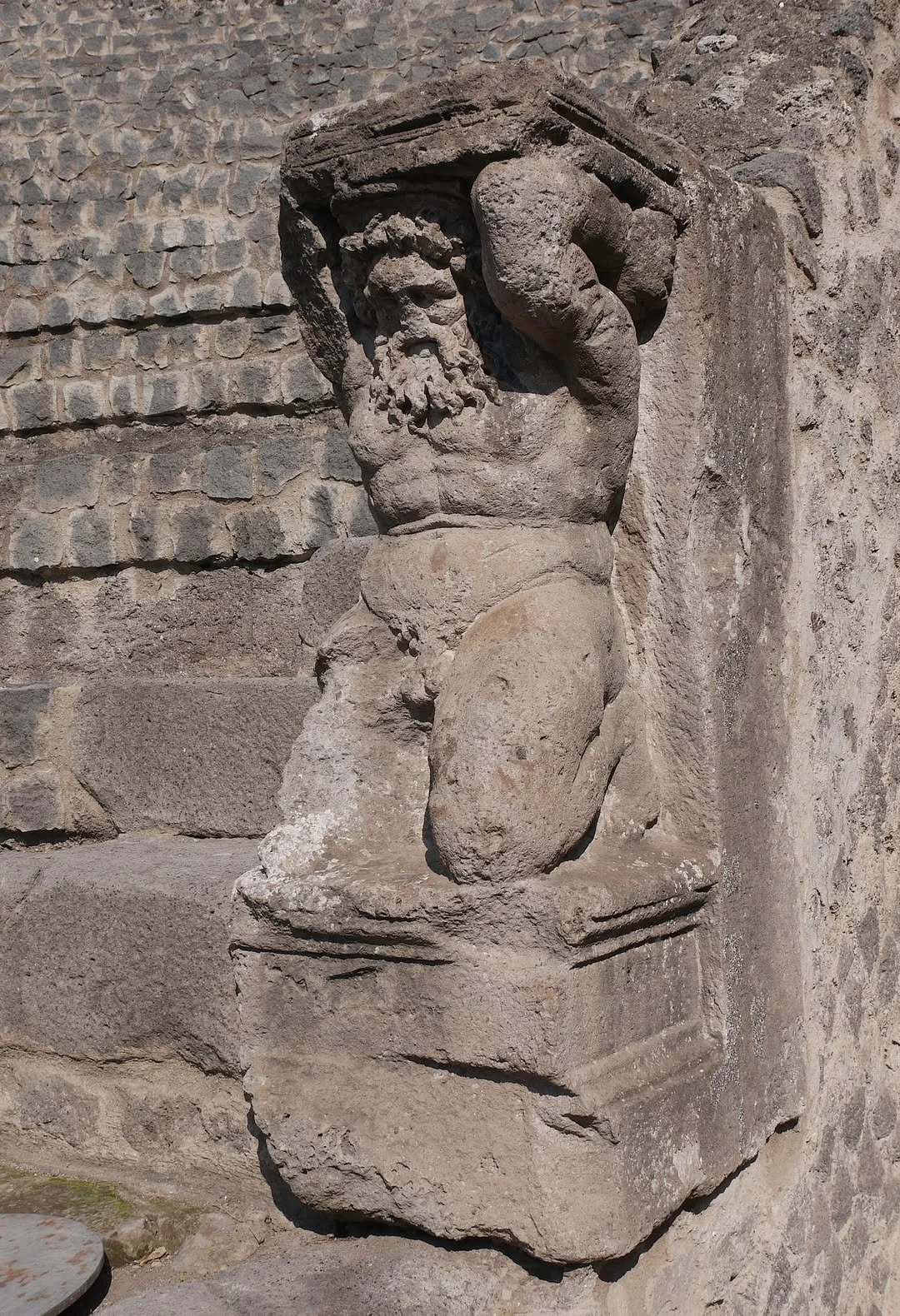
A well-preserved Roman sculpture of a Kneeling Atlas supporting a ledge in the Odeon theater of Pompeii, Italy.
Frozen in Time: The Kneeling Atlas of the Pompeii Odeon
One of the most striking details in the Odeon (the "Little Theater") of Pompeii, Italy, is the figure of the Kneeling Atlas. In Greek and Roman mythology, Atlas was tasked with holding up the celestial heavens; here, he stoically supports the architecture of one of antiquity's most intimate entertainment venues.
The Rise and Fall of the Little Theater
The Pompeii odeon was a hub for music and poetry, offering a more refined atmosphere than the large open-air amphitheater nearby. Its timeline is a dramatic window into Roman history:
Built: 1st Century BC.
Destroyed: 1st Century AD.
Like the rest of the city, the Odeon was enveloped in several meters of volcanic ash when Mt. Vesuvius erupted in AD 79. This cataclysmic event paradoxically served as a time capsule, preserving the intricate stonework of the Atlas figures for nearly two millennia.
Note: have a look at our post on the odeon of Ephesus here.
For more on Pompeii, click the link here.
Walk the Streets of Pompeii with Us
If seeing the well-preserved wonders of the Roman world is on your bucket list, we invite you to join us next year (May 28-June 6, 2026). We are returning to Italy to explore the ruins of Pompeii, the coast of Naples, and the layers of history in Rome.