
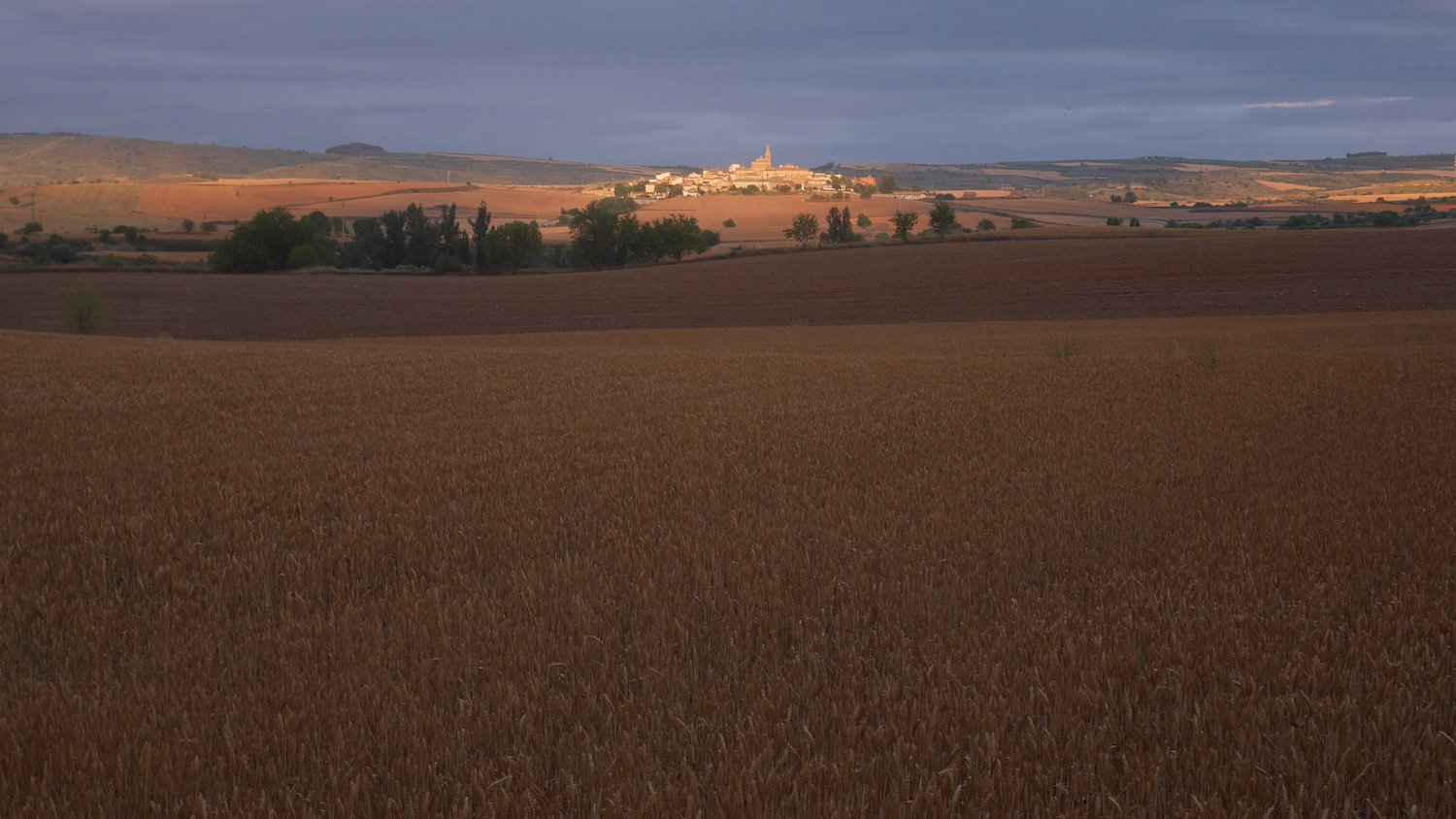
Clouds on La Sierra de Codés.
We passed a significant milestone with no fanfare. There was no signage that I recall; had I not been consulting Brierley’s guidebook—which I was discarding page by page to "save weight"—we might have missed it entirely.
Since stepping off the bus in St-Jean-Pied-de-Port, Bob and I had covered 100 miles of the Camino Francés. The first twenty-five, crossing the Pyrénées, were undoubtedly the toughest. Beyond that, the terrain rolled out like an old burlap bag—the hills soft and fraying, the watersheds wide. When we did encounter a stream, it was feeble. The Spanish sky, by contrast, was a ponderous sapphire that pressed hard against the land. Only 400 miles now separated this spot in Navarre from the Cathedral of Santiago de Compostela. My mind tried to hide that number from my feet; it felt like too much.
One day at a time, sweet Jesus / That's all I'm asking of You / Just give me the strength to do every day / What I have to do.

Our path cut through the Pyrenees and ran south of the Basque and Cantabrian Mountains. Image courtesy of the site here.
Perhaps it was the rhythm of the walk, the internal energy diverted to growing new brain cells,* or simply a choice to seize the moment with the eye rather than the lens—whatever the cause—my photography began to taper off after the first week. My note-taking slowed, too. To the north, the Sierra de Codés dominated the horizon, part of the “Basque Mountains.” This 5,000-foot scarp stood as a barrier between us and the Bay of Biscay. While experts wrangle over how these peaks relate to the Pyrénées and the Cantabrians, I preferred Aubrey Bell’s more eloquent take: she saw the “Basque Threshold” as a place to be considered on its own merit.**
We hiked from Los Arcos to Longrono. It was an 18-mile day, largely rural in character. This was a good thing. Natural surfaces were kinder to the knees than blacktop.

The sun played through the clouds on our approach to Sansol. It was a tiny place, like many Spanish hamlets, dominated by a single church house. The 18th-century structure topping the knob, however, was not the 12th-century hospitum mentioned in several sources.*** This pilgrim shelter, now completely erased, belonged to the Hospitallers of Saint John of Jerusalem (or simply Knights Hospitallers), a formidable military order of Crusader period. In Spain, as in Israel-Palestine, they tended sick, poor, or injured peregrinos (among other things).**** I wondered what this hamlet would have looked like in the 12th-century. The surrounding fields seemed eternal.
Cereal fields surrounded the village of Sansol.
With the crunch of gravel we were overtaken by a strider. To our surprise, it was Greg! We hadn’t seen him since Pamplona. He had given us lessons in checking a bunk for chinches (bedbugs) in Zubiri (see post here). Greg was working on his second Camino and was insistent on traveling alone. We agreed to look for each other down the trail. We walked together for a time and then parted. Greg shot ahead, grinning silly. We each offered the customary exchange.
¡Buen Camino!

Greg was long and skinny and on the way.
*They say (they being psychology-types) that walking is crucial for helping memory and mood. Part of this may be linked to the connection between exercise and the act of pumping out new brain cells. Check out the article here in Psychology Today or here in The New York Times.
**See Aubrey F. G. Bell, “The Basque Threshold” in Bulletin of Hispanic Studies 24/93 (Jan 1, 1947): 5-10.
***See T. López Selles, Contribución a un catálogo de ermitas de Navarra (1973). A pdf of this work is posted here. Find the entry for Sansol on page 195.
****For an introduction to the Knights Hospitallers, see the work by Ernle Bradford, The Shield and the Sword: The Knights of Malta. Open Road, 1972. Further afield, I cannot say enough good things about the experience of reading Roger Crowley, Empires of the Sea: The Siege of Malta, the Battle of Lepanto, and the Contest for the Center of the World. Random House, 2009.
With travel restrictions easing, we have a full slate of Bible Land trips ready to launch in 2022. Check out a complete list by clicking here or perusing under the heading “Find your Trip.” For more information on how to join one of these trips or if you are interested in helping to craft a unique trip for your own group, church, or school, contact me at markziese@gmail.com.

