
The La Rioja region of Spain is famous for its wines. The secret, in part, is in the climate. The region is protected by the nearby Cantabrian Mountains. Image from here (accessed 8/29/2018).
walking the Vineyards of La Rioja
The hills rose and fell like sea swells—unhurried and splayed rather than steep. As soon as we reached the bottom of one, another began to build. Bob and I poled our way to the top of each, enjoyed the view, then dropped into the next trough. We continued this way, west of Logroño, for a long time.
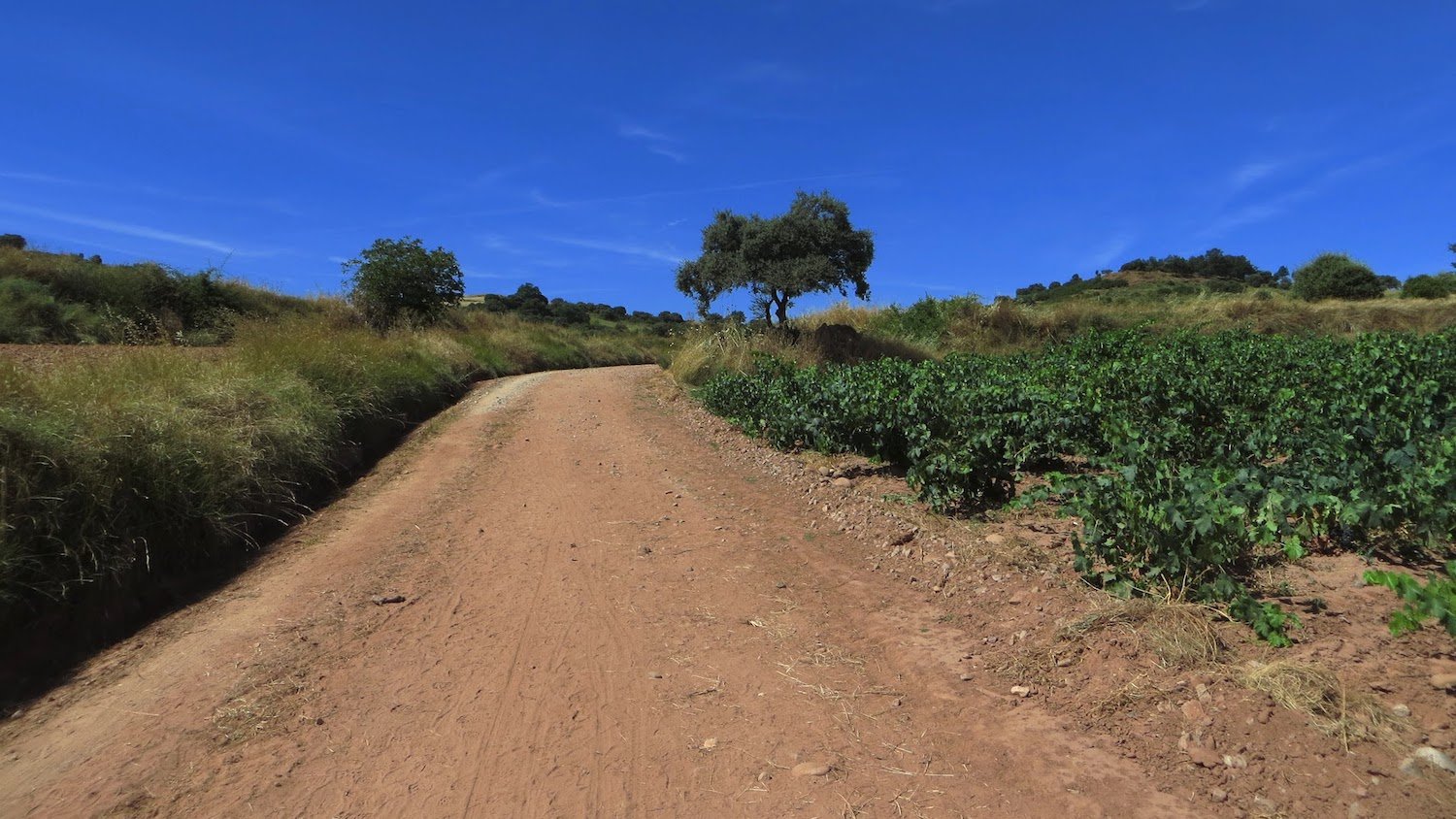
Along our track were rows and rows of grapes.
A Viticulturalist's Paradise
Along our track were rows upon rows of grapes. Suspended on systems of wires and supports, they were laid out with such precise intent that one could almost believe a giant comb had been pulled across the hills. The mad tangles of vines, leaves, and fruit—as tall as a man—had been disciplined to defy their own nature as well as the nature of the hills. They ran in their lanes, straight and true.
It was a viticulturalist's paradise. More than three million acres of Spain are devoted to wine; here, alongside Italy and France, the grape enjoys celebrity status.

The grapevines are disciplined to defy their own nature.
The Farmer from Navarrete
A man appeared out of nowhere and inquired if we were pilgrims bound for Nájera. We affirmed the obvious. He asked to accompany us for a while. “I want to practice my English,” he offered as an excuse. “And I need the exercise.”
With little else to do but walk, we welcomed this stranger into our small troop. The usual pleasantries followed. We learned his name was Alex, his family had lived in the village of Navarrete "forever," and he farmed nine hectares of vineyards. He had been tending the vines when he heard us coming.
“Do you know the story of the Camino?” His English was Spanish-stained but clear.
Bob and I had notions of course, but we welcomed his company. We also welcomed the conversation that his question would set in motion.
“No. Tell us.”

We genuinely enjoyed the company of Alex. He was knowledgeable and engaging, a historian as well as a farmer.
The Tomb as an Excuse
Alex looked pleased. He slipped between us as we poled our way over another crest. Tink—tink—tink. The silver cap of my walking stick tapped the stones.
The grape farmer began with the familiar details: how James was one of Jesus's key men and how his tomb was rediscovered in the time of King Alfonso II. (If you are just now joining us, you really should go back and read our previous stories. Here’s the place to begin.) As he rehearsed these details, it was obvious Alex was skeptical. I squeezed him for an opinion on the identity of the tomb in Santiago de Compostela.
"I don't know if James is really there or not." He hesitated, then blurted, “The tomb of James was the excuse.”
Bob and I looked at him with curiosity.
He went on to explain the Reconquista—how Christian leaders encouraged settlement by using the pilgrimage. They knew that if people walked to Santiago, they would discover the beauty of the land and stay. He waved his hands at the rolling green hills as proof. This was why his family had lived here forever.
Etched in Earth and Parchment
This flow of travelers strengthened the bond between the Iberian Peninsula and the rest of Europe. By the tenth century, northern Hispānia was firmly in Christian hands; a century later, the Camino Francés entered its “Golden Age.” More than 250,000 pilgrims walked the path each year, their feet etching the trail into the earth. The Codex Calixtinus, the guidebook of the twelfth century, more or less “canonized” the route in both earth and parchment.
A Teacher Becomes the Student
We reached a park beside the trail, Alex wound down. “Now I must walk back.”
I wondered what would come next. In the Middle East, the conversation at this point often turns to a sales pitch. But there was no such thing here. Alex's motives were purely altruistic. We parted as Camino friends—Bob and I toward Nájera, and Alex back to his vines.
I shook his hand warmly. “I am a teacher, but today you have taught me.”
The grape farmer seemed pleased.
¡Buen Camino!

Three men tread grapes. This 2nd century AD mosaic is from the Amphitheatre House, Merida, Spain. It illustrates a part of the job of wine-making. Image from here (accessed 8/29/2018).

Eager to get back out there? So are we!
If you are interested in seeing wine country with your own eyes, you really should join Mark and Vicki for a Mediterranean cruise! Click the link here for a future travel schedule. We visit biblical sites on the Mediterranean rim and contemplate places where the grape, olive, and fig still hold celebrity status.