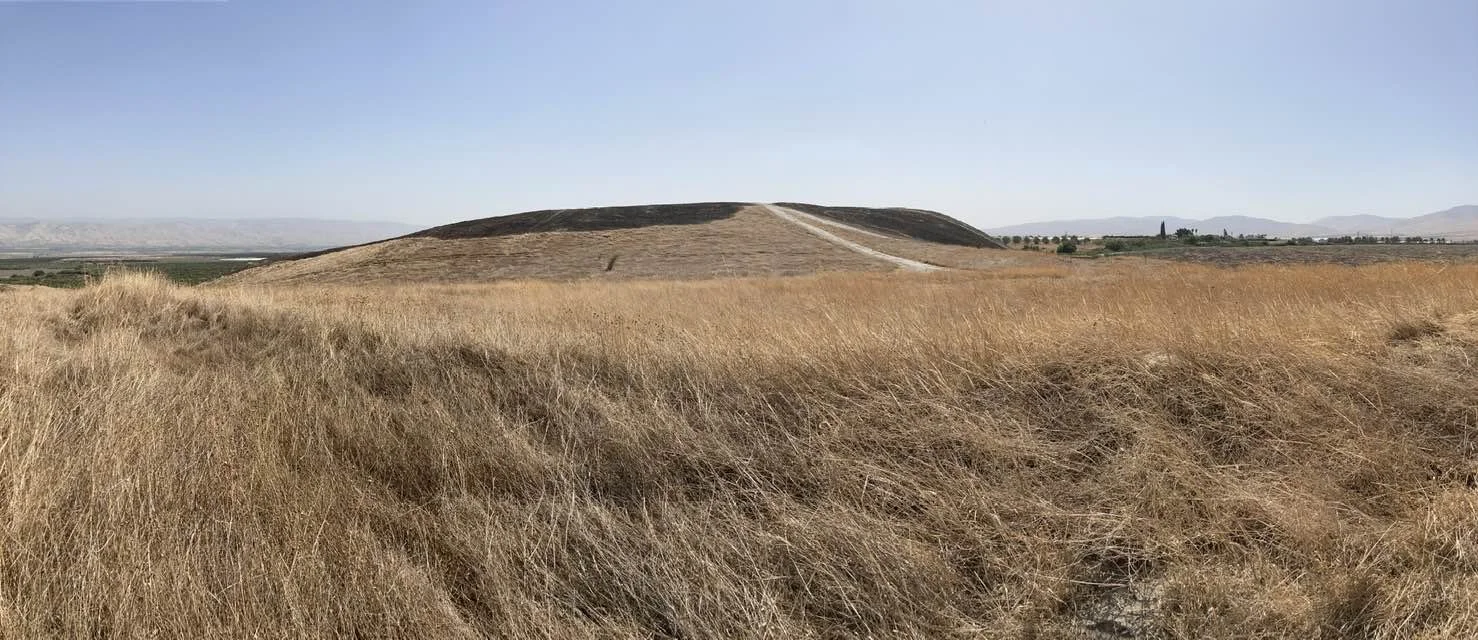
The steep, grassy slopes of the ancient Tell Rehov mound rising 20 meters above the surrounding fertile plain in the Lower Jordan Valley.
Visiting Tel Rehov
After landing in the Heartland and overnighting in Jerusalem, I pointed my rental car north toward Galilee. The drive up Highway 90 was steady, but the archaeology was calling too loudly to ignore. I pulled off at Tel Rehov (Arab. Tell es-Sarem) to stretch my legs and see what the summit had to offer.
Standing on that mound, one realizes why it was a powerhouse for centuries. The view overlooking the Lower Jordan Valley is simply unmatched—a strategic vantage point on the pulse of the region.
Biblical Archaeology at TelL es-Sarem: Ancient Apiaries and Prophetic Clues
But there’s more to this pile of rubble than a good view. The Hebrew University in Jerusalem excavated here between 1997 and 2012 and revealed many aspects of life from the Old Testament, including
An Ancient Apiary: This site yielded the oldest known beehives in the world, dating back nearly 3,000 years.
The Anatolian Connection: Scientists found that these ancient beekeepers actually imported “gentler” bees from Turkey to boost their honey production (“designer bees”?).
Prophetic Clues: A pottery shard found here bears the name “Elisha,” leading many to wonder if this was a home base for the biblical prophet himself.
It was the perfect stop before hitting the Sea of Galilee. What would these stones say if they could speak? So many memories!