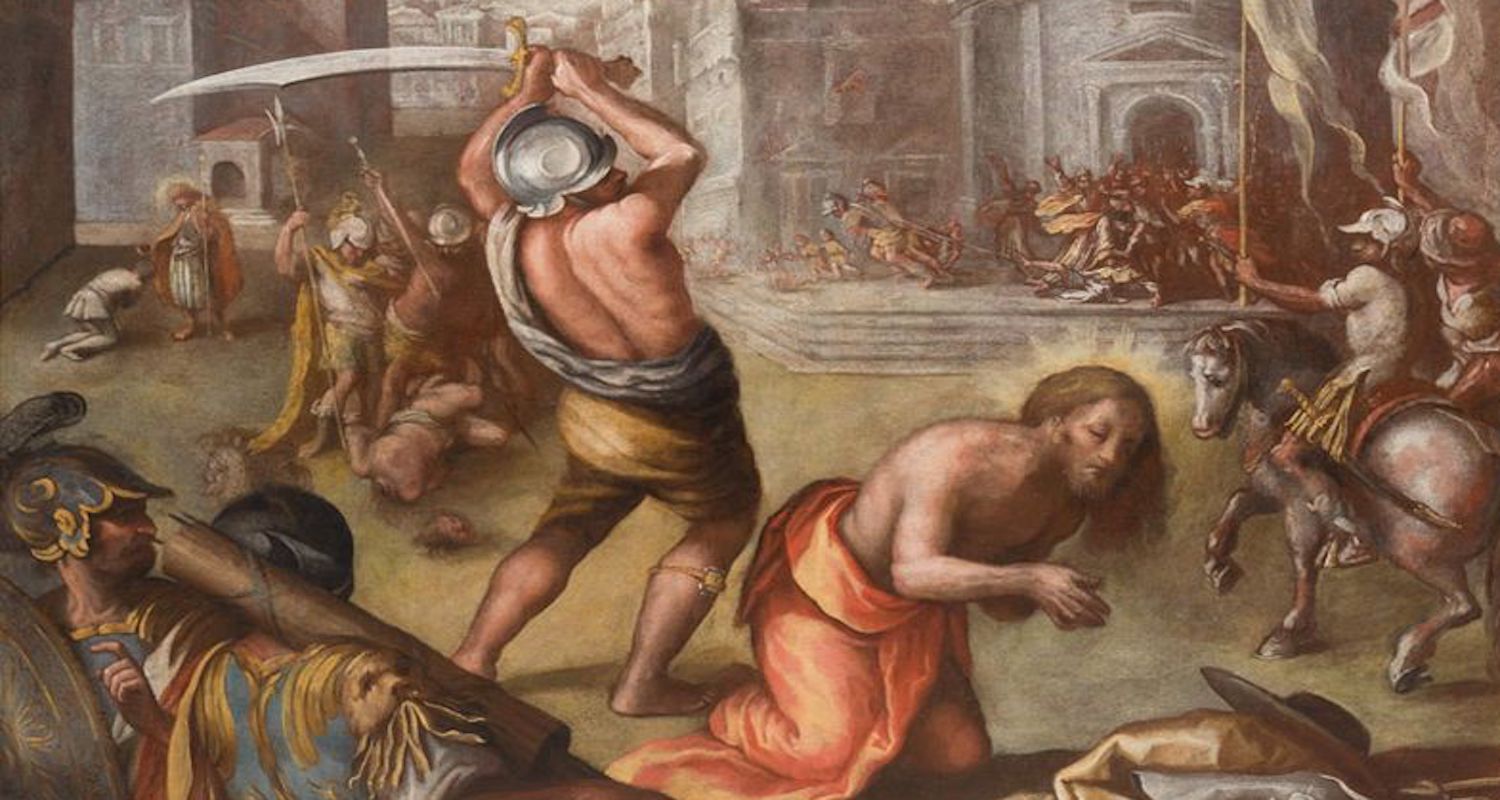
The beheading of James the Great. Notice below his hands is the floppy hat of the pilgrim. Jame is Santiago! Image from here. Accessed 7/16/2018.
I sit on a terrace, thinking about James. My knees are weary, still vibrating from the splintered shale of Monte Irago.
A while back, we sifted through the “James Gang” and identified the three distinct characters who carry that name in the New Testament: James the Great, James the Less, and James the Just. (For a refresher, you can wander back to that post here). Today, we leave “the Less” and “the Just” behind.
James the Great was one of the Twelve, and the only apostle whose martyrdom is recorded in Scripture. His execution serves as a grim preface to Acts 12: “About that time Herod the king laid violent hands on some who belonged to the church. He killed James the brother of John with the sword . . . ” (Acts 12:1-3).
Blood is spattered at the start of that chapter to cast Peter’s subsequent arrest in the darkest possible tones. The reader is led to believe Peter will be whacked just as James was. There is a twist, of course, but I’ll let you discover that on your own (see here).

James the Great is the patron saint of Spain. How is this connection made, you ask? Good question! I captured this image of James in the Astorga cathedral. He is cast as a pilgrim with a staff and drinking gourd, book, and shells on his shoulders.
From a purely New Testament perspective, this is where the earthly life of James ends. He witnessed the ministry, death, and resurrection of Jesus, only to be executed in the very city where his Lord was crucified.
However, outside the Bible, the story of James the Great lives on—and it gets wild. Part of his legend involves an epic journey the Bible is mum about; another part involves a post-mortem appearance. Both accounts teeter into the realm of myth, but I wouldn't say that too loudly to a Spaniard. This is the stuff of national epic. Proceed with caution.
There is a gap of roughly fifteen years between the crucifixion of Jesus (ca. AD 30) and the execution of James (AD 44). This provides the atmospheric oxygen for the story of James’s mission to Spain to breathe.
A cloud drifts through the terrace where I am sitting. My view is suddenly limited. I hope the rain will pass.
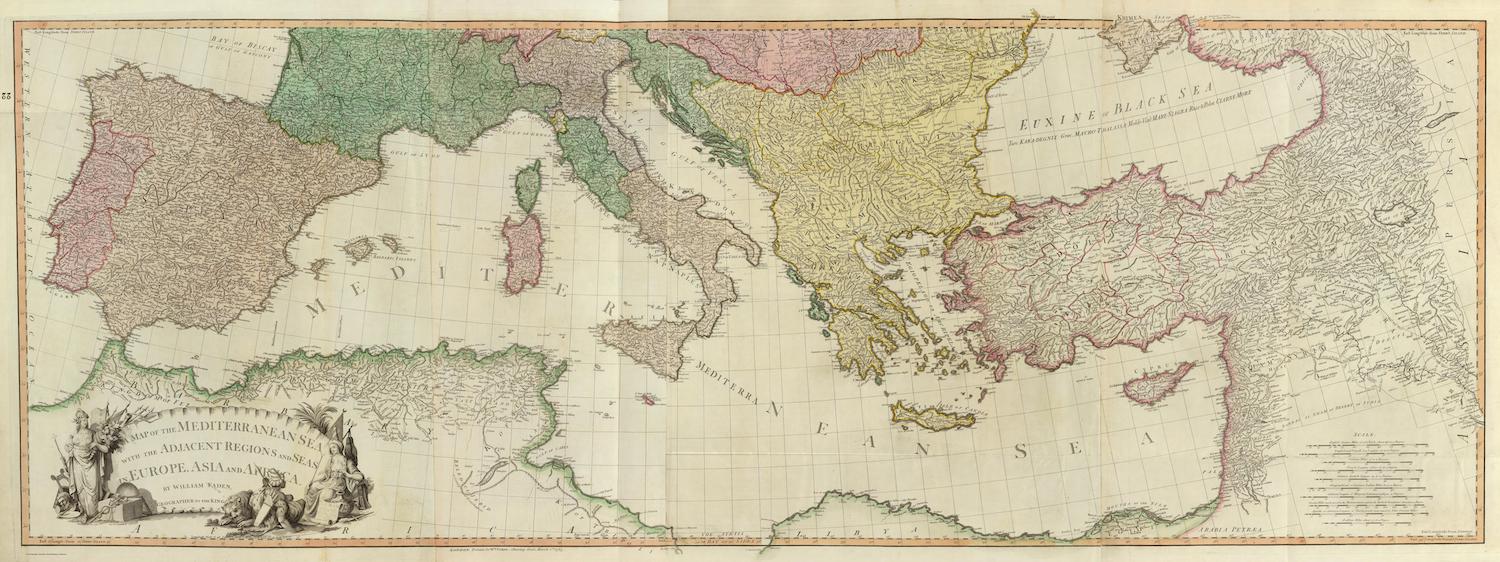
That's Spain and Portugal over there on the far left (west). These two countries together form the region called Hiberia (Ibēría) by the Greeks and Romans. Today we call it the Iberian Peninsula. Image from here (accessed 7/18/2018).
Christian tradition suggests the Apostles divided the world into personal assignments to fulfill the Great Commission. According to the apocryphal Gospel of the Twelve Apostles, James received the gift of Latin on Pentecost. Since Spain was firmly under Roman rule, the case for his mission begins to take shape. Sea voyages across the Mediterranean were common (think “Paul”), and diaspora Jewish communities in Spain would have provided a natural starting point for his preaching.*
Remember this is all conjectural and apocryphal and you certainly shouldn't hold your breath. The wheels turn slowly, at least at first.
In a late 6th century work, known as The Breviary of the Apostles, we find the first explicit written link between James and "Spain and the western regions."** By the 7th and 8th centuries, the legend gained serious traction—fueled by the Reconquista, the Christian effort to push the Moors out of the Iberian Peninsula.*** The movement needed an iconic hero, and “Thunderboy” was called to ride again.
The sky rumbles around me now.

My view from the terrace. Monte Irago is in the clouds. Now you know why my knees are weary.
Here is the short end of the tradition: After Pentecost, James traveled to Spain to labor as a missionary. He reportedly converted only nine people, his message was largely ignored, and he was even imprisoned in Granada. Finally, prompted by a vision of the Virgin Mary (who was still alive at the time), he was recalled to Jerusalem.**** There, he was beheaded.
It is not exactly a megapastor success story.
James's noggin was buried in Jerusalem, say the Armenians (who point to the spot). But his body had more miles to travel. We'll take that up that story at a future time.
¡Buen Camino!

Roman trade ship. Image from here (accessed 7/19/2018).
*The group known as Sephardic Jews is certainly a later development, but even today the Hebrew term Sefarad refers to Spain.
**See page 41 of John Williams/Alison Stone's Codex Calixtinus and the Shrine of Saint James (1992). Other slightly later evidence is listed as well.
***Chase down references in the writings of Isidore of Seville, Aldhelm of Malmesbury, or Beatus of Liébana. It is not exactly bedtime reading.
****This vision is considered the first visionary appearance of Mary. It supposedly took place in Zaragoza, Spain. Today the site is marked by the Basilica of Our Lady of the Pillar. Read more about the site here.

With travel restrictions easing, we have a full slate of Bible Land trips ready to launch in 2022. Check out a complete list by clicking here or perusing under the heading “Find your Trip.” For more information on how to join one of these trips or if you are interested in helping to craft a unique trip for your own group, church, or school, contact me at markziese@gmail.com.