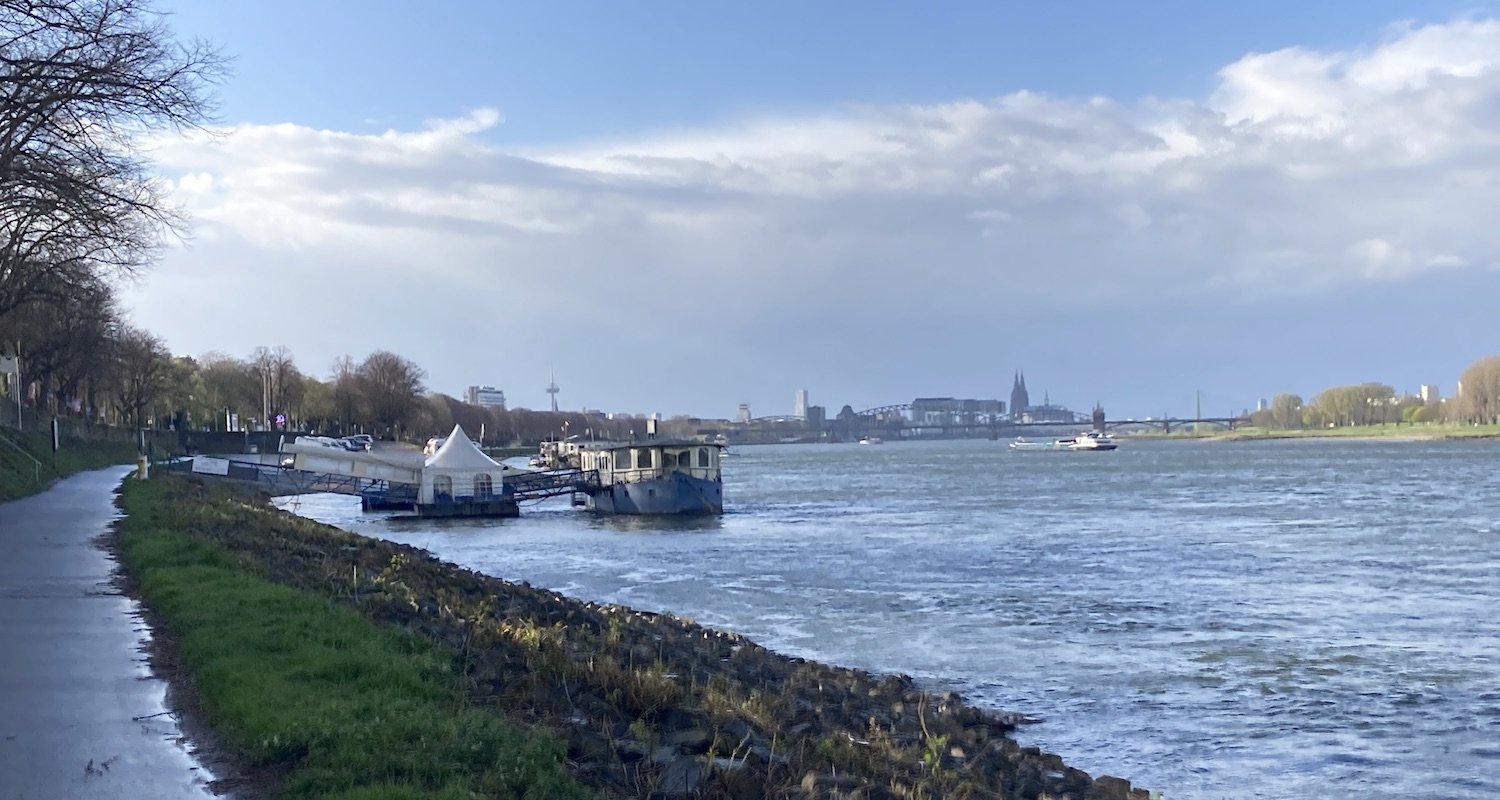
The Rhine River flows through Köln, Germany.
We walked the asphalt trail under an indecisive sky. The earth smelled wet and looked smudgy. One moment, the rain veered and dropped in gusts; the next, the muslin drapes of the sky pulled back to let sunlight shoot through. The light ricocheted off the wet pavement, transforming the droplets clinging to leafless branches into temporary diamonds. Then, just as suddenly, the drapes curled shut and the dance was over.
Moriah had warned me to bring clothes. I was wearing my fleece under my raincoat. Springtime in Köln (or Cologne), Germany, is a fickle thing.
Above us, the bank rose steeply, fortified in places by concrete and stacked stone to protect the city from the clawing current. Moriah pointed to a spot high on the wall. “A few weeks ago, the water came up to here. The whole trail was underwater.”
Below the trail, the source of that flood—the Rhine—charged north with considerable force. While today’s rain was light, we could only imagine the volume falling on the Black Forest or the Swiss Alps upriver. This 1,326-kilometer watercourse begins in what the Roman historian Tacitus could only describe as a place of “precipitous and inaccessible height.”*
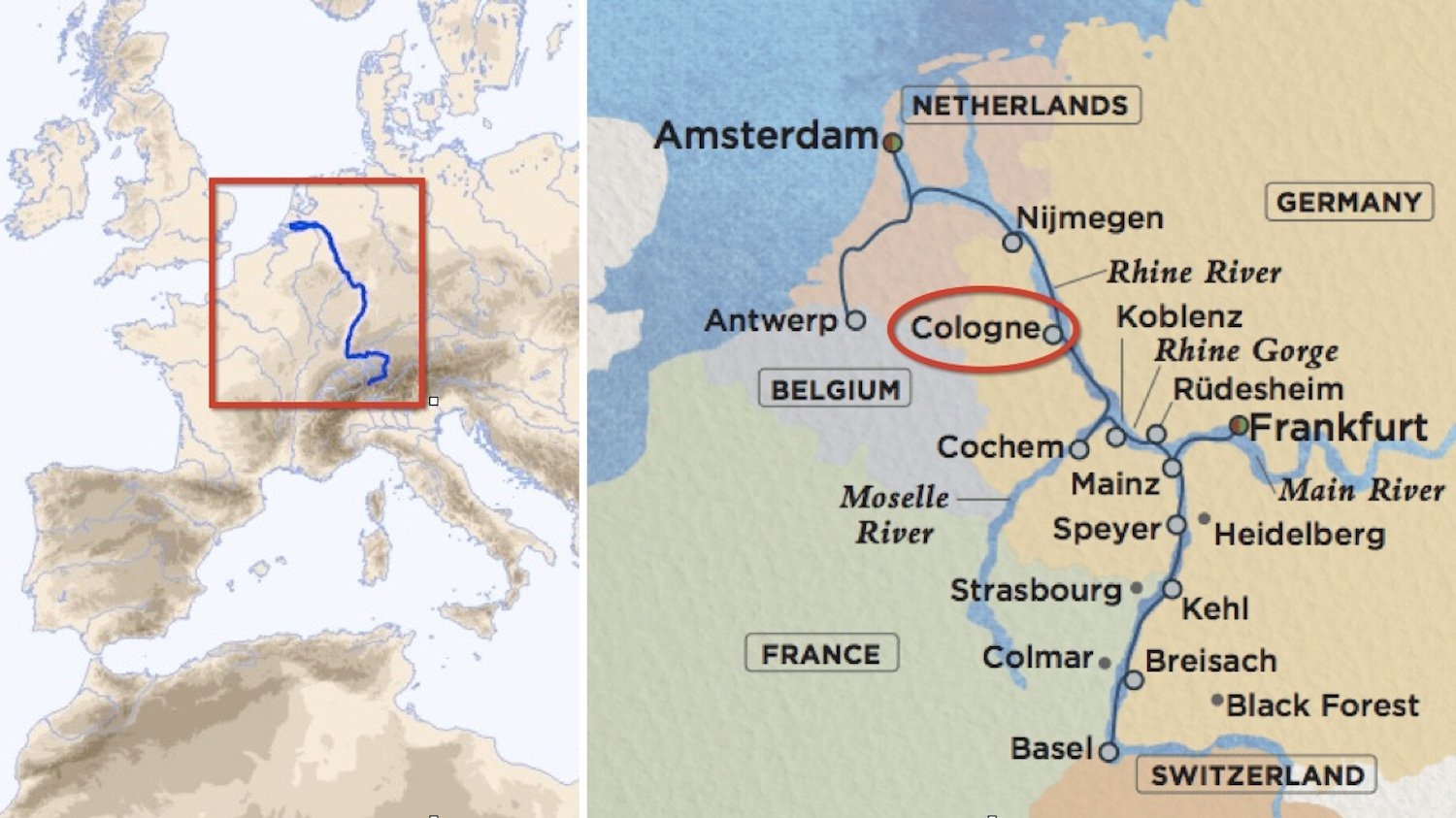
The Rhine originates in Switzerland and runs through Germany and France, the Netherlands, and into to the North Sea. Image on the right is from https://www.euratlas.net/geography/europe/rivers/rhine.html (accessed 5/8/2022).
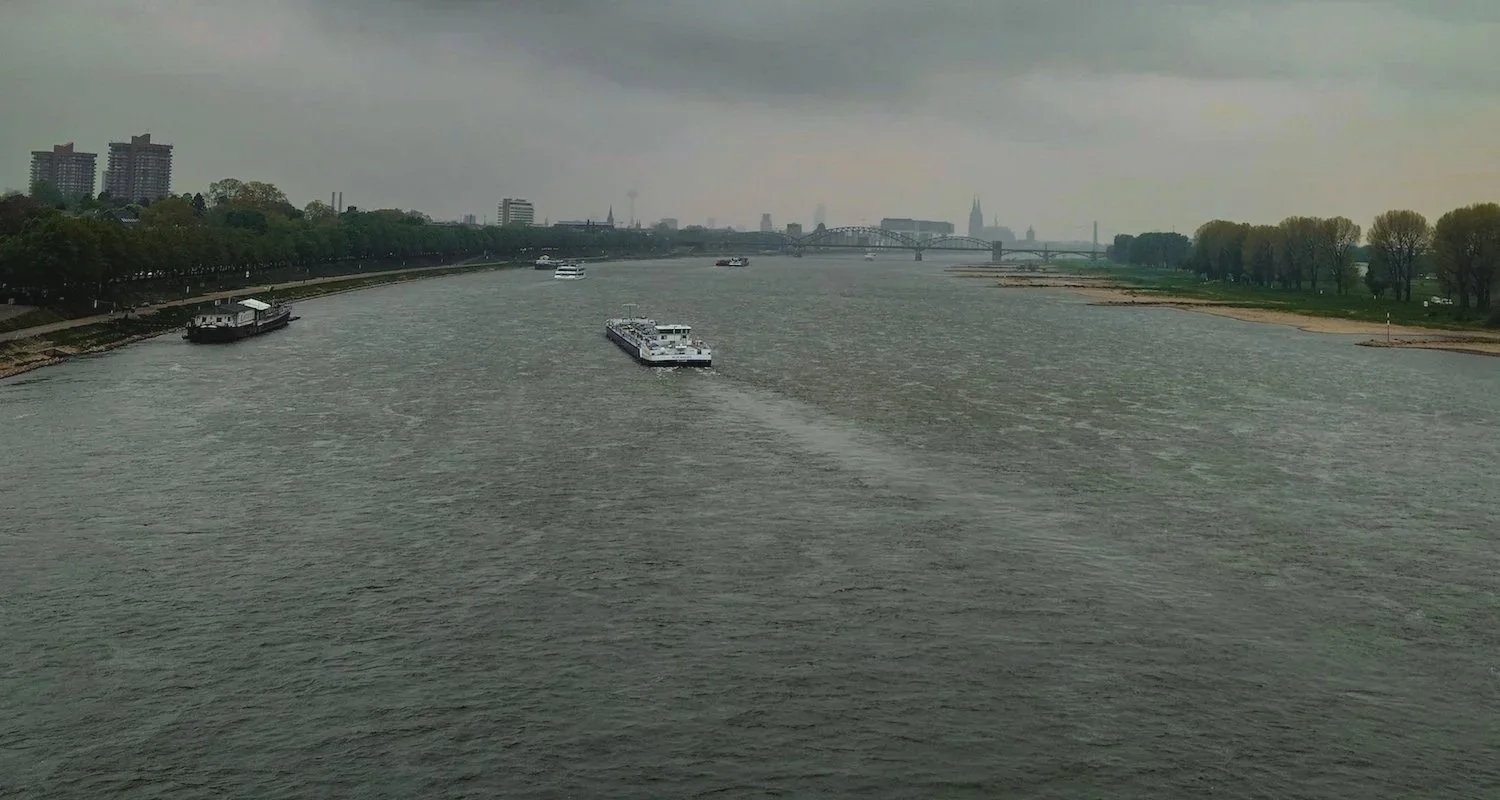
Traffic on the Rhine near Moriah’s apartment. Photograph by Peter Dohrn.
That mystery was supposedly solved in 1785, when the Danubian Antiquarius described a house on Mount Abnoba with two gutters: one gushing into the source of the Danube, the other into the Rhine.** An enviable location for a house, to be sure.
Some dub the Rhine the most important river in Europe.*** While Danube travelers might argue the point, the Rhine is undeniably the primary artery of German life and history. As we chatted (and chattered in the cold!), a barge loaded with shipping containers struggled against the current. Its power wasn't measured by speed—I think we could have outwalked it—but by the rhythmic throb of its engines. It was a labor felt more than heard.
The scene felt familiar. Having spent twenty years on the banks of the Ohio River in Northern Kentucky, we knew the language of tugs and barges. Köln, as an old river town of mud and flood, felt like home. Though the Rhine is similar in length to the Ohio, its discharge is much lighter—perhaps only a third of the Ohio's volume—yet its historical weight is immense.
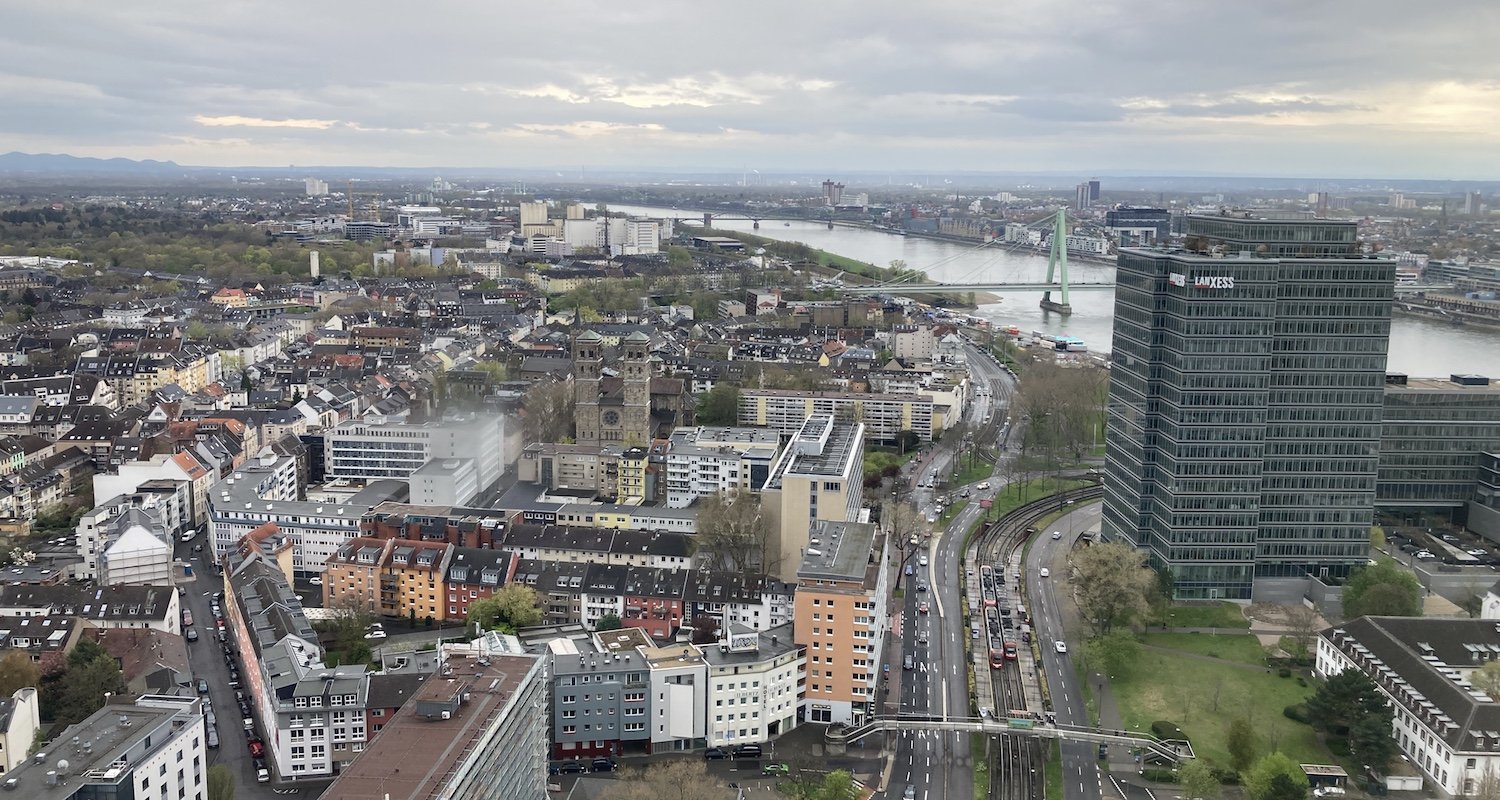
View to the Rhine from the observation deck of the KölnTriangle building.
As one dedicated to the landscapes of the biblical world, the Rhine may appear to be even more remote. It is not mentioned in the biblical text at all. And yet, this river and its environs were familiar to many in the New Testament world, by word if not by experience.
The Rhenus—or “flow”— as the Rhine was known to the Latin-speaking Romans, ran along the edge of the Roman frontier. Stories about the “barbarian” tribes that lived on and beyond this river curled the nose-hairs of the more civilized Mediterraneans. These mentions are worth exploring.
*Tacitus was a first-century AD Roman historian who offers many tidbits of interest (including an early extra-biblical mention of the crucifixion of Jesus). While there is much that is unknown about the north country in his day, Tacitus understands that “the Rhine springs from a precipitous and inaccessible height of the Rhætian Alps, bends slightly westward, and mingles with the Northern Ocean.” See his Germany and its Tribes, chapter 1. Text available at http://www.perseus.tufts.edu/hopper/text?doc=Perseus%3Atext%3A1999.02.0083%3Achapter%3D1 (accessed 5/9/2022).
**This and other wondrous details are revealed by Claudio Magris in his Danube (translated by Patrick Creagh. Farrar Straus Giroux, 1989): 27.
***See the article by Elisa Miebach in Bloomburg.com (U.S. Edition) “Germany Is Re-Engineering Europe’s Most Important River,” published 9/6/2020. The article is available online at https://www.bloomberg.com/news/features/2020-09-06/germany-is-re-engineering-the-rhine-europe-s-most-important-river (accessed 5/8/2022).
Reservations are now being received for our April 21-May 1, 2023 excursion to Greece. Bible Land Explorers will follow in Paul’s footsteps in the classical world, with stops at Thessaloniki, Amphipolis, Philippi, Neapoli (Kavala), Meteora, Delphi, Corinth, Mycenae, Epidaurus, and Sparta. Conclude this grand tour in Athens, the classical center of it all. Click here for the brochure. Early bird discounts apply. Direct all questions to BibleLandExplorer@gmail.com
