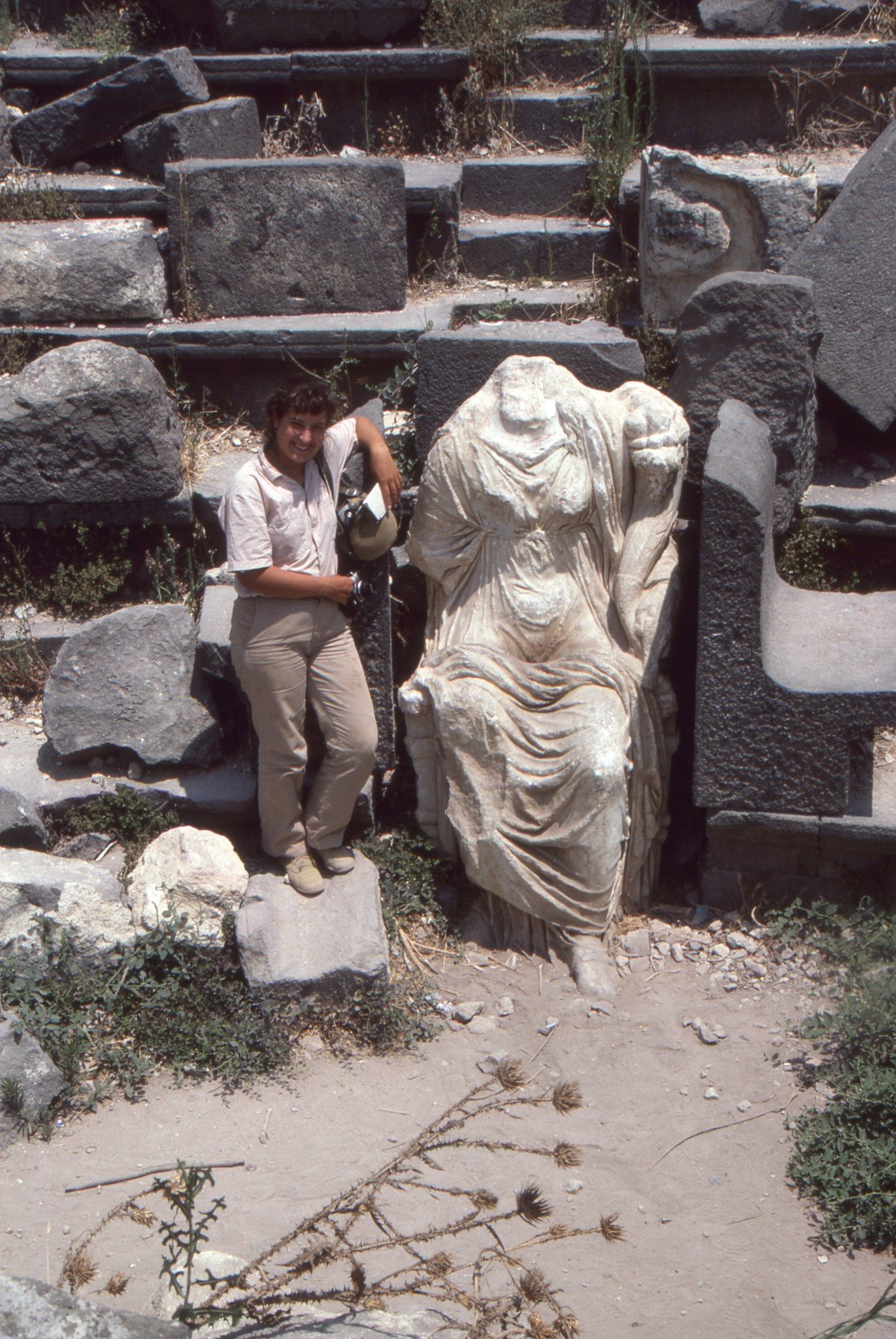
Amy Deeds (Barr) stands beside the seated goddess of Gadara (Umm Qays), Jordan.
The Seated Goddess of Gadara
In this 1986 slide, Amy Deeds (Barr) stands alongside a larger-than-life white marble statue of Tyche, the Greek goddess of fortune and the patron deity of Gadara
Symbolism: The goddess holds a cornucopia (horn of plenty) in her left hand, a classic attribute representing the prosperity and fertility she bestowed upon the city.
The Setting: The statue was famously discovered in the western theater, a stunning structure built of black basalt.
Placement: Its original position was in the lowest row of the orchestra, likely placed between the seats of honor (the proedria) for city dignitaries and councillors.
A City of the Decapolis
Gadara was a intellectual and cultural powerhouse, once dubbed a "new Athens" for its famous poets and philosophers. It was a key member of the Decapolis, a league of ten Hellenized cities that served as centers of Greco-Roman culture in the region.
The Miracle of the Swine
Gadara is most famous in the New Testament for the healing of the demoniac (Matthew 8:28-34).
The Narrative: Jesus encountered a man (or two, per Matthew) living among the tombs on the outskirts of the city. Upon healing him, the demons were cast into a herd of swine, which then rushed down a steep bank into the Sea of Galilee.
The Geography: While the modern site of Umm Qays is about 6 km from the shore, the "country of the Gadarenes" likely encompassed the steep slopes leading down to the lake.
Archaeological Roots: Abila 1986
This 1986 trip took place in a significant era for Jordanian archaeology. That summer, the Abila Archaeological Project conducted its third major season of excavation at Abila of the Decapolis (Quweilbeh). Amy Barr, now a co-founder of The Lukeion Project, spent over a decade excavating sites like these across the Mediterranean.