The Porcelain Rule: Water Safety while Traveling Abroad
Beware the water when traveling abroad.
It’s the porcelain rule, right? And if you’ve ever contracted the explosive sick, you know why.

Studying the signage at a fountain near Pamplona, Spain.
Unfortunate experiences (it’s best not to discuss such things publicly) gave me reason to question water from Middle Eastern and African spigots. Such came to mind when I walked into Spain.
But here is the good news: drinking water in Spain is a matter of civic pride. Public fountains are ubiquitous, ancient, and 99.5% safe.* The Spanish understand dehydration better than most, and unsafe sources are clearly marked both in guidebooks and on-site. Agua no potable is a phrase worth mastering.
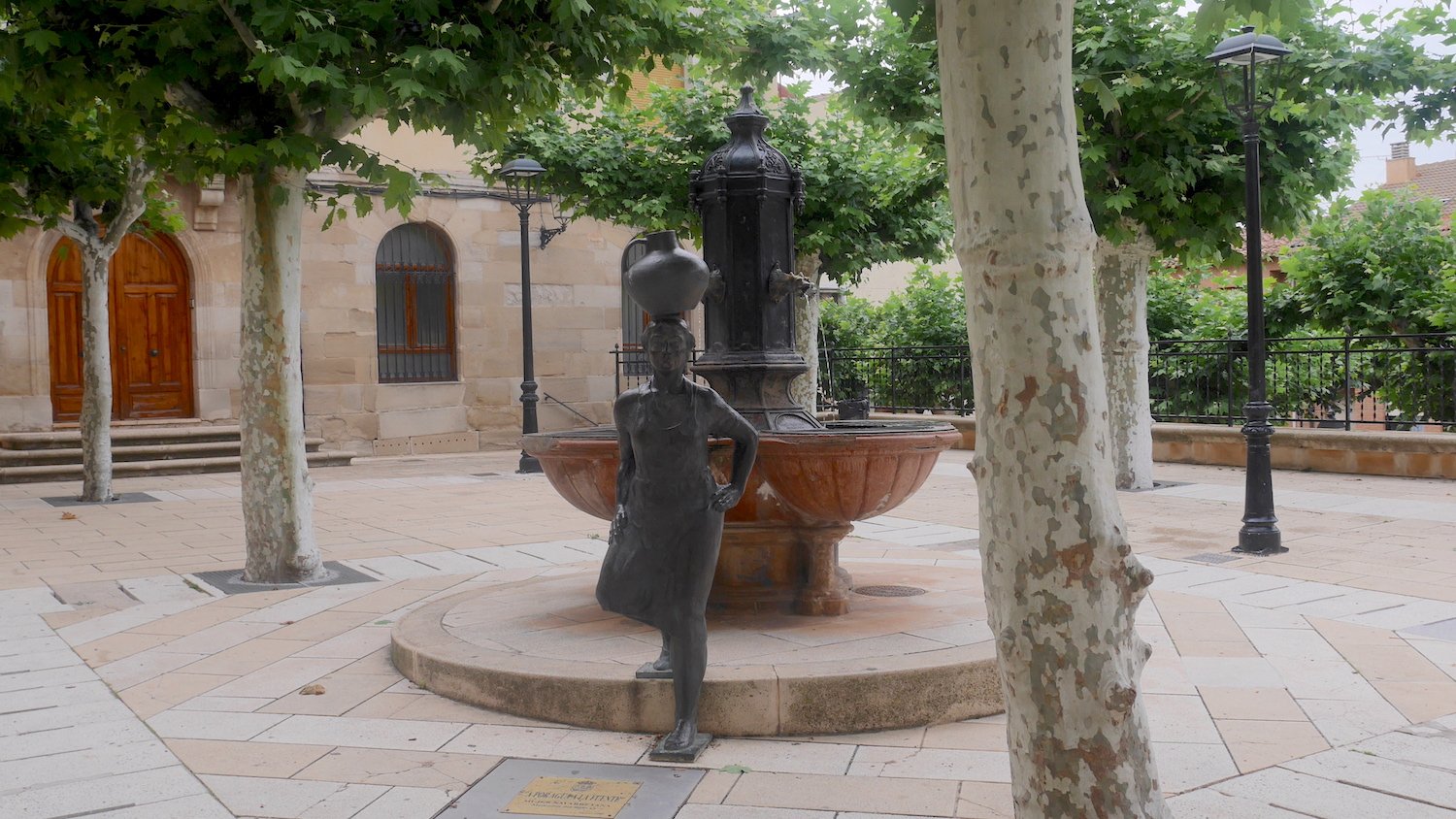
This fountain in Navarrete was particularly lovely.
I learned it and spent more than a month traveling from one end of Spain to the other. I did this without digestive distress from one end to the other of me.

No, Bob! No! Agua no potable does not mean “really tasty water.”
The Morning Ritual: Petroleum Jelly and Pack Hacks
Needless to say, after a light breakfast at the parochial in Estella,** I did my rituals.
This included greasing up my feet with petroleum jelly and filling my water bottles from the kitchen spigot. The first kept the wheels spinning blister-free; the second kept the rest of the machine working. Both were repeated like the Divine Office.
Bob and I slipped a donation in San Miguel’s box, found our walking sticks outside, and buttoned up the packs.
While both our packs had generous hip “holsters” that could be used for water storage, it was difficult to retrieve these with a one-elbowed arm. Instead, I kept my sips dangling from my shoulders.

Note the system. Other than a few long days crossing Spain’s central plateau, two smaller bottles proved sufficient to get me from fountain to fountain.
I found the hack online. The secret was a small silicone loop and a couple of cheap carabiners.*** One end of the loop went around the neck of a plastic bottle, the other was clipped to a pack-ring on the shoulder strap. Achieving the proper location—high enough to ride out of the way, yet low enough to unclip with one hand—required experimentation. Finally (as an afterthought) to keep the bottle from swinging wildly (and smacking me in the face), I hand-sewed a wide elastic band into the shoulder strap. This band captured the bottom of the bottle and could easily be stretched on or off.
Hence, just two moves were needed to free the bottle: (1) slip off the bottom elastic band, and (2) release the carabiner. I found I could do this without breaking stride.

This system works too. But not well. Image from here (accessed 10/26/2021).
Stepping Back in Time: The Monastery of Irache
Just down the road from Estella, we entered the village of Ayegui. Dominating the blocky structures was an ancient Benedictine monastery sitting adjacent to an equally historic winery, Bodegas Irache. According to the 12th-century Codex Calixtinus, this region was "fortunate with bread and wine and meat and all fertility” (Book V, Chapter 3). Can’t beat that, I thought.
Bodegas Irache features a famous fountain that looks like any other, save for one major difference: it has two spigots. The first offers cool, clean water. The second offers free-flowing Spanish red wine. It is the Camino’s only Fuente de Vino.
The Fuente de Vino: Wine from a Hole in the Wall
Originally, the monks shared a glass with passing peregrinos, but they eventually installed a tap in the outer wall to distribute “liquid encouragement.” A sign above it reads: “Pilgrim, if you wish to arrive at Santiago full of strength and vitality, have a drink of this great wine and make a toast to happiness.” A second sign politely requests moderation, reminding travelers that if they want to take the wine with them, they ought to buy a bottle.
I’m guessing if you filled your bottle and carried it off it would somehow turn to water. I think that’s a New Testament thing.

The Irache Monastery sits at the base of a mountain. Vineyards line the valley floor.
Liquid Encouragement: A Morning Toast to Santiago
I am no aficionado in matters of drink, but I encouraged Bob to take a pull.
“It’s only eight in the morning!” he protested mildly. Nevertheless, he emptied a water bottle and held it under the red flow.
“Do it again for the picture,” I said, fumbling for my camera. Click... click-click.
"What’s it taste like?"
Bob wiped his grinning face with the back of his hand. “Like it came out of a hole in the wall.”
¡Buen Camino!

You don’t come across a free wine fountain very often. Maybe not ever, unless you stop by the Monastery of Irache.
*This is according to the source posted here (accessed 10/26/2021).
**I wrote about one kind of lodging along the Camino—the municipal—here. Unlike the municipal, the parochial is a hostel operated by the church. These organizations are the oldest form of lodging on the trail, known for encouraging communal meals and worship.
***I can’t remember the brand of the loops I carry, but they are like the ones in the link here (accessed 10/26/2021).

With travel restrictions easing, we have a full slate of Bible Land trips ready to launch in 2022. Check out a complete list by clicking here or perusing under the heading “Find your Trip.” For more information on how to join one of these trips or if you are interested in helping to craft a unique trip for your own group, church, or school, contact me at markziese@gmail.com.