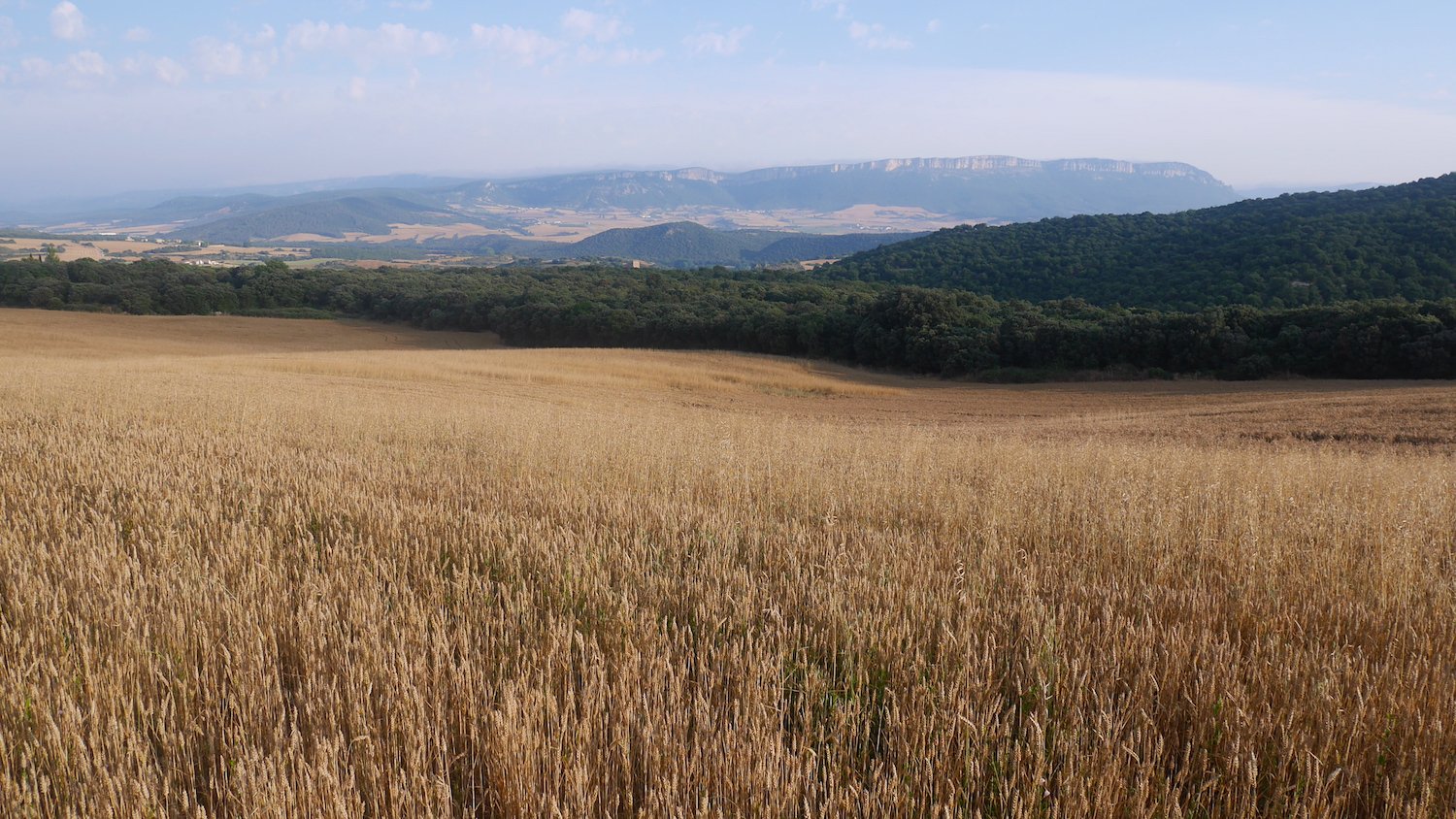
It is big barley country between Estella and Los Arcos.
The hills and valleys rolled south in even swells. The rising slopes were forested and slightly wild, while the troughs between them lay thoroughly domesticated and partially harvested. Fortresses of stacked bales appeared on a brittle-brown checkerboard, though the fields were empty of workers. It was hot; the flies were our only companions.
Bob and I were as weary as the day was long. We pushed toward Los Arcos and an albergue called Casa de la Abuela, a place recommended by a passing stranger and scribbled into my dog-eared notebook.
The breeze shifted, then surged. The air felt oddly familiar—How did I know it? Was it memories of wind-swept Kansas? Weather never changes without announcement; the trick is reading the signs. Some say the trees know first—that their bark swells and leaves curl in anticipation. Others insist you don’t smell the moisture itself, but the scent of plants dumping waste, an odor like sweet compost.
We sniffed the moving air and pushed on.

Hills and valleys rolled like swells as we approached Los Arcos. Image courtesy of Google maps.
We passed through one last gap. Los Arcos was a dusty, ancient place with tall, earthen-toned houses pressed tight together. The Río Odrón served as its artery, though it looked more like a crick than a río. Life here is deep-rooted, stretching back to the Romans, who left five tombs near the town’s entrance as a testament to the centuries.*
Following our guidebook, we found the hostel. Inside were Suzy from Essex—a solo traveler we’d crossed paths with before—and a couple from North Carolina. We claimed our bunks and spent the late afternoon in the quiet ritual of the trail: washing clothes, napping, and reading.

The Casa de la Abuela was a lovely place, clean and welcoming.
Outside, the clouds organized, then roiled. By late afternoon, they had enough of the bluster; they tore each other to pieces, spilling thunder, lightning, and a sudden, violent hail. We huddled in a dry spot under the balcony to watch the show.
They say the rain in Spain stays mainly in the plain, but nobody mentioned the hail. Sheets of rain were chased by ice pellets that ricocheted against the stone walls and pavers. Tink… tink… tink-tink-tink! A stream of water raced down the street, in search of a river, and I thanked God we were no longer on the trail.
I ducked back inside for my camera, desperate to capture the steeple of Santa María de los Arcos against the ragged sky. I ran down the street, shielding the lens under my coat, snapping pictures with one hand while fighting the elements with the other. By the time I finished, the storm had vanished. It dissipated as quickly as it had arrived, leaving behind the sound of dripping eaves and shiny puddles reflecting the returning sun.
The air was fresh.

The church of Santa María de los Arcos is the focal point of the village.
That evening, Bob and I walked to a local bar where a poster advertised paella. I didn’t know it then, but this would become my go-to dinner in Spain. Cheap, carb-heavy, and fragrant with saffron, it arrived bubbling in the skillet. On that damp night, we shared our first—chicken, I recall, served with crusty bread. Many more skillets would follow, topped with rabbit, seafood, or chorizo. Spain, I was realizing, is no country for vegetarians.
¡Buen Camino!
*It is suggested that Los Arcos is Roman town of Curnonium, mentioned in Ptolemy’s Geography (Book II, Chapter V). If correct, it is one of the towns of a people group known as the Vascones. See Gitlitz and Davidson, The Pilgrimage Road to Santiago (2000): 113. For a fuller discussion of the remains of Los Arcos, consult the work by Javier Armendariz Martija posted here.

With travel restrictions easing, we have a full slate of Bible Land trips ready to launch in 2022. Check out a complete list by clicking here or perusing under the heading “Find your Trip.” For more information on how to join one of these trips or if you are interested in helping to craft a unique trip for your own group, church, or school, contact me at markziese@gmail.com.