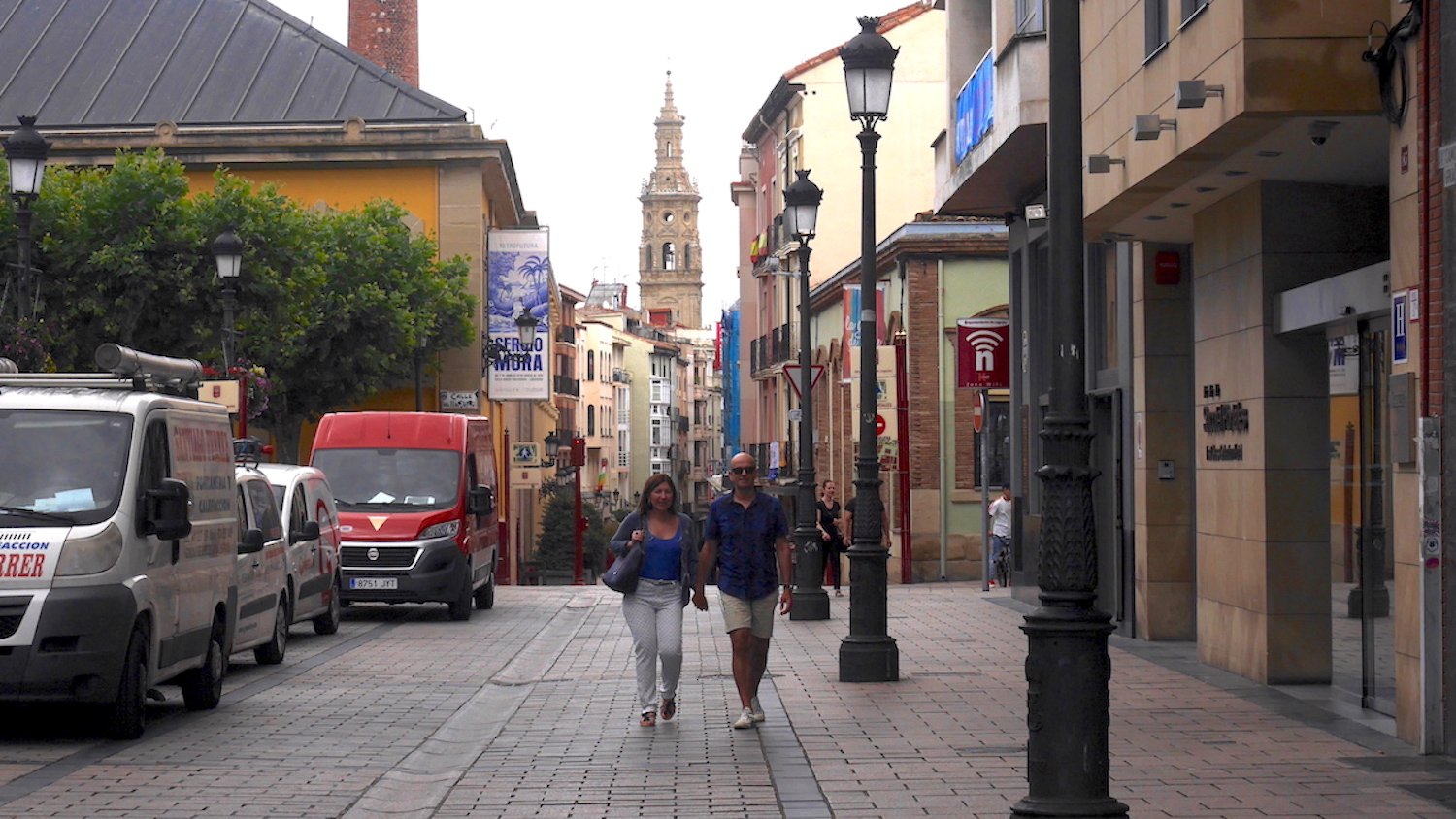
Downtown Logroño.
Bob and I walked into Logroño, a city where the modern and medieval collide on the banks of the Río Ebro. The air was a cacophony of screeching tires, blaring music, and the hollering of a city in motion. Steel and glass skyscrapers crowded against weathered stone walls—a study of Spain’s “yesterday” and “today” on one canvas.

Modified image courtesy of Good Earth.
We grabbed our bunks early. We opted for a one-star albergue called the Entresueños, or “Between Dreams.” It was a slight upgrade from our usual “Between Nightmares” stops—nicer, central, but still a bargain at ten euros. Most importantly, it sat at the edge of the historic district, just steps from the legendary Calle del Laurel, Logroño's nerve center for tapas (or, as we have started calling them, “snacks galore”). We were hungry. We cleaned up and went exploring.

Schoolgirls beneath the cathedral façade.
Ancient Potsherds and Modern Plates
The city’s reputation as a gastronomic capital isn’t new. Long before us, a Roman settlement called Varea (or Ouaria)** stood here at the navigable limit of the Ebro. During Rome's struggle with Carthage, Varea served as a vital supply hub. Today, archaeologists still find wine vessels, bowls, and plates in abundance—proof that the local obsession with good wine and food has been centuries in the making.

Martin, Daniel, and Kay. And Bob.
Gossip at the Plaza Mercado
It was a short walk from our hostel to the Plaza Mercado, where sidewalk cafés clustered in the deep shadows of the Santa María de la Redonda Cathedral.
We spotted several trail mates resting at tables. They called and waved. We pulled in and joined them. Kay, Daniel, and Martin had been with us, more or less, from the beginning. Kay was a school teacher from Oklahoma City. She had dined with us in Roncesvalles. Daniel was an artillery officer in the Danish army and Martin was a stonemason from Copenhagen. The two Nordic adventurers showed off their blisters and recounted tales of sleeping on the ground and being caught in the hailstorm outside of Los Arcos. If that weren’t enough, Martin talked of walking back to Pamplona for the running of bulls. I encouraged him to take the bus.

The plaza and the Santa María de la Redonda Cathedral, Logroño. Sidewalk cafés lined the shadows.
The atmosphere was bittersweet as we caught up with others. Harpo-Honi and Suzie from Essex were both struggling with swollen knees; Harpo-Honi had been told by a medic his Camino was over. Then there was Greg, the solo hiker and “chinche-fighter” (see the post here) who was frantic about being seen with a man smoking marijuana, fearing the priest would evict him. As is often the case on the trail, it was the last time we’d see many of them—ships passing in the night on the long road to Santiago.
A Hidden Masterpiece
Refreshed by the gossip and a bit of rest, Bob and I stepped into the cathedral. Originally a 12th-century Romanesque chapel, the building evolved into a Gothic marvel. Unlike the heavy, grounded style of its predecessor, the Gothic interior used slender columns and ribbed vaults to pull your gaze upward into a dizzying vertical space.***

The retablo in Logroño is amazing.
However, we weren't there for the architecture alone. Deep in a vault in the back wall sits a small painting—no more than a foot square—of the Crucifixion. The artist? A man more familiar to most as a sculptor than painter (apart from his Sistine Chapel Ceiling, of course). His name? Miguel Ángel Buronorotti, better known as Michaelangelo.

Cuadro del Calvario by Miguel Ángel Buronorotti (mid 16th c).
The story is as beautiful as the art. Michelangelo painted the scene for his friend, Vittoria Colonna, whose late husband was from the Logroño region. The artist modeled the figure of Mary Magdalene after Vittoria herself. Generations later, the painting was brought to Logroño, locked in a chest, and forgotten until its rediscovery in the late 20th century.
Standing in the shadows of the massive cathedral, the details were hard to see. But for the price of one euro, we triggered a pay-box light that flooded the vault. In that sudden glow, the strokes and story of the Cuadro del Calvario finally came to life.

*See the article by Pepe Castillo, “The Navigability of the River Ebro: A Reason for Roman Territorial” (available digitally here). Castillo masterfully scours the classical sources for helpful tidbits and demonstrates the importance of the Ebro as an axis for Roman control of the region.
**The site is mentioned in Livy, Strabo, Pliny and Ptolemy. See the entry in Smith’s Dictionary of Greek and Roman Geography here.
***Just for fun, if you want to read some fiction about the engineering struggles in the transition between Romanesque- and Gothic-style architecture, check out Ken Follet’s best-seller, The Pillars of the Earth (Macmillian, 1989).

With travel restrictions easing, we have a full slate of Bible Land trips ready to launch in 2022. Check out a complete list by clicking here or perusing under the heading “Find your Trip.” For more information on how to join one of these trips or if you are interested in helping to craft a unique trip for your own group, church, or school, contact me at markziese@gmail.com.