Then the unthinkable happened: work on the Cologne Cathedral sputtered and stalled.

Köln in 1824. This lithograph depicts the Church of Saint John the Evangelist in the middle and the seminary building of the archbishopric on the left. Behind these buildings rises the outline of the unfinished Cathedral. Note the Domkran on top of the tower on the far left. Image from here: https://upload.wikimedia.org/wikipedia/commons/2/26/Koeln_Dom_%2B_St._Johann_Evangelist_1824.jpg
After 300 years of labor, this “structure of hope” had outpaced its resources. It sat unfinished, unfunded, and partially unroofed. The 25-meter wooden Domkran (crane) sat idle atop the south steeple—a muscular arm with no strength left. To make matters worse, the original building plans were lost to French revolutionaries in 1794. The 13th-century vision for a grand cathedral seemed all but lost.
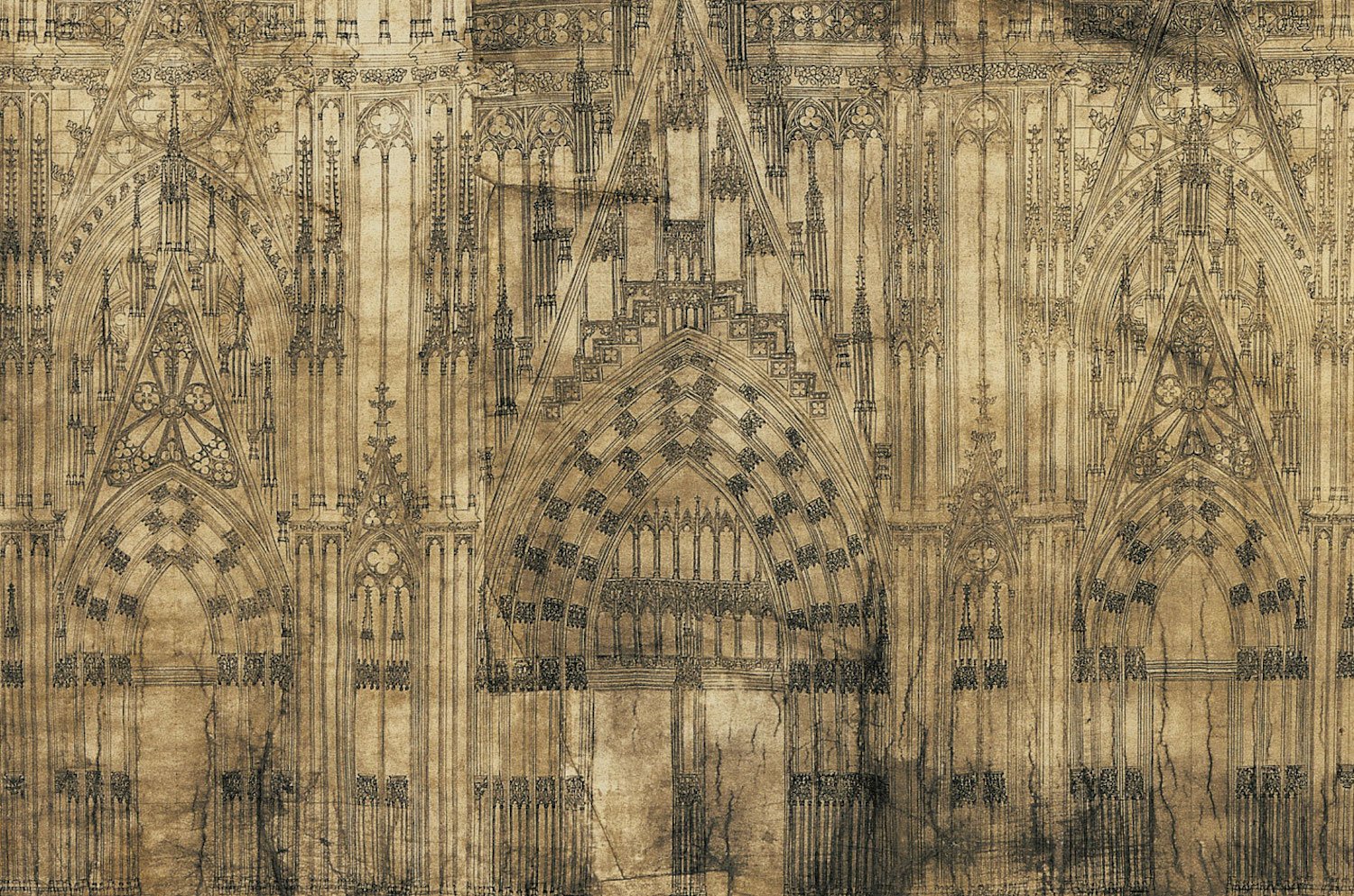
Detail from Riß F. The “sketch” was four meters in length and consisted of 20 parchments pasted together. For the image above and more on the discovery of Riß F, see the site here: https://www.koelner-dom.de/ausstattung/riss-f-ende-des-13-jahrhunderts (accessed 6/1/22).
However, some of the missing plans resurfaced in the early 19th century. One was over four meters long, offering a detailed drawing of the façade and twin steeples. Dated to 1280, it represented the original designers' vision and became known as “Sketch F.” Its discovery provided the momentum needed to finish the work. Funds were raised—exceeding a billion dollars by today’s standards—and on October 15, 1880, the Hohe Domkirche Sankt Petrus was finally dedicated. It had taken 632 years to complete. While modern materials like iron girders were used in the roof, the integrity of the medieval style remained intact.***
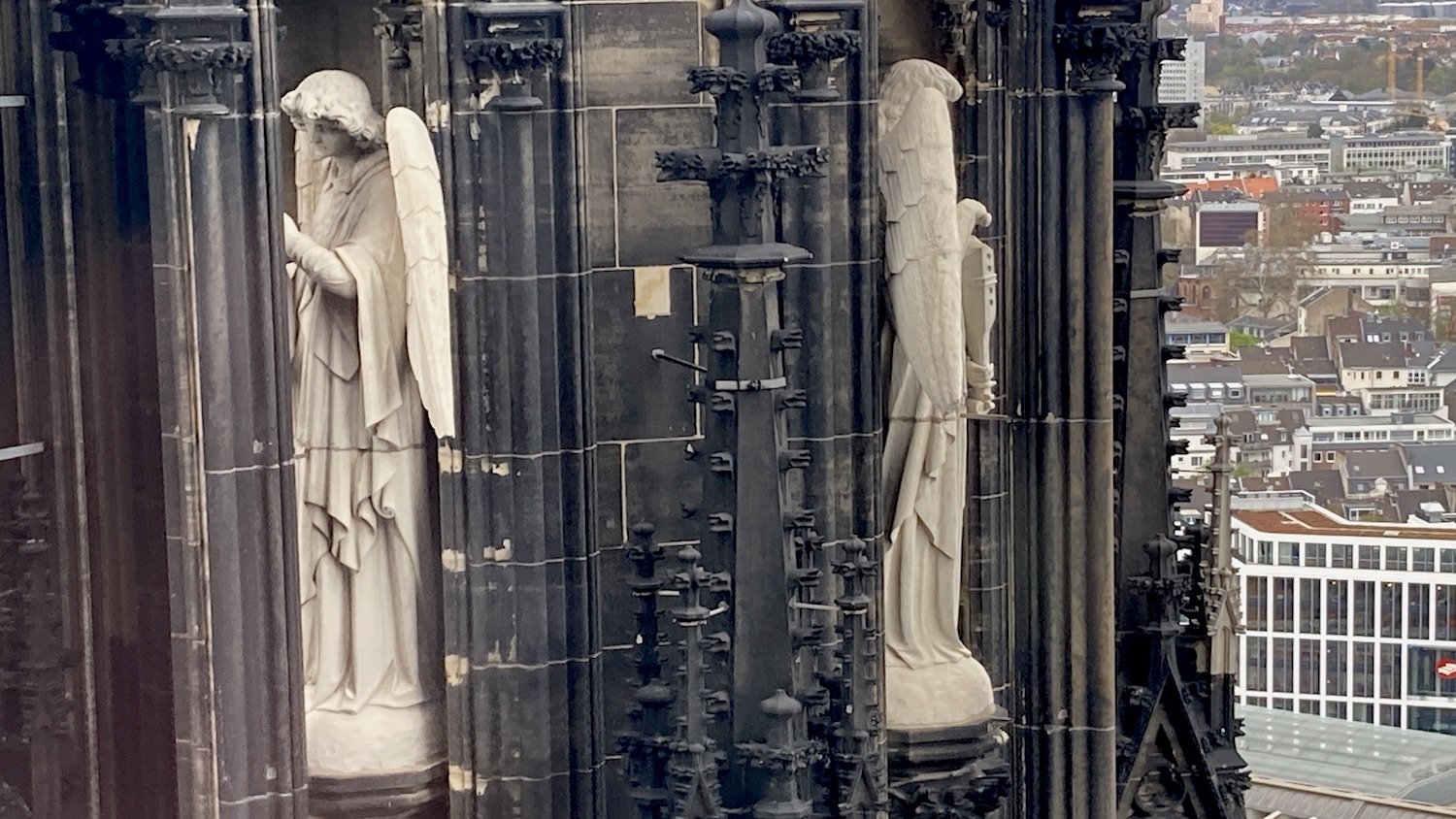
Niches cut into the towers are occupied by carved angels. The sky is their habitat.
The Dom remains an engineering marvel. In 1880, its façade was the largest of any church in the world—a record it holds to this day. For a brief time, its twin steeples were the tallest man-made structures on earth. The northern tower stands three inches taller than its twin, reaching a staggering 516 feet—the equivalent of a 47-story building. Unlike modern skyscrapers, these towers were engineered in the Middle Ages and executed in stacked stone.

Left: diagram of the Dom façade with some of its components. Right: inside the belfry on the right. Image on left is from https://www.pinterest.ca/pin/488077678360678001/ (accessed 6/1/22).
Though surpassed in height, the steeples still house the world’s largest free-swinging bell: Decke Pitter, or “Fat Peter,” which weighs nearly 53,000 pounds. And it is just one of eleven bells in the belfry.

The lower portion of the ascent requires managing a narrow stair through a vertical tube. The final fifty feet or so above the belfry made my knees tremble! It consists of a steel scaffold with open traceries on all sides. If the heart quakes, there’s help for that nearby.
I knew from the moment that I stepped off the train and looked up that I needed to climb those steeples. With Moriah busy, I had my chance. I bought a ticket and drew a deep breath.
The climb is not for the faint of heart. There are no elevators—only 533 stairs that wind through the belfry and up a steel scaffold toward the observation deck. Steel cages prevent a fall, but the height steals whatever breath the stairs haven't already taken.

Sightseers on the observation circuit.
The observation circuit consists of a walkway mounted just beneath the steeple tracery. It gives a spectacular view to the city, the Rhine, and the surrounding region.

I was fascinated by the panoramic view, but also by the staggering stone-cut detail of the steeple, the roof, and its supporting towers.
That afternoon was cold and blustery. I pulled my cap low against the wind and pressed my camera lens through the steel mesh. At exactly three o'clock, the bells below me gonged. The vibrations surged through the stone and the fence.

A keyhole shot from the steeple stairs to the “Musical Dome” (in blue) and the Ukrainian refugee camp (white tents) now parked in the downtown bus lot. The latter “structures of hope” is where Moriah was working while I was foolin’ around.
Today I have a greater appreciation for the famous watercolor of Vincenz Statz. It is a visionary work, painted before the Dom steeples were completed. Statz gave it to the lead architect on the project, Ernst Zwirner, on the occasion of his birthday. It was titled Und fertig wird er doch! or “And it is finished it after all!”
After 632 years, that is quite an accomplishment.

Vincenz Statz, “Und fertig wird er doch!” (1861). Image from here: https://upload.wikimedia.org/wikipedia/commons/e/e9/Vincenz_Statz%2C_Und_fertig_wird_er_doch%2C_1861.jpg (accessed 6/1/22).
*For more on the history of the Cologne Cathedral, “Geschichte der Kölner Dombauhütte” (author unknown). You may find it here: https://www.koelnerdom.de/fileadmin/media/PDF/newsroom/Geschichte_der_Koelner_Dombauhuette.pdf (accessed 5/31/22).
**https://www.newworldencyclopedia.org/entry/Cologne_Cathedral (accessed 6/1/22).
***“Gothic” design is particularly difficult to decipher, since so few explanations have been preserved. As Robert Bork noted, the training of Gothic builders “emphasized visual rather than verbal communication.” See his fascinating presentation of “Dynamic Unfolding and the Conventions of Procedure: Geometric Proportioning Strategies in Gothic Architectural Design.” Find the link here: http://dx.doi.org/10.5334/ah.bq (accessed 6/1/22).

Reservations are now being received for our April 21-May 1, 2023 excursion to Greece. Bible Land Explorers will follow in Paul’s footsteps in the classical world, with stops at Thessaloniki, Amphipolis, Philippi, Neapoli (Kavala), Meteora, Delphi, Corinth, Mycenae, Epidaurus, and Sparta. Conclude this grand tour in Athens, the classical center of it all. Click here for the brochure. Early bird discounts apply. Direct all questions to BibleLandExplorer@gmail.com