porté (pɔʀt) n. [PIE *prtu].
door, gate, haven, mountain pass.
A bullet-train got us most of the way there; a bus finished the job.
We stepped off and joined the others on the sidewalk. Eyes, sleepy from the ride, were now wide and darting. Despite the different languages being whispered, the group had one thing in common: we had all come to walk the Camino Francés.
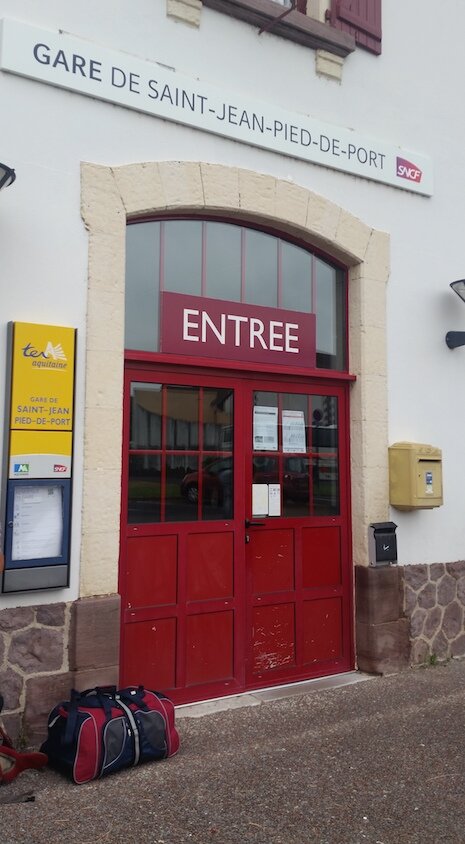
Scenes from our arrival at Saint-Jean-Pied-de-Port.


Arriving at Saint-Jean-Pied-de-Port: The Foot of the Pass
Uniforms suggested stories of preparation and personality: trail shoes or boots with thick socks, high-tech shorts, custom t-shirts, hats, hankies, bangles, beads, tattoos, and trekking poles. Hovering in the air was that locker-room anxiety you feel moments before the coach sticks his head through the door and breathes: “Game time.”
Overhead, the mist draped the Pyrénées like a silky jabot.
The driver said nothing. He hopped out, ponytail swinging, and raised the bus belly doors. Bob and I found our backpacks and shouldered them.
We high-fived, grinning silly. “This is it!”
Saint-Jean-Pied-de-Port is tucked into the Basque Country of southwestern France, pressed against the River Nive at a strategic gap in the mountains. This position distinguishes it from all the other Saint Johns or San Juans or Ivans of the world. This is “Saint John at the Foot of the Pass.” The pass in question is the “port of the Cize” (Portus Cisere to the author of Codex Callixtinus)), a vital artery connecting France and Spain.*
Bob and I shot our obligatory photos of the bus station. We consulted the map. Then we followed the others-in-boots for a short walk into town. Before us was a cluster of perfectly manicured houses and buildings. Their roofs were “red and rosy, as a Frenchman.”**
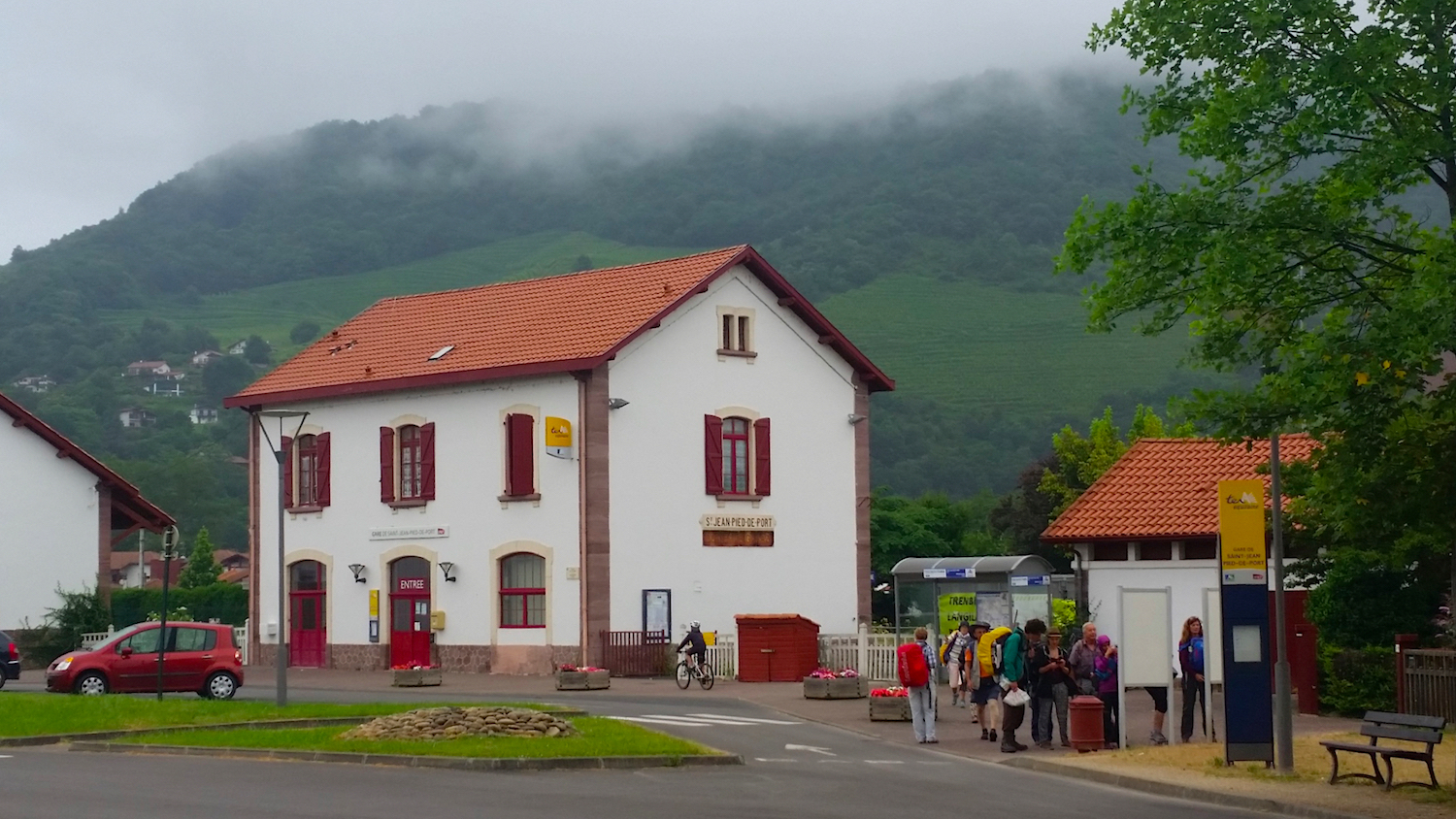
The bus station at Saint-Jean-Pied-de Port.
From Roman Gold Mines to Richard the Lionheart
It’s hard to say when the original settlement began. Artifacts from the nearby Isturitz and Oxocelhaya caves suggest human habitation stretching into deep prehistory. Much later, the Romans arrived. The gold mines of Asturica Augusta (modern Astorga, Spain) had to be linked to the empire, creating a network remembered by the 3rd century AD as the “Route of Antonin.”
History here is thick. Richard I of England (of Robin Hood fame) razed the region in 1177, earning his "Lionheart" nickname during the campaign. The Kings of Navarre later rebuilt the town and erected a fortified château, which Richelieu eventually turned into a citadel. Through centuries of Franco-Spanish conflict, the flow of pilgrims never stopped. They came from across Europe to find healing, hope, and forgiveness at the tomb of the Apostle (if you missed it, see the “four streams” map in our post here).

The white stucco buildings of Saint-Jean-Pied-de-Port crowd the River Nive.
The Pilgrims’ Office and the Porte Saint-Jacques
We found our pension clinging to a steep hill a kilometer out of town, dropped our gear, and headed back to explore. In some ways, Saint-Jean was less than expected—essentially just the intersection of a small road and a small river. Postcard perfect, certainly, but a bit kitschy (and pricy!).
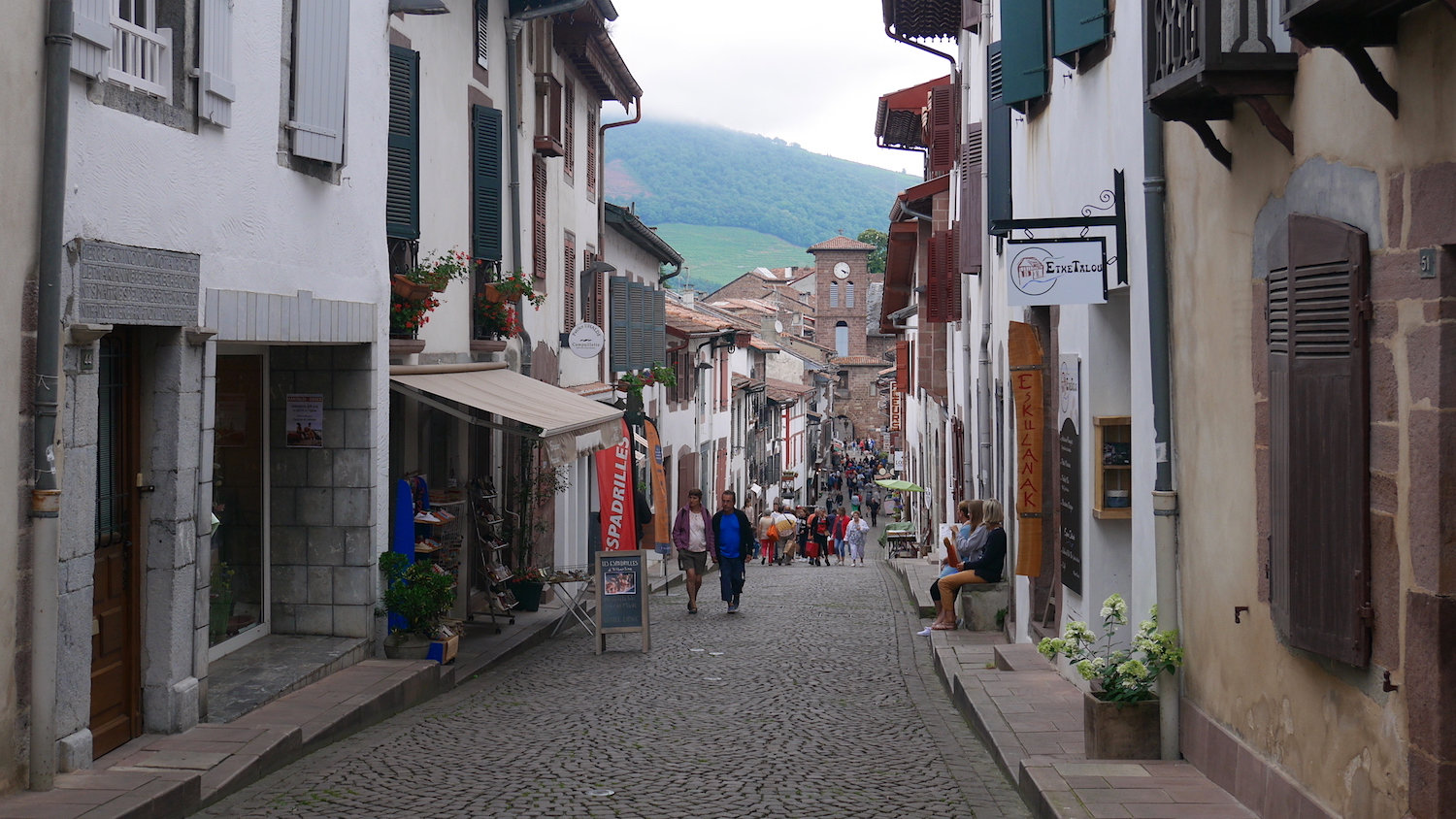
The rue d’Espagne is a cobblestone artery that runs through the center of the village. On the north side of the Nive it becomes the rue de la citadelle.
The Pilgrims’ Office and the Mendiguren Citadel, however, were another story.
The line at 39 Rue de la Citadelle proved the value of what lay inside. When our turn came, a volunteer provided maps, advice, and warm encouragement. She validated our Pilgrim Credentials and issued our first stamps. This office is the heartbeat of the trail; roughly 20,000 hikers launch their journey from this very spot every year.***

The Pilgrims’ Office was abuzz with activity.
The 17th-century Citadel offered even more. With its moat, bastions, and portcullis, it stirred the imagination—and the steep climb to the top effectively thinned out the less-motivated crowds. To top it off, we found the Porte Saint-Jacques (the Gate of Saint James).
It is the fenèstra of the fenster, the porté of the portal, the vindr of the window. We were real peregrinos now. We carried the credencials to prove it.
¡Buen Camino!
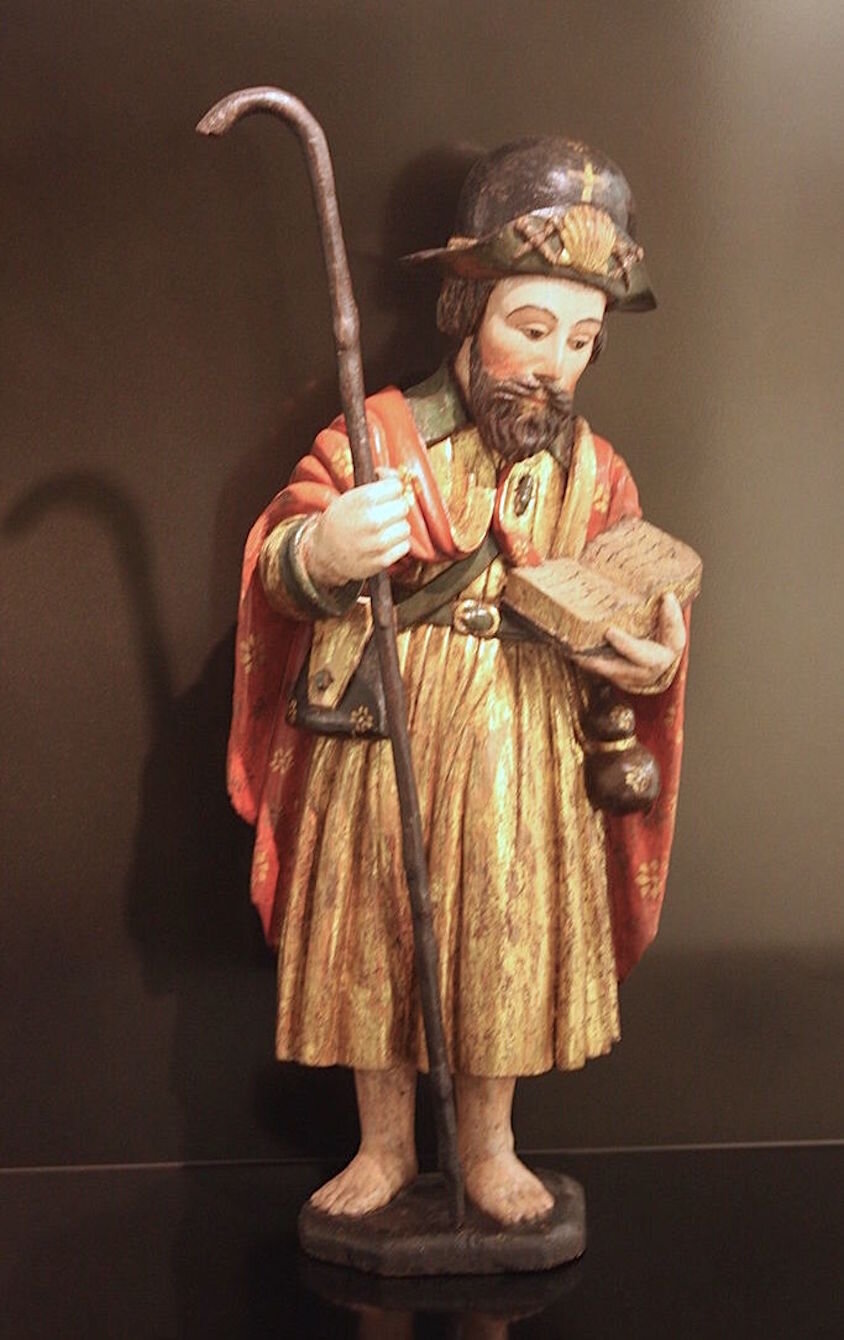
Saint James dressed as a pilgrim. Image from here (accessed 8/3/2021).

La porte Saint-Jacques is incorporated into the fortification line of Saint-Jean-Pied-de-Port.
To top it off, we found the porté Saint-Jacques or the Gate of Saint James. It is the fenèstra of the fenster, the porté of the portal, the vindr of the window. We were real peregrinos now. We carried the credencials to prove it.
¡Buen Camino!
*Codex Calixtinus mentions Pass of Cize on several occasions. See here for an English translation of this important medieval document on the Camino.
** As Francis Miltoun described it in his Castles and Chateaux of Old Navarre (1907: 393). See an online version here.
***See the website on the Camino de Santiago here.


Join Mark and Vicki for a Mediterranean experience May 25-June 5, 2022. We'll be cruising aboard the luxurious Celebrity Infinity. See the link here for details. Onboard lectures will provide focus for the group as we visit the ports of Olympia, Santorini, Ephesus, and Athens among others. Optional add-on visits to Venice or Rome are possible on either end of the trip. Questions? Contact me at markziese@gmail.com.