
The trail between Pamplona and Sierra del Perdón.
The Ascent to Alto del Perdón: Leaving Pamplona Behind
The Hill of Forgiveness rose like an island from a cereal sea. A light wind rippled the grain and brushed against my face as the gravel crunched underfoot. Powered by vending-machine coffee, Bob and I put some distance between ourselves and Pamplona.
This ridge represented the last wrinkle of the mighty Pyrénées. For westbound trekkers on the Camino Francés, it is the highest point for the next hundred miles—and possibly the dampest. As the Arga River dropped behind us, the trail turned upward. Still higher, suspended above the earth itself, a line of slender, Quixotic giants caught and slung the Atlantic air.
In addition to these wind turbines, the blue-green ridge carried a name, a promise, and a work of art.

Pamplona environs. Modified image courtesy of Google Earth.
The History and Meaning of the Hill of Forgiveness
Sierra del Perdón—the Hill of Forgiveness—is the label found on the maps. Pardon is a recurring theme on the path to Santiago de Compostela. For medieval Christians, pilgrimage was an act of devotion or penance; today, approximately one-fourth of those walking across Spain still claim a spiritual motivation.* On this path, place names like “High Cross” or “Hill of Joy” are to be expected.
The climb was exactly what we anticipated: steep, but manageable. As Bob and I ground it out, the toothy Pyrénées behind us gained depth with every foot of elevation. We reached the summit in a full sweat, greeted by the cheers of fellow hikers, a surprise limonada stand, and an iconic silhouette of iron.
It was a good moment for this Protestant peregrino to pause.
Perdón, Señor. Forgive me for thinking I am powered by my own steam.

The view back toward Pamplona and the Arga River Basin.
The Lost Promise of Nuestra Señora del Perdón
Beyond its name, the ridge carried a promise rooted in a 13th-century hospital-chapel that once stood here: Nuestra Señora del Perdón (“Our Lady of Forgiveness”). The shelter offered rest to blistered peregrinos, and, according to some, forgiveness in the event of death along the Santiago trail.
Bob and I high-fived when we read this tidbit on the historical marker.
However, where a sanctuary once stood, there is now only a graveled lot. The chapel was looted by the French during the Spanish War of Independence and subsequently vanished.
Perdón, Señor. Forgive me for deeds done and undone.
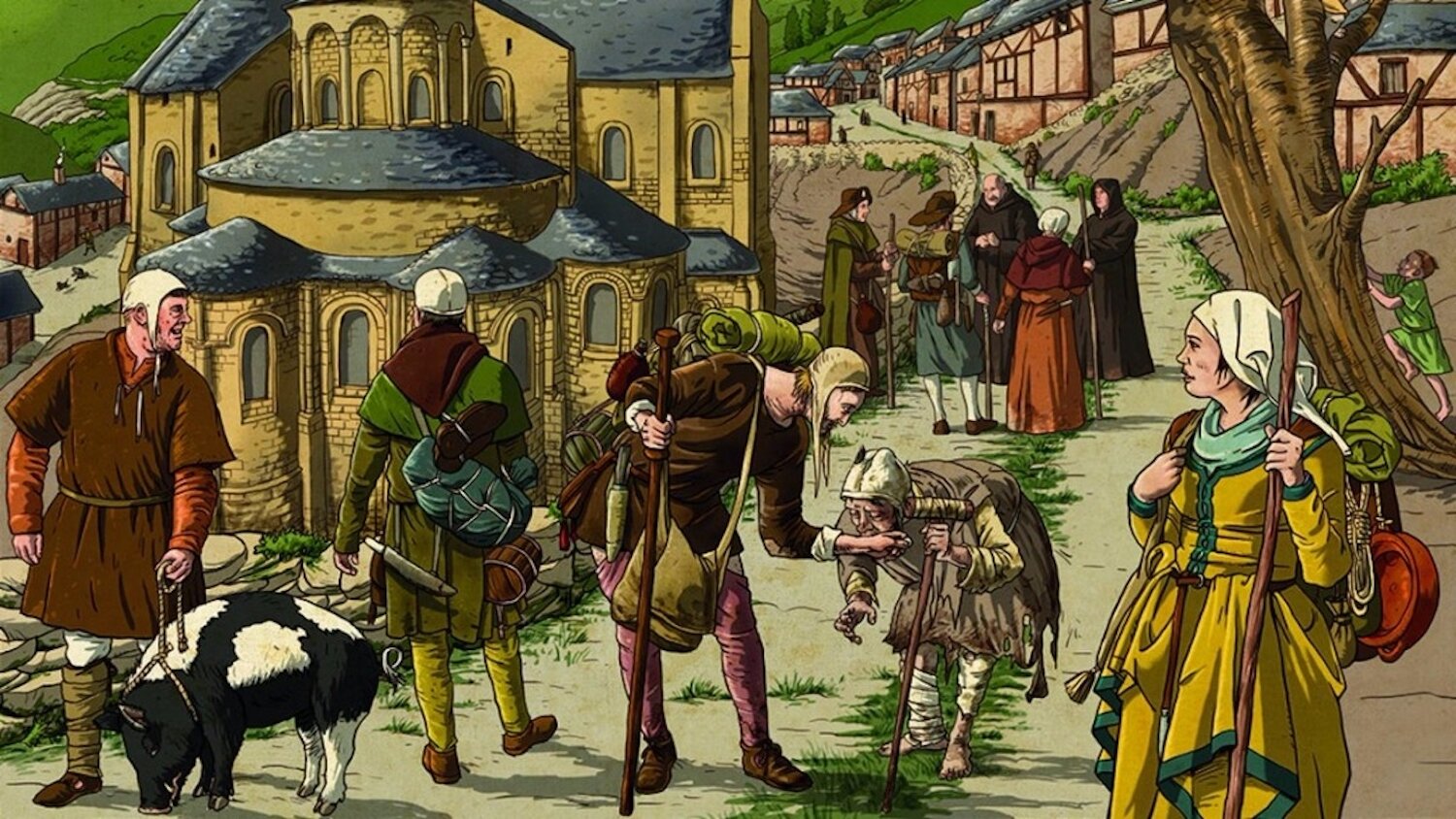
Illustration of the Camino de Santiago in the Middle Ages. Illustration by Chema Roman. Image from here (accessed 10/14/2021).
The Iconic Iron Pilgrims: Where the Path of the Wind Crosses the Stars
Finally, the ridge carries a masterpiece. The present-day occupants of the Alto del Perdón are made of iron—a parade of pilgrim silhouettes walking toward Santiago. Their rusty profiles troop beneath rods supporting stars, a nod to the piece’s title: Donde se cruza el camino del viento con el de las estrellas (“Where the path of the wind crosses that of the stars”).
Erected in 1996 by artist Vicente Galbete, it has become the quintessential image of the Camino. Galbete arranged the figures to track the history of the pilgrimage; the figures at the back of the line wear the backpacks and sunhats of the modern era. It is a timely reminder that our journey does not begin or end in isolation. We are part of a march connected to both the ancient past and the unknown future. We have the freedom to choose our steps, but our context is chosen for us.
Perdón, Señor. Forgive me when I forget those around me.

The parade of figures.
Bob and I took the obligatory photos, soaked in the panoramic view, and ate the snacks we’d carried up. Satisfied, we rejoined the trail and began our descent down the other side of the blue-green ridge.
¡Buen Camino!
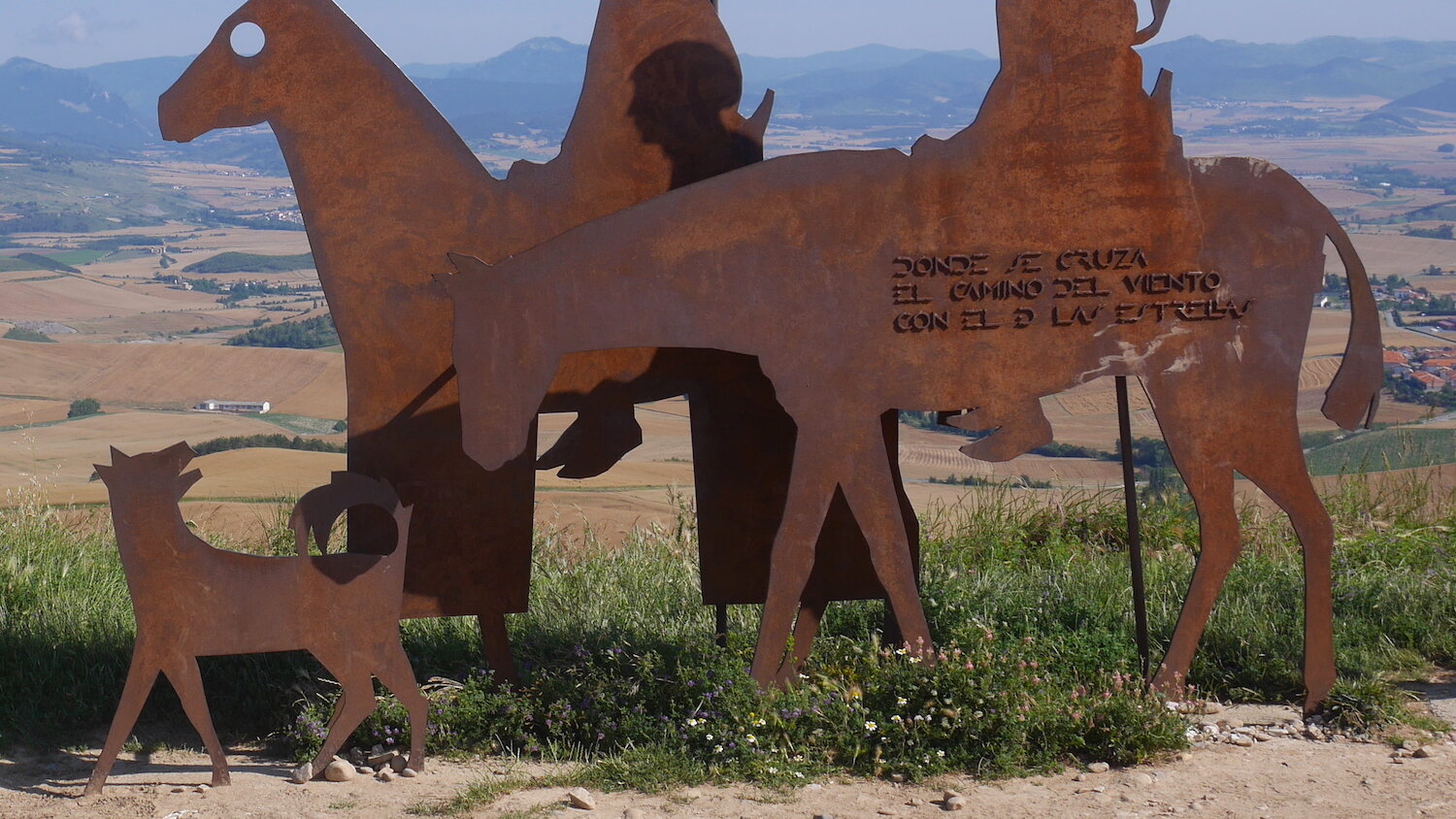
The title of the work appears on the side of one of the horses: “Where the path of the wind crosses with that of the stars.” I liked the dog.
*This statistic comes from the post here (accessed 10/14/2021). Other people walk the Camino for exercise, adventure, disconnection from everyday life, and for fun. My motivation would include all of the above, but would add the category of “historical exercise” to the list.

With travel restrictions easing, we have a full slate of trips to the Bible Lands ready to launch in 2022. One departs New York for Israel on March 12 and returns on March 25. This high-energy study tour will move light and fast, so pack your hiking shoes! Walt Harper, professor from Central Christian College of the Bible and Jeff Snell from Johnson University will assist with teaching duties on this one. For more information click here or contact me at markziese@gmail.com.