
French TGV (Train à Grande Vitesse) bullet trains typically operate at commercial speeds of 320 km/h (200 mph) on high-speed lines (LGV). They are among the fastest trains in Europe.
The bullet train glided to a stop. The sign for Gare de Bayonne drifted past our window.
Bob and I shouldered our packs and stepped onto the asphalt. We were too giddy to realize the gravity of the trade we’d just made: we had exchanged a futuristic marvel for the most primal transport of all—our own feet. Little did we know it would take a full month of time, and more physical and emotional energy than we could imagine, to cover the same distance our train had devoured in just three hours and 52 minutes. We had come from Paris to southwest France to slow down and walk the Camino de Santiago—the Way of St. James.
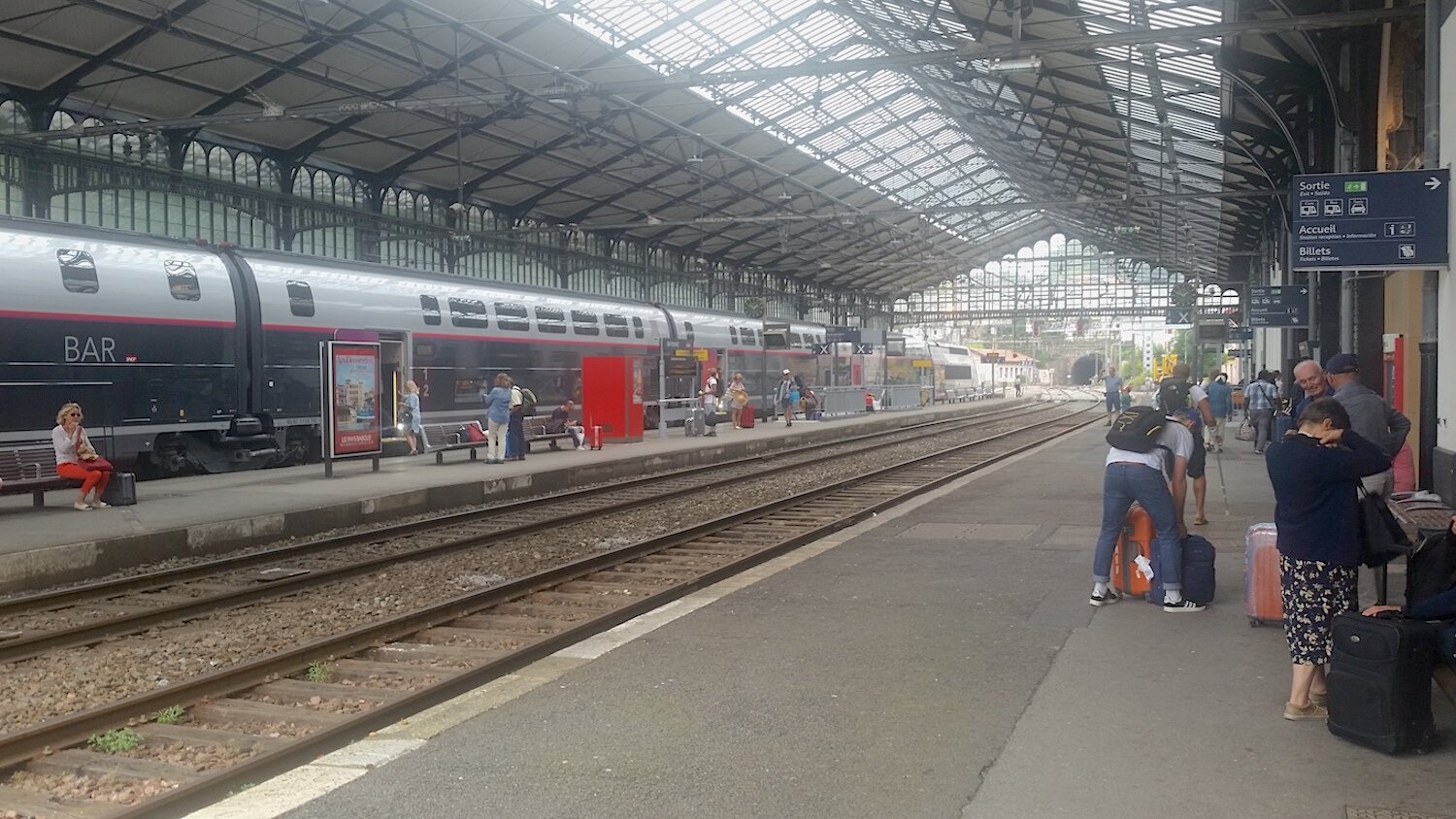
The Gare de Bayonne marked the transition between flight and feet.
Bayonne: Old-World Charm and the Birth of the Bayonet
Outside the station, we entered the beauty of Basque Country. Bayonne exudes old-world charm with its narrow streets, half-timbered houses, and colorful shutters. Along with its sister-city, Biarritz, it is an urban anomaly in this rustic corner of France.

The city of Bayonne is located at the confluence of the Nive and Adour Rivers. The Pyrénées mountain range, carrying the French-Spanish border, set the backdrop. The Bay of Biscay, a lobe of the Atlantic Ocean, fronts the scene. Our walk began in St-Jean-Pied-de-Port, France. Image modified from Google Earth.
Bayonne’s heritage is deep. The Roman army pushed through here in the decades before Christ, "romanizing" the salty tribes of the region (See De Bello Gallico 3.27.1). By the fourth century, this confluence of rivers was fortified as Lapurdum.* By the 10th century, it took the name Baiona—Basque for “good river.”** That one stuck. Interestingly, this name is likely already in your vocabulary: it was in this bucolic setting that soldiers first mounted stabbing knives to the muzzles of their firearms. The baïonnette—or bayonet—was born in Bayonne.
Our experience of the place was less violent, although when presented with the facture d'hôtel (“hotel bill”) at the desk, we did bleed a little.
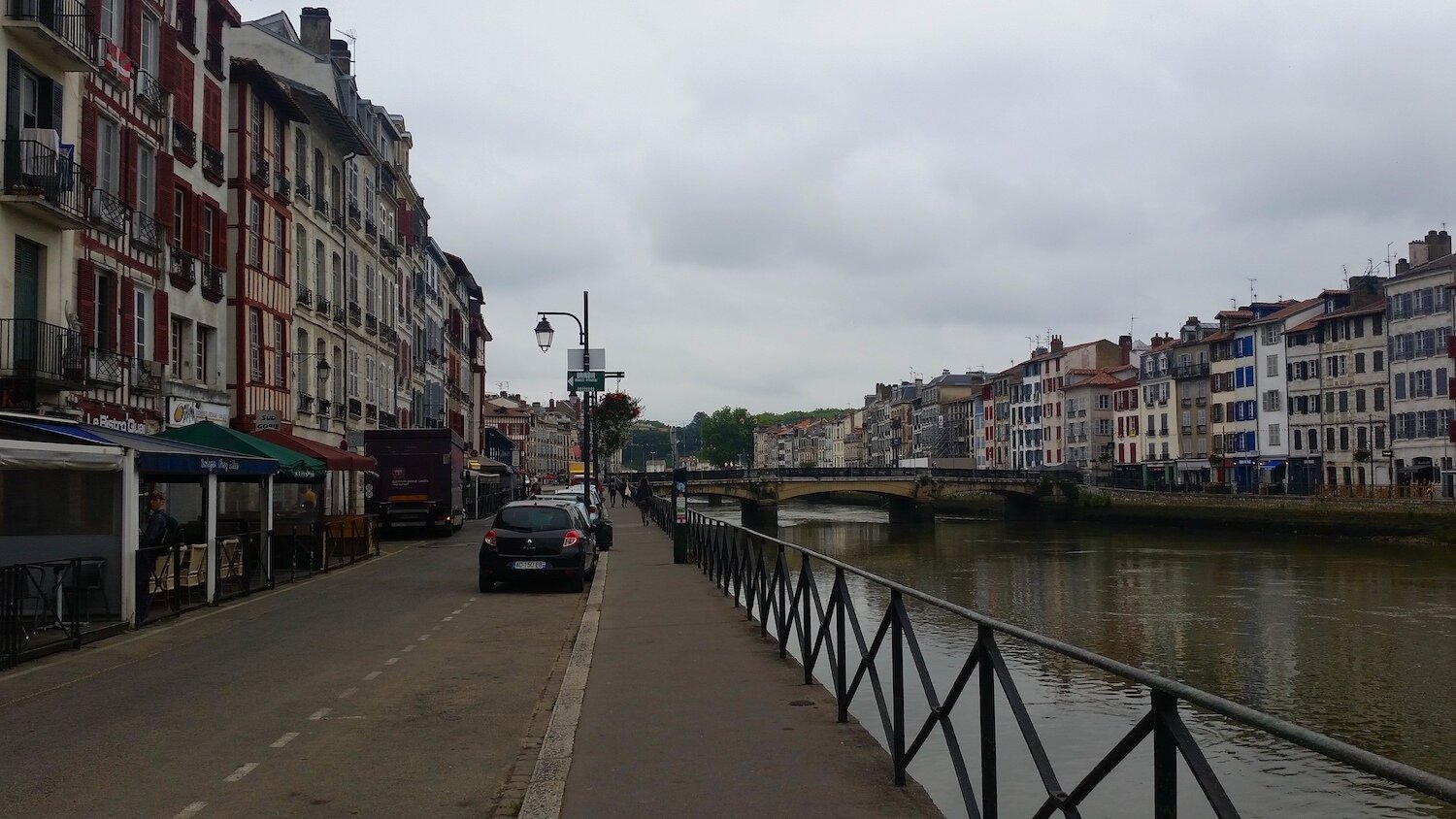
One is never far from a riverfront in Bayonne. All these waterways meet and flow into the nearby Bay of Biscay.
The Spire of the South: Cathédrale Sainte-Marie de Bayonne
Armed with a good night’s sleep, we set off to visit Bayonne’s primary landmark, the Cathédrale Sainte-Marie de Bayonne. With spires reaching more than 85 meters into the sky, it was easy enough to find in the historic district.

The spires of the Cathédrale Sainte-Marie de Bayonne rise above the river and the surrounding buildings.
The Gothic structure we see today is merely the latest embodiment of the site. Started in the 13th century, it replaced an earlier Romanesque church that was—fittingly for this dramatic landscape—destroyed by lightning. Construction was slow, moving stone by stone for centuries. The main structure was finished by the 17th century, but those towering steeples weren't added until the 19th.
Standing in their shadow calls for the eloquence of Victor Hugo who visited in 1843.
"The cathedral of Bayonne is a fine church... mushroom-colored and gnawed all over by the sea wind. Nowhere have I seen richer and more capricious fenestration... the strength of the fourteenth century mingled with all the fantasy of the fifteenth."***

The cloister (or enclosed church yard) is one of the largest in all of France. Lingering below are the relics of Saint Leo, a 9th century bishop and missionary to the Basque peoples.
Inside, our faces turned instinctively upward. A cascade of light tumbled from narrow stained glass, spilling into the darkened corners below. It was spatial artistry of a wondrous order. Squinting, we made out saints and sinners, leopards and birds dancing overhead. The Red Sea is crossed; the Christ is raised. Our memories were teased as the Divine presence was invoked: “May your eyes be open day and night on this house.”
The Cathédrale Sainte-Marie de Bayonnean is a transitional experience and primer to the mysterious world of medieval architecture. Bob and I had much to learn.
¡Buen Camino!

View to the choir.

Plan of the cathedral. This drawing, dated 1898, may be found in the Archives rationales France. See here (accessed 8/2/2021).
*Lapurdum is noted at the beginning of the 5th century AD in the Notita Dignitatum (occ. 42.18f). See the description of the site in Perseus here (accessed 8/1/2021).
**Read more about “The History of Bayonne” here (accessed 8/1/2021).
***I draw these words from Hugo’s Alpes et Pyrénées as translated into English by John Mason (1898:127). A digital version of the work may be found here (accessed 8/2/2021).


Join Mark and Vicki for a Mediterranean experience May 25-June 5, 2022. We'll be cruising aboard the luxurious Celebrity Infinity. See the link here for details. Onboard lectures will provide focus for the group as we visit the ports of Olympia, Santorini, Ephesus, and Athens among others. Optional add-on visits to Venice or Rome are possible on either end of the trip. Contact me at markziese@gmail.com.