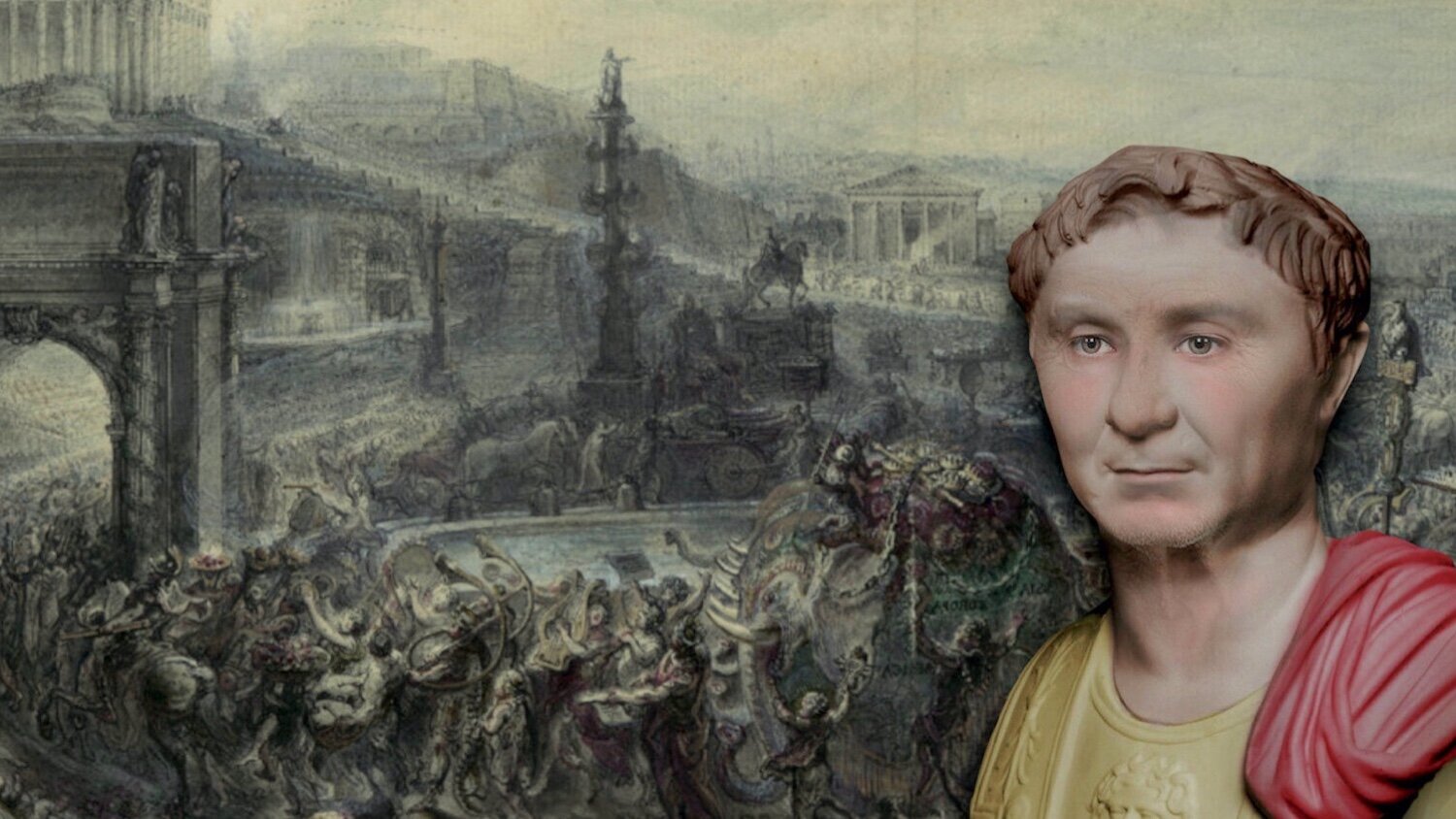
Reconstruction of Pompey’s face based upon his bust found in the Licinian Tomb. Image from here.
Long before the hobnailed boots of Pompey the Great scraped the pavers of the Jerusalem Temple,* the Roman commander was making his mark in the West. On the Iberian Peninsula, Pompey pursued a grueling campaign against the guerrillas of Quintus Sertorius. This pursuit kept him occupied for five years, from 76 to 71 BC—a half-decade where Pompey sharpened his military chops, earned a reputation for brutality, and secured a Roman triumph. The experience would serve him well.
The Sertorian War and the Birth of Pompelo
Details of the Sertorian War are scattered but telling. One thing is certain: Pompey’s forces struggled with severe supply shortages, especially during the harsh winter months. His men established military camps, pleaded with Rome for reinforcements, and foraged among local tribes. Ancient sources highlight two specific groups in this context: the Vaccaei and the Vascones.**
The geographer Strabo connects these dots with a specific claim, noting that the tribe of the Vasconians lived in the north, “where there is a city Pompelo or, as one might say, Pompeiopolis.”***

Pompeiopolis is located in the area of the Vascones. Image adapted from here (accessed 9/21/2021). During the Sertorian War, the peninsula was a patchwork of people-groups. Their independent character and shifting alliances was a challenge to anyone who wished to control them.
From Bengoda to Pamplona: Roman Origins
This northern stronghold was a chief site for the Vascon people.**** Under Pompey’s influence, it became a hub of Romanization when he established his headquarters there. In the process, the city’s ancient name—Bengoda, known today only from weathered coins—was exchanged for Pompey-polis, the "City of Pompey."

Obverse and reverse of an hispanic denarius. On left is a bearded head with the name Benkoda in Iberian signs. On the right is a sword-wielding warrior on horseback with the name Barskunes (akin to Basque) beneath. 2nd or 1st century BC. Image from here (accessed 9/22/2021).
Today, only vestiges of this Roman settlement remain. Archaeologists have uncovered elements of an ancient artisan neighborhood, only for them to slip away again beneath the modern, living city. Roman remains are often found overbuilt—tucked under a parking lot here or beside an access ramp there.

We followed fencerows into the Arga River basin.
Beyond Hemingway: The Deep History of Pamplona
As Bob and I navigated the river-washed foothills of the Pyrénées, we talked of things past and things to come. Long before this was Hemingway-country, it was Pompey-country. While the robust figure of the American author is a celebrated feature of northeast Spain, the memory of the Roman general is deeper and more visceral. Before the Spanish bullring, there was a Roman bath. After all, this is Pamplona—the City of Pompey.
Two Final Tidbits for the Curious Pilgrim
Pompeii vs. Pompey: Don't be fooled by the names; the Italian city of Pompeii was not named after the general. The resemblance is purely accidental. Pompeii was founded in the 8th century BC, hundreds of years before Pompey the Great was born.
The Other Pompeiopolises: Pompey covered a lot of ground. Another city bearing his name sits in ancient Paphlagonia (modern-day Turkey). One might call it Pompeiopolis of Paphlagonia . Hopefully, its mascot wasn't the hippopotamus—the "Pompeiopolis Hippopotamuses of Paphlagonia" is far too plosive (and pompous). I don’t think it would firt on a T-shirt either.
¡Buen Camino!

We arrived in Pamplona, Spain.
*Stories of Pompey’s siege of Jerusalem are recorded by the Jewish historian, Josephus. See his War 1.123-54 and his Antiquities 13.398-14.97.
**See Plutarch, Life of Sertorius, 21 (English translation here) or Sallustius, Histories 2.75-76 (English translation here). For a modern assessment, see Philip Matyszak’s Sertorius and the Struggle for Spain (Pen & Sword, 2013).
***Strabo, Geography 3.4.10. Find the English translation here.
****The Vascones inhabited the area between the upper course of the Ebro river system and the Pyrenees Mountains. They are believed to be the ancestors of the Basque peoples.


We have a full slate of trips to the Bible Lands ready to launch in 2022. One departs New York for Israel on March 12 and returns on March 25. This high-energy study tour will move light and fast, so pack your hiking shoes! Walt Harper, professor from Central Christian College of the Bible and Jeff Snell from Johnson University will assist with teaching duties on this one. For more information click here or contact me at markziese@gmail.com.