This post continues the narrative of our recent safari experience in Africa. But it also serves as the first of a series. “And there I was when I woke up” will relate some memorable overnights in places around the world. Watch for pieces down the road.
Understanding the Maasai Enkaji: Architecture of the Savannah
It was a world away from a Maasai enkaji, yet it carried the vibe.
A traditional Maasai home is a low-slung structure of wattle and daub—a skeleton of branches and twigs suspended from support poles, capped with layered grass like a coolie hat to deflect the sun and rain. Its earthen floor is stamped firm by the soft pads of bare feet. In local tradition, building these homes—the ultimate in "eco-green," though no one there would use the term—is the work of women.
The hut is a literal reflection of tribal life: a single space where a family sleeps, eats, and socializes, with only a lone door and a tiny window opening to the world. That world is the kraal (an Afrikaans term that wound through Spanish into English as "corral"), an enclosure of thorny branches designed to protect the herds at night. For the Maasai, life revolves around cattle. As the song goes after a day of grazing: “You are making me drunk by your many colours, you, my fine heifer! I will sing a song as I pass with you through the gate.”*

This group of huts in Tanzania is typical of a tribal settlement. I found it here (accessed 10/17/2019).
Staying at Ilburu Safari Lodge: Our Gateway to Tanzania
Our “hut” at Ilburu Safari Lodge was nothing like that. We had brick walls, concrete floors, glass windows, and a bathroom with porcelain fixtures. It was anything but eco-green. After our weary arrival in Tanzania, Vicki took it all in with delight, watching as a porter settled us into our room near the back fence of the five-acre property.
Beyond that fence lay the soundtrack of an Arusha morning: the chirping of birds, the cry of babies, the drone of motorcycles, and the rhythmic chatter of human life. It was the music of Africa, and Vicki, wide-eyed, was hearing it for the first time. This would be our sanctuary—a place to revive and adjust to new rhythms after months of back-to-back teaching in Israel. It also gave Turkish Air a narrow window to find Vicki’s lost suitcase in Chicago and rush it to Arusha. I squeezed her hand, we dropped our meager gear, and followed the scent of the kitchen to the main lodge.
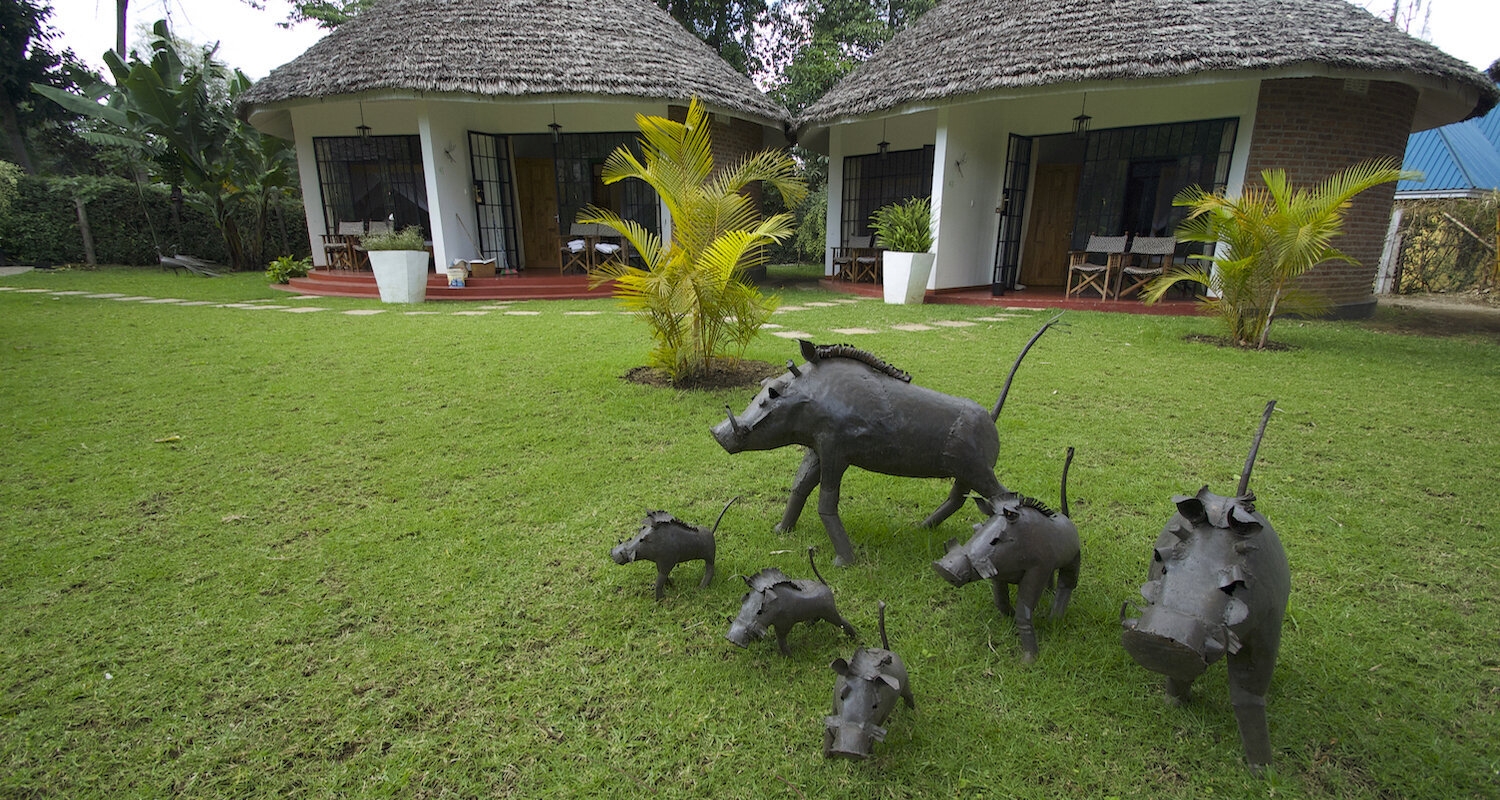
The huts in the Ilboru Lodge are immaculate. Warthog art in our kraal added a wild touch.
The Sounds and Colors of an Arusha Morning
The aroma tugged at my memory: when was the last time I’d eaten a real meal? Istanbul? Tel Aviv? The upstairs dining area was a mosaic of internationals, either bracing for or returning from safari. Everyone, it seemed, shared two things: a cup of coffee and a wardrobe of khaki.

The main building of the Ilburu Safai Lodge housed the reception area, a small store, offices, and the kitchen and dining room. Image found here (accessed 10/19/2019).
We spent the day in the shade of our porch, watching the garden come alive. The Superb Starlings lived up to their name, their feathers shimmering like metallic silk in hues of orange and iridescent blue. Canaries dived into flowers just inches from us, while Weavers fussed and chattered—Skwieeer, kiiyerr, tew, tew, tew. A pair of speckled mousebirds, drab but dignified with their tall crests and flowing tails, tended a nest in the fence.
I retrieved my camera and the massive zoom lens I’d borrowed for the trip. I had lugged that heavy glass from the States to Israel to Turkey and finally to East Africa, only to discover weeks prior that it wouldn't sync with my Nikon’s settings. For the next three weeks, I would be guessing at apertures and shutter speeds, operating on pure intuition.

A speckled mousebird (Colius striatus) is a resident of urban areas in Tanzania. This was one of a pair that set up shop in the vegetation of the kraal fence.
The Call of Africa: Preparing for Our Safari Adventure
We leaned into the stillness—the napping, the birdwatching, the simple joy of being back together. It brought to mind the lines of C. Emily-Dibb’s “The Call of Africa”**:
When you've acquired a taste for dust,
the scent of our first rain,
You're hooked for life on Africa
and you'll not be right again.
When you long to see the elephants,
Or to hear the coucal’s song,
When the moonrise sets your blood on fire,
You’ve been away too long.
It’s time to cut the traces loose
And let your heart go free
Beyond that far horizon,
Where your spirit yearns to be.
Africa is waiting… come!
Since you’ve touched the open sky
And learned to love the rustling grass,
The wild fish eagle’s cry,
You’ll always hunger for the bush,
For the lion’s rasping roar,
To camp at last beneath the stars
And to be at peace once more.
And there I was when I woke up, ready to go on safari.

If you are a traveler, church leader, or educator who is interested in visiting Israel-Palestine (or Tanzania!), let me hear from you. I partner with faith-based groups to deliver outdoor academic experiences. Leaders receive the same perks that other agencies offer, at competitive prices and without the self-serving interests.
Right now we are building the passenger roster for an Israel excursion scheduled for March 17-28, 2020. Seats will be open until Thanksgiving. For a list of trips go to the link here or contact me at markziese@gmail.com.