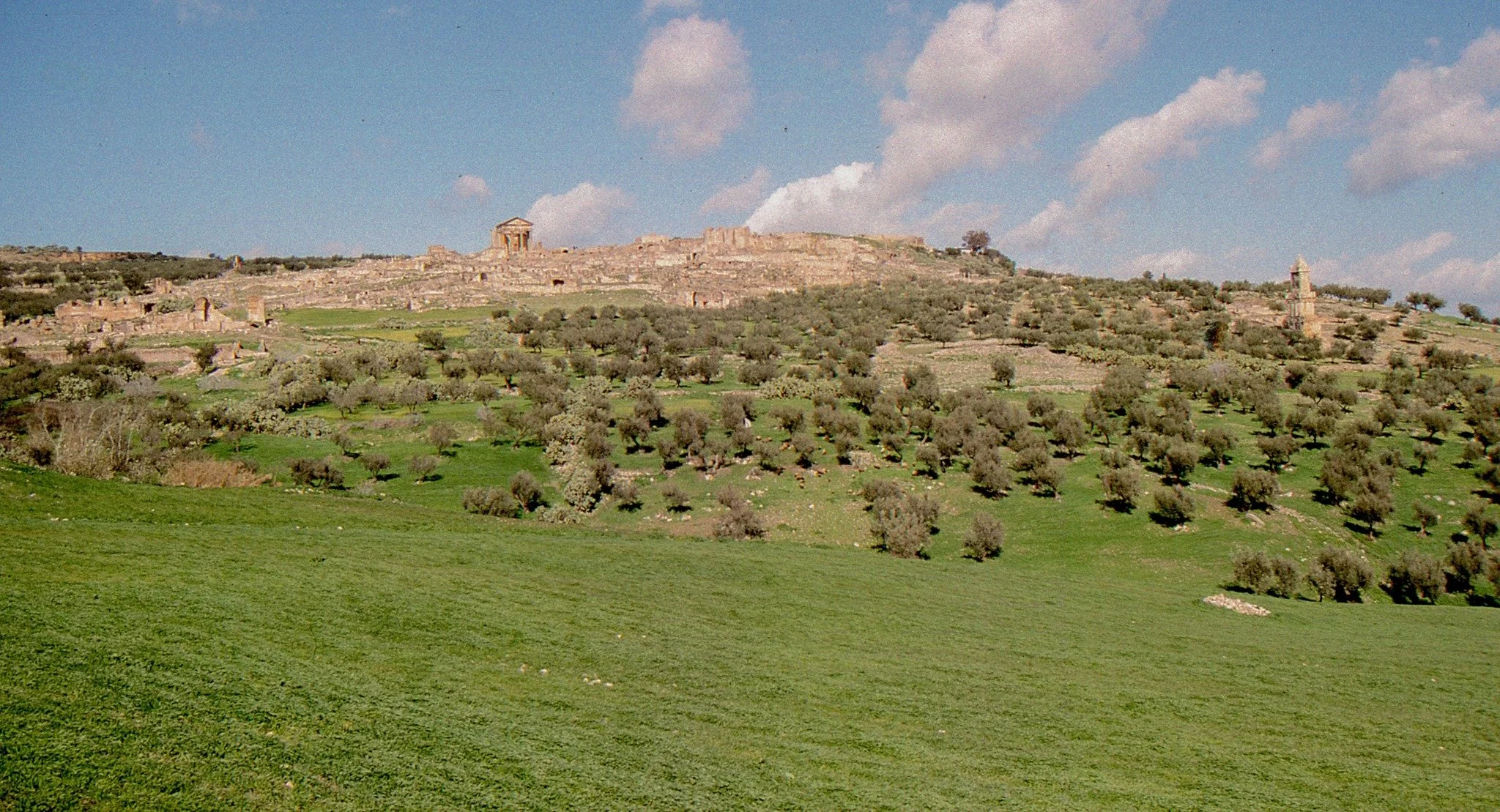
View to the skyline of ancient Dougga in Tunisia.
Yesterday I posted an old slide of the Mausoleum of Ateban, a second century BC tomb marker at the site of Dougga (ancient Thugga) in northern Tunisia. Here's a shot to the larger context. You can see the mausoleum rising on the right hand site of the ruins. Visible at the top of the hill is the Capitolium, a temple dedicated to Jupiter, Juno and Minerva.
A UNESCO World Heritage Treasure
Because of its impressive size, exceptional preservation, and stunning landscape, Dougga (ancient Thugga) was declared a UNESCO World Heritage site in 1997. Unlike many other Roman sites that were built on flat ground, Dougga is built on a steep slope, maintaining the organic layout of an indigenous Numidian community that was later Romanized.
It has frequently been dubbed “the best-preserved Roman small town in North Africa.” It possesses all the essential components of a Roman urban center:
The Theatre: One of the most beautiful in the Roman world.
The Capitolium: A towering example of second-century architecture.
The Mausoleum of Ateban: A rare example of pre-Roman Numidian architecture.
A Moment in Time
I took this shot of the Dougga skyline in the winter of 2001, just a few years after the site received its UNESCO designation. The winter light in northern Tunisia highlights the golden limestone of the ruins against the green valley below—a view that hasn't changed much in two millennia.