We boarded the coach to carry us from Bad Kohlgrub to the Danube.
Vicki and I found two seats among the group. It was a warm crowd, members of a Methodist congregation from somewhere in the deep South, just a peach short of the Georgia line. They were all aglow from their Oberammergau experience of the night before. We listened to conversations about the music, the acting, and the pageantry of this world-famous passion play. The buzz made me feel sorry that I had missed it.

This pilgrimage church near Schwangau, Bavaria, was built to honor the memory of an Irishman by the name of Koloman. His story doesn’t end well. Koloman rested on this spot on the way to the Holy Land in the year 1012. He didn’t reach his destination. He was mistaken for a spy and because he couldn’t speak German, he was unable to defend himself. He was hanged by the neck.
The contrast between their Carolina drawl and the bark of our German guide was lurching.
“Good morning!” she chirped into the microphone.
It was a sonniger Morgen indeed. The sunshine was breaking through the clouds. The air was crisp and cool.

View to Schloss Neuschwanstein from the tourist strip.
She laid out the plan: our destination was a castle on the German-Austrian border. While the name Schloss Neuschwanstein might not be a household phrase, its silhouette is unmistakable. It famously inspired the castle in Chitty Chitty Bang Bang and stands as the iconic symbol of Walt Disney Pictures. Hollywood has been sprinkling pixie dust over these spires for decades.

More dog than bun is a good problem to have. Sausage is everywhere around here.

Loaded on the carriage and ready to roll. Our Viennese guide commented on this driver’s dialect: “Now he’s real Bavarian.” I’m not sure it was a compliment.
The Original Imagineer
After a horse-drawn carriage ride up the mountain, we queued in the courtyard. "No backpacks. No photos," we were told. As we walked through the finished halls, the incredible—and odd—story of the castle unfolded.

The cylindrical towers stretched high above our heads. The structure was made of brick, marble, and white limestone.
Conceived in 1868, Neuschwanstein was built in the likeness of a medieval fortress at a time when such defensive positions were already obsolete. To make way for this fantasy, King Ludwig II of Bavaria flattened the ruins of two actual medieval castles. “Mad Ludwig” was a reclusive monarch and the original Imagineer, preferring a make-believe world of opera and myth to the shifting politics of the real one.*
Ludwig was the ultimate fan-boy of composer Richard Wagner. He identified with Lohengrin,** a Knight of the Holy Grail who traveled in a boat pulled by swans. This motif defined the palace; even the name Neuschwanstein (pronounced: Noish-VAN-Stine) translates to “New Swan Stone.”

The courtyard of Schloss Neuschwanstein.
Ludwig was intimately involved in the design and decor of the castle, drawing upon traditional aspects of medieval structures, yet upgrading these with modern technological advances. As an example, iron columns, beams, and brackets were used for critical supports in places where conventional stonework was impossible. The king’s regular interventions and demands for alterations meant that the castle would never be finished. Only 15 of the planned 200 rooms or halls were completed.
Unlike its medieval predecessors, Ludwig’s Tomorrowland had all of the luxuries of the 19th century, including a heating system, flushing toilets, a push-button communication system, and a telephone (even if it only communicated with the structures in the valley below).

Wikipedia offers this view to Ludwig’s throne room. It is clearly Byzantine and Romanesque. You can find the image here: https://upload.wikimedia.org/wikipedia/commons/8/84/Throne_room%2C_Neuschwanstein_Castle%2C_Upper_Bavaria%2C_Germany-LCCN2002696256.jpg (accessed 6/25/2022).
A Throne Between Heaven and Earth
My own interest in the architecture of the Bible Lands drew me to the Throne Room. Built in a lavish Byzantine style, it featured a mosaic floor of plants and animals beneath a dome of sun and stars. Ludwig pictured himself suspended between heaven and earth—a “Holy Grail” figure overshadowed by a painting of Christ.
But Ludwig was a tormented soul. Struggling with his sexuality, his finances, and his grip on his kingdom, he was eventually deemed unfit to rule. Shortly after, his body—and that of his psychiatrist—was found floating in a nearby lake. A strong swimmer, his drowning remains a mystery to this day.
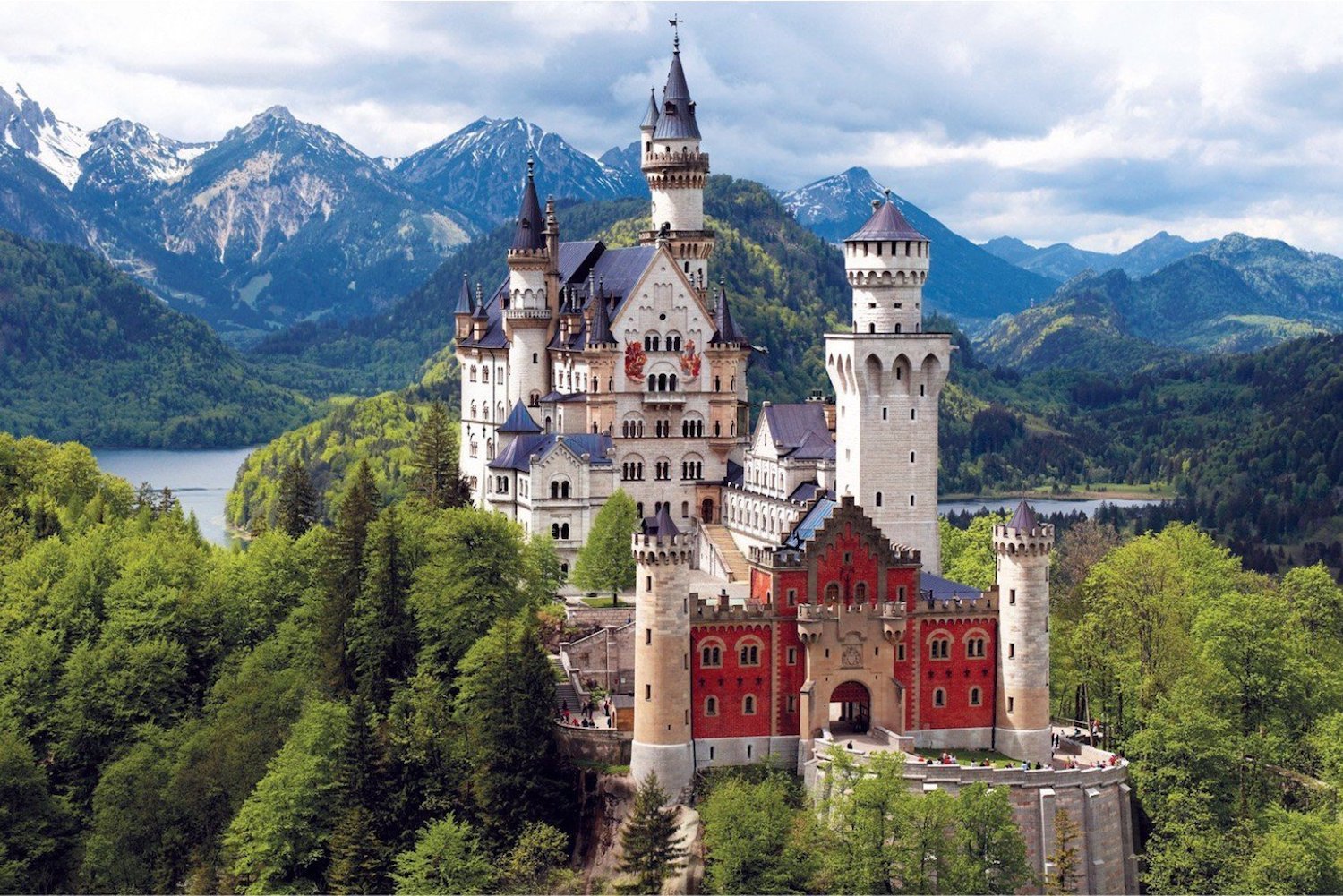
I found this amazing aerial view to Ludwig’s castle here: https://wantsee.world/neuschwanstein-castle-deu/ (accessed 6/24/2022).
From Fairy Tale to Führer
Upon his death, the private retreat became a public spectacle, now hosting 6,000 visitors a day. But the castle’s story has a darker epilogue.
In the 20th century, Adolf Hitler—another Wagner “fan-boy”—selected Neuschwanstein as the storage vault for his Führermuseum. He filled the castle with a priceless collection of looted artwork and artifacts. As WWII drew to a close, the SS planned to blow the castle up along with its treasures. Fortunately, the order was never executed.
When the Nazi loot was finally removed, it took 49 train cars to carry the collection away. Like Ludwig before him, Hitler’s attempt to reshape the world from the fabric of myth ended in ruin.

The forest below the castle. Ludwig wrote of the site “The location is one of the most beautiful to be found, holy and unapproachable” . . . “I am looking forward very much to living there.”*** Ludwig worked on the castle for 17 years but lived in it for only 172 days.
A Legacy of Myth
Vicki and I walked through the forest back down to the road, listening to the birdsong and the trickle of a mountain stream. It was hard to imagine sad endings in such a beautiful place. I wondered: Is it ironic—or perhaps redemptive—that Walt Disney chose this castle as his icon? He, too, was a mythmaker and an imagineer, though his stories focused on the hope of a happy ending.
Footnote for sermonizers: Some folks run on about the “power” of story. Story certainly has power, but it also has a very real ceiling. When we try to live entirely within the myth, the real world eventually comes knocking.

Walt Disney, Mickey Mouse, and the Snow White Castle at Disneyland, Anaheim, California. Image from https://www.encirclephotos.com/image/walt-disney-and-mickey-mouse-partners-statue-at-disneyland-in-anaheim-california/ (accessed 6/23/2022).
*I found this article helpful: “Schloss Neuschwanstein: A Romantic Interpretation of the Middle Ages” by Megan Knox. You can find it here: https://www.uwo.ca/visarts/research/2009-10/bat_2010/mk.html
**Lohengrin is a three-act opera written by Richard Wagner, first performed in 1850. The German composer was sponsored and idolized by Ludwig. If you’ve ever heard the “The Bridal Chorus” or the song,“Here Comes the Bride,” you’ve sampled a piece of this famous opera.

On the balcony of Schloss Neuschwanstein.
Bible Land Explorers will be returning to the Mediterranean in September of 2023. From the port of Athens, we depart for Ephesus and Patmos, then sail for the Holy Land. There, we disembark for day trips to Jerusalem and the Galilee. Following these experiences, we return to Greece, via ports in Cyprus—Limassol and Paphos—and the spectacular volcanic island of Santorini. Onboard lectures give focus to life in the biblical world. English-speaking guides will meet us at each port. We partner with Norwegian Cruise Line for a “mid-sized ship” with a “bigger experience.” For more details click the link here.