On my last visit to Salzburg, over 20 years ago, the streets were alive with busloads of tourists yodeling and singing alle zusammen. Surrounded by the peaks and babbling brooks of Austria, it was easy to fall into a von Trapp groove. This time, it was different.

The von Trapp family in The Sound of Music. 20th Century Fox (1965).
The landscape remained, of course. Nonnberg Abbey still stood where the sisters once fretted over Maria, and the Horse Fountain still snorted nearby. But between the lingering quiet of the Covid-19 pandemic and the decades passing since the film’s 1965 release, the vibe was less "Climb Ev’ry Mountain" and more "Lonely Goatherd." I didn't hear my favorite things even once.
It was a bit of a letdown for a musical theater sucker like me—especially the ones involving Nazis or cowboys. Vicki, a devotee of true crime, remained characteristically unmoved.
“Groups of people don’t just break into song and dance in real life,” she insisted.
“That’s exactly why musicals are so great,” I countered. “They’re something good.”
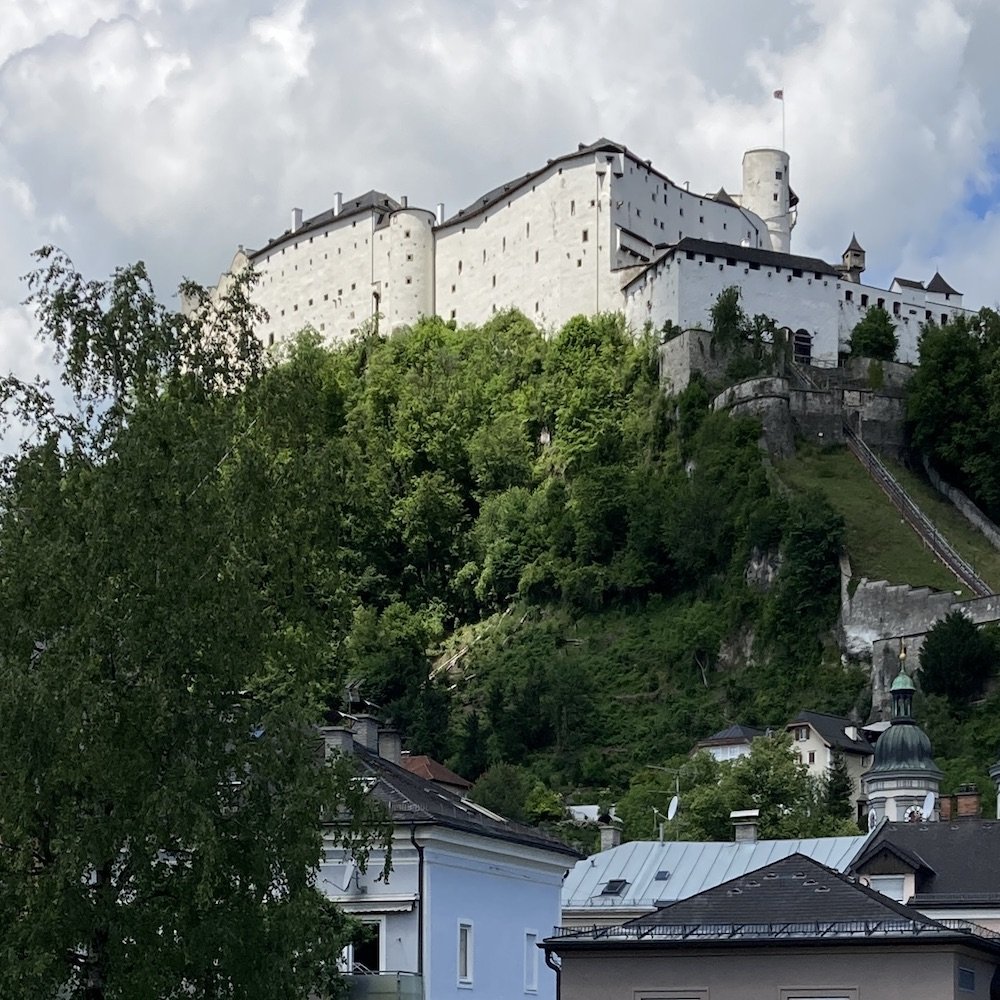

It was good that we had another agenda: we were hunting Romans.
Our quest had taken us south from the Danube and the city of Linz. We were now roughly sixteen going on seventeen miles behind the old Roman limes (frontier line). This geography is laid out clearly in the Tabula Peutingeriana, an ancient map of the Roman road network. There, modern Salzburg appears as Iuvavum—or more formally, Municipium Claudium Iuvavum, named for the Emperor Claudius (mentioned in Acts 11:28). Iuvavum straddles the road running between Alps and the Danube.*

I circled the location of Iuvavum as it appear on Section 3 of the Tabula Peutingeriana. The river colored blue at the top of the image is the Danube. The river at the bottom (also blue) is the Po. The mountains in the middle, colored green, are the Alps. Image from here: https://www.euratlas.net/cartogra/peutinger/medium_zoom/original_map_10_1.html (accessed 7/8/2022).
The earliest remains of Iuvavum are piecemeal, as the city has been built and rebuilt many times. Some conclusions may be drawn, however.
Early settlers have been identified as Celts, the first to recognize the value of this location on the banks of the Salzach River. A fertile plain was backed by steep mountains, perfect for food and defense.**
The Romans followed. They built a prosperous community with a bridge, forum, temple, and triumphal arch. Consider this interpretive reconstruction of the city from the second century AD.
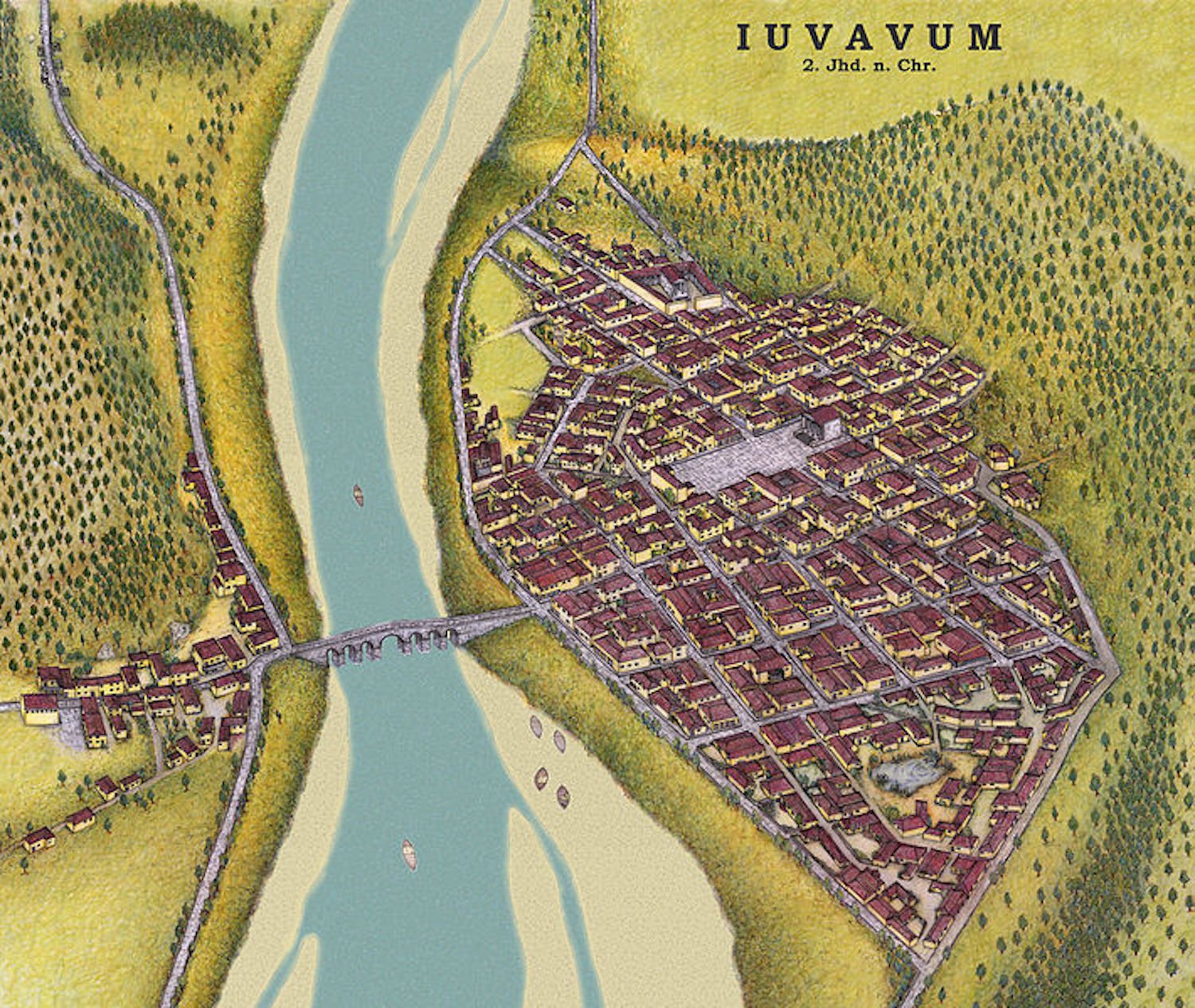
Roman Iuvavum. Image from here: https://commons.wikimedia.org/wiki/File:Reconstruction_Iuvavum.jpg (accessed 7/8/2022).
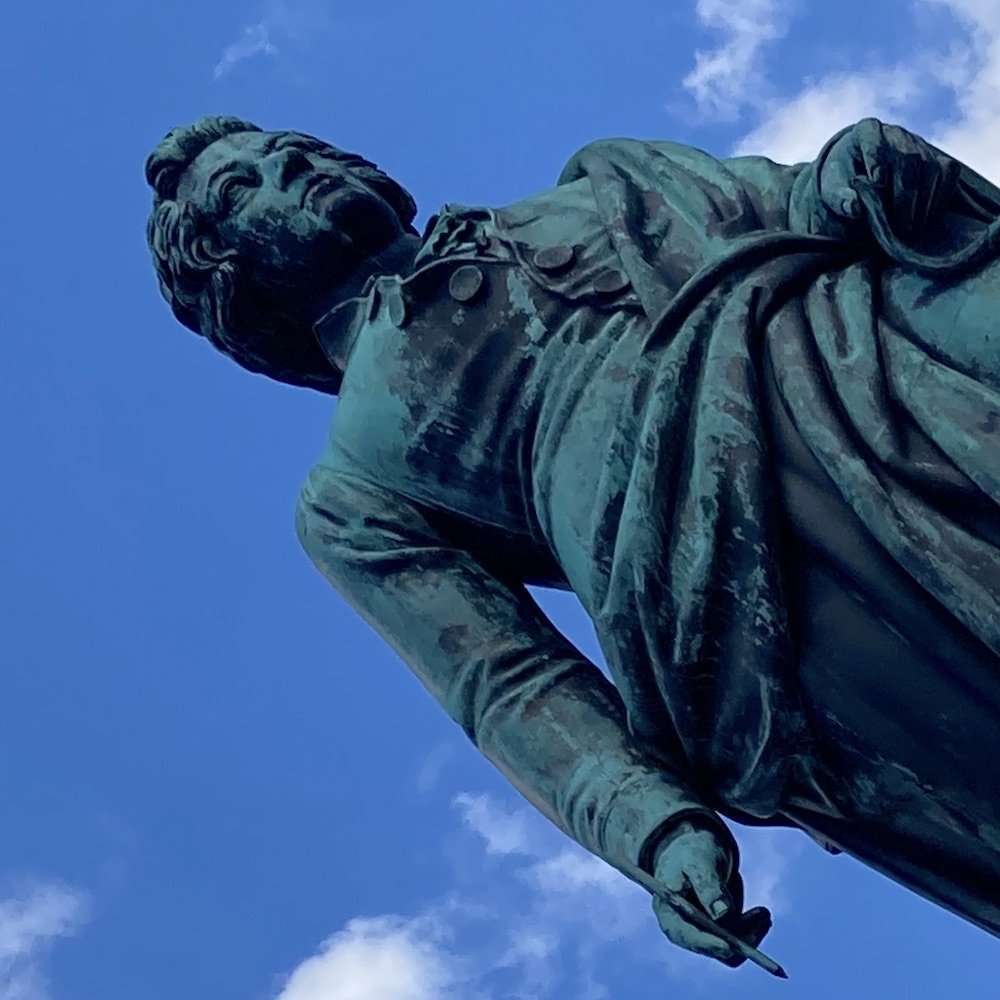
Vicki and I wandered the streets of the Altstadt (Old Town), nosing through bakeries and admiring the statue of Mozart—the actual sound of music. We sat on a bench, enjoyed a couple of döner kebabs, and successfully resisted the urge to buy lederhosen.
At the Residenzplatz, we found the magnificent Residenzbrunnen fountain. Excavations from the 1950s suggest a Roman triumphal arch once stood in this very yard, near an altar to Jupiter. Nearby, the swell of a violin drew us toward the Salzburg Cathedral. Large stones found beneath the cathedral’s 17th-century Baroque facade suggest this was once the heart of the Roman forum.

The 17th-century Baroque facade of the Salzburg Cathedral, built atop the site of the ancient Roman forum and earlier medieval churches. Mozart was baptized here.
We chose to linger outside, listening to the street performer in the afternoon sun rather than heading indoors. Our schedule required a return to Linz that evening, leaving bits of Roman mosaics and residential dwellings for a future trip. I’d love to return for the full "Historic Roman Salzburg Tour" (see here) or the Cathedral Excavations Museum (see here). Sigh.
As it was, we had to say so long, farewell. At least for now. I hummed as I boarded the bus and wondered if others would join me?
“Adieu, adieu, to yieu and yieu and yieu...”.”***
*The way to the east forks at Iuvavum with one branch running to Castra Regina (Regensburg) on the Danube where there was a large military base and the other branch running to Ovilava (Wels) near Linz.
**I found this article by Nick Richwagen on the earliest history of Salzburg to be fascinating. Read it here: https://seventhcoalition.org/2020/08/08/ancient-salzburg-prehistory-the-celts-and-the-kingdom-of-noricum/ (accessed 7/8/2022).
*** “So Long, Farewell” was another great Hammerstein and Rodgers tune from The Sound of Music (20th Century Fox, 1965). Check out the clip here if you’re feeling nostalgic: https://www.youtube.com/watch?v=Qy9_lfjQopU (accessed 7/8/2022).

Our journey on the Romantic Danube was made possible by Educational Opportunities (EO), the parent company of the Jerusalem Center for Biblical Studies (JCBS). Many of our Bible Land Explorer trips to the biblical Heartland are facilitated by JCBS. If you are interested in exploring the place where faith begins, check out our travel schedule here or email me at BibleLandExplorer@gmail.com.