Leaving the Ebro: Climbing the Montes de Oca

The Ebro Basin is Spain’s largest and longest river valley, measuring nearly 33,030 square miles in size. Geologists tell us that this valley was once submerged and that seawater flowed between the Atlantic Ocean (Bay of Biscay) and the Mediterranean Sea. Original image from here (accessed 12/28/2021).
Since clearing the Pyrénées, the Ebro River basin had defined our experience of Spain—but that was about to change.
From Logroño, we trekked toward the corner of the basin, climbed over the watershed of the Sistema Ibérico, and began our descent toward Burgos.
The Sistema Ibérico or “Iberian System,” is a sprawling mountain chain in central Spain. Geologically complex and defying easy categorization, its primary role for the pilgrim is a physical one: it acts as a massive wall isolating the Ebro Valley from the Meseta, Spain’s high central plateau.

One "finger" of this system reaches northwest. Named the Montes de Oca after the nearby Roman village of Auca, these “mountains” are less about jagged peaks and more about desolate, hilly scrubland. We crossed the watershed here.
By the time we hit the trail, the sauwetter (foul weather) of the previous day had blown over, leaving a slippery, muddy wake in its path. The climb out of Villafranca Montes de Oca was steep; it didn't help that I took a wrong turn early on (my bad, Bob!).
Eventually, we rejoined the path and found ourselves enveloped by forest.
Three modest ridges awaited, each slightly higher than the one before. None were over 4,000 feet.

Bob on the trail through the Montes de Oca, a finger of the Sistema Ibérico.
Eventually, we rejoined the path and found ourselves enveloped by dense forest.
Three modest ridges awaited us, each stepping slightly higher than the last, though none topped 4,000 feet. Had I consulted the guidebook more carefully, I would have known better than to hope for a mid-trail café. Instead, we were truly in the “thick(et)” of it: a ten-mile, coffee-less slog through oak, pine, mud, and flies. The pine pollen hammered Bob’s allergies, while my lack of caffeine hammered me with a mounting headache.
Of course, it could have been worse.
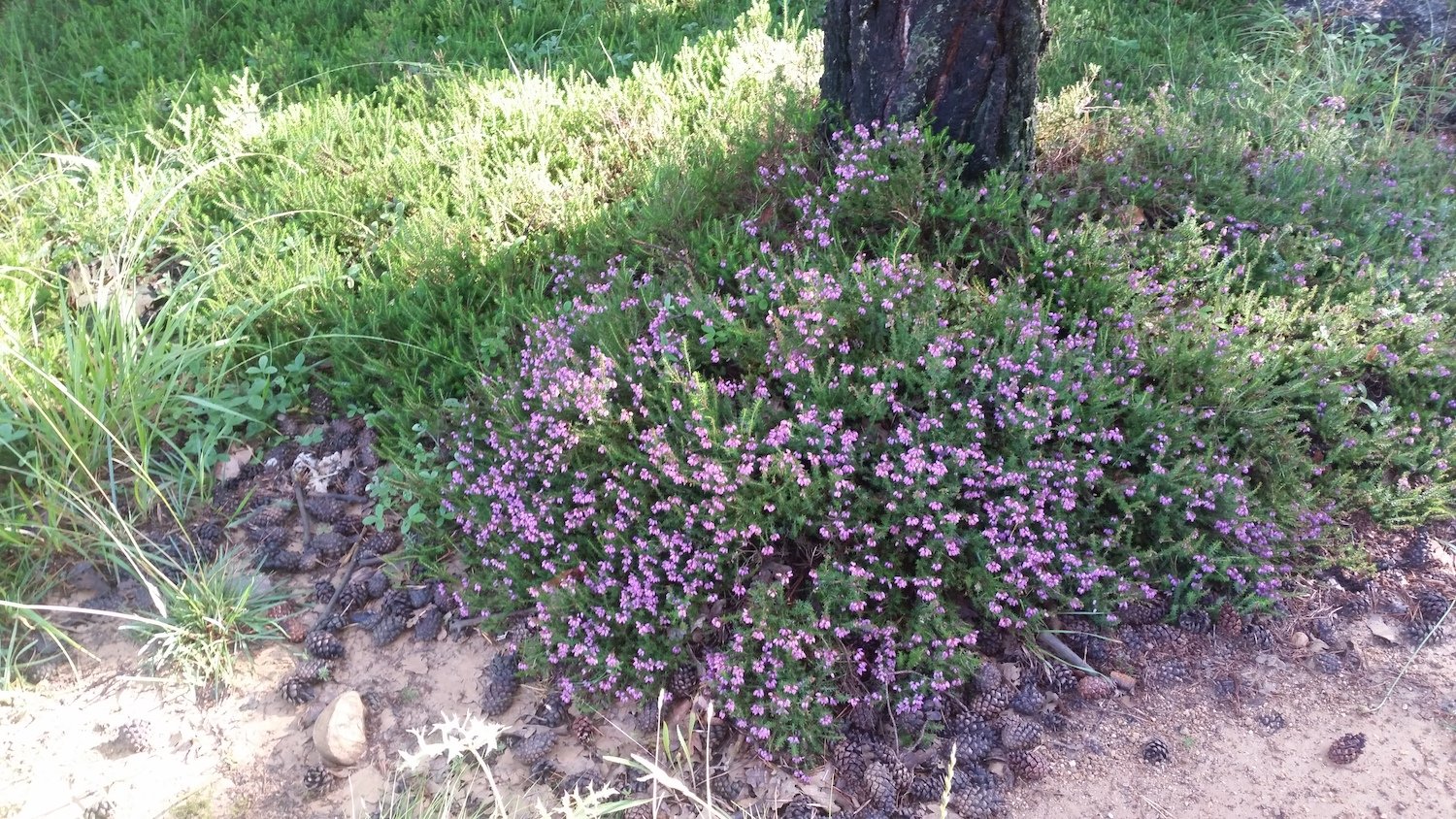
Small flowers at the base of a tree.
The Legend of the Bread Thief and the Drying Spring
Legend tells of a group of travelers who, like us, once overnighted in Villafranca Montes de Oca. They awoke to find a companion missing—along with their only bag of bread crusts. They tracked the thief into the woods and found him in a grim state: choking to death. He had tried to soften the stolen bread at a spring, but mid-act, the water suddenly stopped flowing. Without “spit to swallow,” he would have died with the crust in his craw if his friends hadn't shown mercy. Their choice to save rather than punish him sparked a miracle: the spring began to flow once more.**
Other stories of lost travelers, wild animals, and murderous gangs made our struggle with mud, pollen, and caffeine headaches seem rather petty.

The fountain called Mojapán was marked “no good for drinking.” Apparently, it’s been a site of choking for a long time. Image from here (accessed 12/29/2021).
Finding Sanctuary (and Caffeine) in San Juan de Ortega
We descended to the tiny hamlet of San Juan de Ortega. The guidebook described it as home to 18 residents. We were thrilled because one of them had opened a bar. Inside, we found fresh coffee and empanadas waiting.
With the mountains and wood behind us, a fresh phase in our journey was about to begin.
¡Buen Camino!

The forest was thick and unrelenting.
*See D. M. Gitlitz and L. K. Davidson, The Pilgrimage Road to Santiago (St Martin’s: 2000): 166.
**The legend of la Fuente Mojapán, as this story is known, is repeated in many places. One version, along with other miracle stories, is found here (accessed 12/28/2021).

A small oak rises rises in the Montes de Oca.
We have a full slate of Bible Land trips ready to launch in 2022. Check out a complete list by clicking here or peruse under the heading “Find your Trip.” For more information on how to join one of these trips or if you are interested in helping to craft a unique trip for your own group, church, or school, contact me at markziese@gmail.com.