Köln Arrival
A light rain was falling in Köln when we hopped off the train. I zipped my jacket as Moriah gave me final instructions; we were to meet at six for dinner.
“Do you have enough Euros for the bathroom?” she asked, looking out for me.
I jangled the coins in my pocket. “All good.”
Satisfied, she adjusted her pack and headed up the street. I watched her go, feeling a surge of pride. She was spending her afternoon organizing donations for Ukrainian refugees living in a temporary compound nearby. It struck me then that "structures of hope" come in many colors, sizes, and shapes—some are made of canvas and kindness, others of ancient stone.

A photo from the twitter site @OpBackPack4Kids. Operation BACKPACK4KIDS is a grassroots effort by pilots from FedEx and UPS dedicated to putting backpacks loaded with useful items in the hands of Ukranian refugees in Germany.
I turned my attention to the ever-present Dom.
The Hohe Domkirche Sankt Petrus is the iconic soul of Cologne. Its twin steeples are featured on everything from coins to pastries, drawing an average of 20,000 visitors a day. I was eager to spend my afternoon poking through its relics and braving the climb for the view.
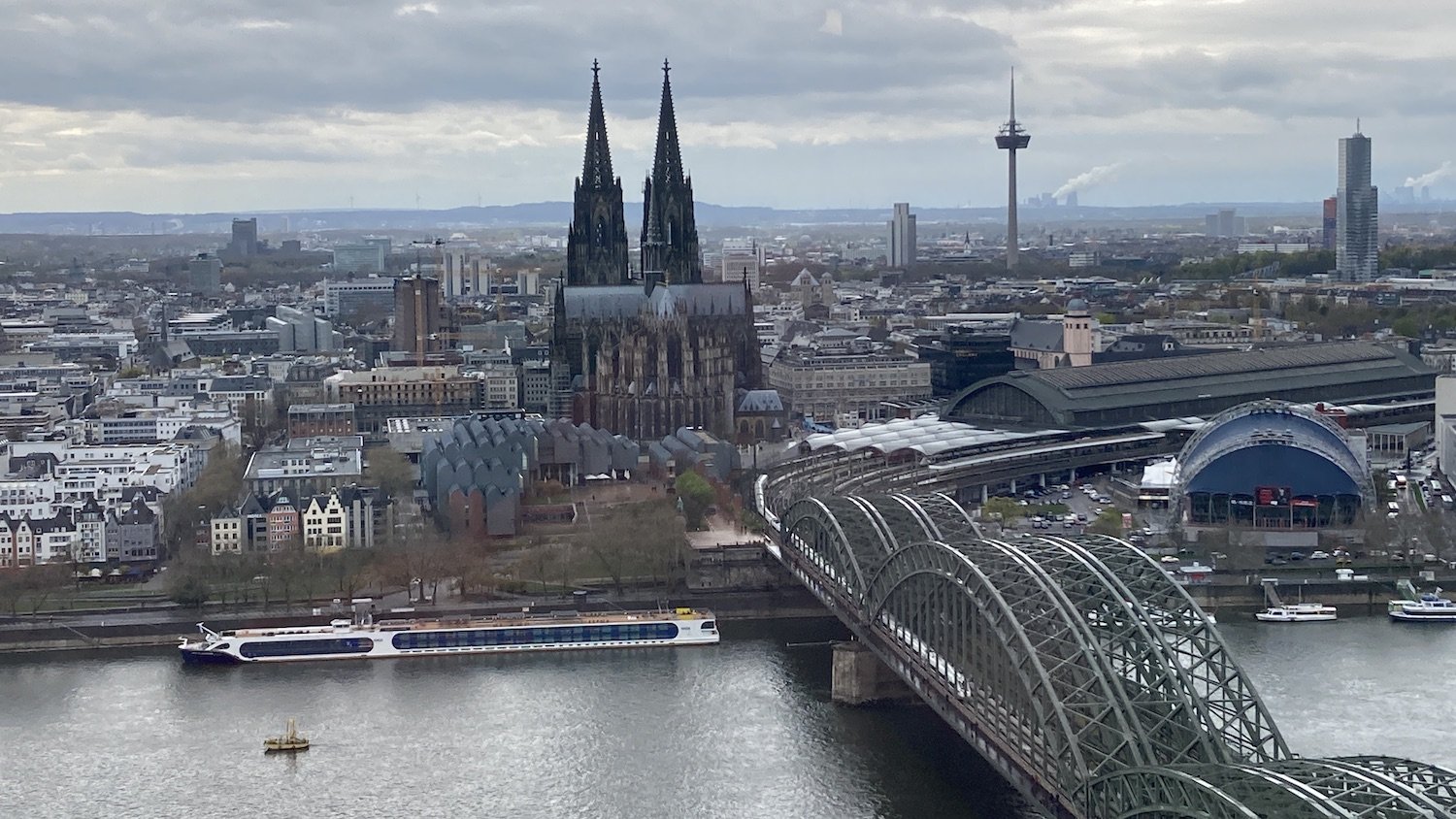
The twin towers of the Dom rise from the center of Köln (Cologne), Germany. The Rhine River flows in the foreground.
Poking around the structure
The Dom is a masterpiece of the “French style”—Opus Francigenum. Its neck-wrenching height and light-filled interior are hallmarks of High (or Rayonnant) Gothic (see our discussion of Gothic developments in the context of Spanish churches here.) architecture. Though construction began in 1248, in many ways, it continues to this day.*

The twin-steeple façade of the Dom is astounding. Decoration fills every fold, nook, and edge.
Standing in Cathedral Square, the west façade—the largest of any church in the world—hung over me like stone drapes. Extravagant decoration filled every fold and edge; statues were pressed into crannies, and gargoyles peered down from lofty perches. The rain gave these features a glossy sheen while carrying the atmospheric acids that stain the light sandstone a dark, brooding charcoal. It felt at once ancient, monstrous, and beautiful.
I recall hearing that this aesthetic is no accident. The outside of a cathedral faces a “fallen world.” Its exterior walls serve as the border between the profane and the sacred—a line demarcating a place of sanctuary.
From the square, it was difficult to appreciate the cross-shaped footprint. The nave (475 feet) ran away to the east and was crossed by a transept (282 feet). Aisles on either side of the nave covered even more air. The Dom can reportedly hold up to 20,000 individuals, making it the third-largest dedicated church-structure in the world. The catholic minds responsible for this design did not think small. They built for the glory of God himself.

Top plan of the Köln Cathedral. Image on left from https://germanculture.com.ua/wp-content/uploads/2018/05/cologne-cathedral2-918829_960_720.jpg (accessed 5/27/22) and image on right courtesy of Wikipedia, s.v. “Cologne Cathedral” (accessed 5/27/22).
No surprisingly “super-size-me attitude” goes vertical as well.
Other than the Lutheran church of Ulmer Münster, the steeples of the Köln Cathedral are the tallest in Europe. Rumor has it that Lutherans deliberately designed Ulmer Münster to top Köln by 14 feet! I guess Luther’s beef with Rome continues.

Dom shaped pastries. One sports the words, Frieden in Europa or “Peace in Europe,” a obvious reference to the war in Ukraine and another expression of hope.
Entry was free and the line was non-existent. An inspector in a scarlet robe waved me through after a quick glance at my camera and notebook. I stepped out of the rain and into the Hohe Domkirche Sankt Petrus, eager to see what 600 years of hope looked like from the inside.
*Rumor has it that when the cathedral of Köln is finished the world will end (Ahem. That’s a German joke.).
Reservations are now being received for our April 21-May 1, 2023 excursion to Greece. Bible Land Explorers will follow in Paul’s footsteps in the classical world, with stops at Thessaloniki, Amphipolis, Philippi, Neapoli (Kavala), Meteora, Delphi, Corinth, Mycenae, Epidaurus, and Sparta. Conclude this grand tour in Athens, the classical center of it all. Click here for the brochure. Early bird discounts apply. Direct all questions to BibleLandExplorer@gmail.com
