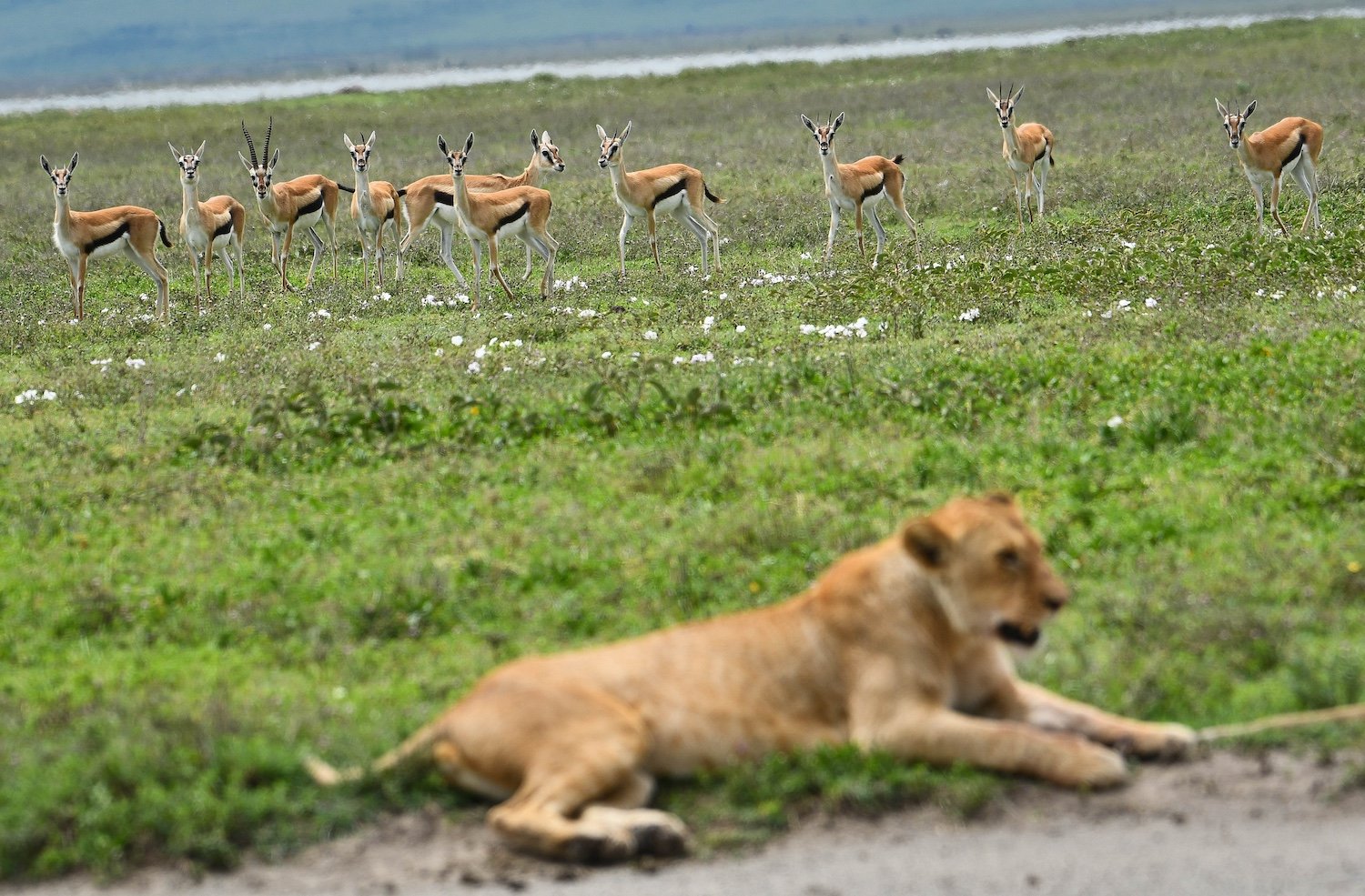
Thomson gazelles adopt a frozen alert stance at the sight of a lioness.
From the look of things, this herd of Thomson’s gazelles (Eudorcas thomsonii) has every reason to be nervous. On the flip side, the lioness couldn’t care less—for now.
Understanding the Frozen Alert Stance
This moment captures a anti-predatory tool known as the frozen alert stance. While not common to all species of gazelle, “the stance” is a trademark pose for Tommies. When one of these savanna speedsters spots danger, his body locks into place. He lifts his head high and fixes his eyes on the threat.
Physiological Shifts: Adrenaline on the savanna
Internally, the gazelle's body prepares for the contest. The heart quickens and breathing becomes shallow and rapid to deliver more oxygen to the muscles. Adrenaline surges into the bloodstream; the liver releases glucose for an energy boost. At the same time, blood vessels in non-essential areas (like skin and stomach) constrict to prioritize flow to the limbs.
Externally, every sensory organ is brought online. Ears stand erect. Pupils dilate. The tail flicks vigorously, flashing a rhythmic warning of white and brown. The threat is assessed.
Communicating with the Herd and the Hunter
This display is a dual-purpose broadcast. It communicates an alert and a taunt.
To the herd: The flicking tail and the gazelle’s rigid posture act as a living arrow, pointing exactly toward the danger: Everybody look this way!
To the predator: “The stance” signals that the element of surprise is now gone, essentially telling the lioness, Your stalk is spoiled. Don’t waste your energy.
evasive maneuvers: From Stance to Speed
If the tension breaks and the danger escalates, the gazelle may stamp its feet, pronk,* or emit a sharp alarm honk before vanishing in a high-speed sprint. Finding her cover blown and unable to compete with this kind of foot speed, the lioness will simply settle back into the grass. She will wait for the herd’s memory to fade or for a less observant target to wander by.
It is another day of life on the Serengeti in Tanzania.
*The “pronk” is a stiff-legged jump where all four legs come off the ground at the same time. The move is believed to be another signal of vitality.
For more on Thomson’s gazelle, see our post here: “New Life in the Serengeti: Witnessing a Thomson’s Gazelle’s First Steps.”