Most people recognize Julius Caesar as the visionary who transitioned Rome from a crumbling Republic to a sprawling Empire. However, few realize that his rise was fueled by a high-stakes “publicity stunt” on the edge of the known world.
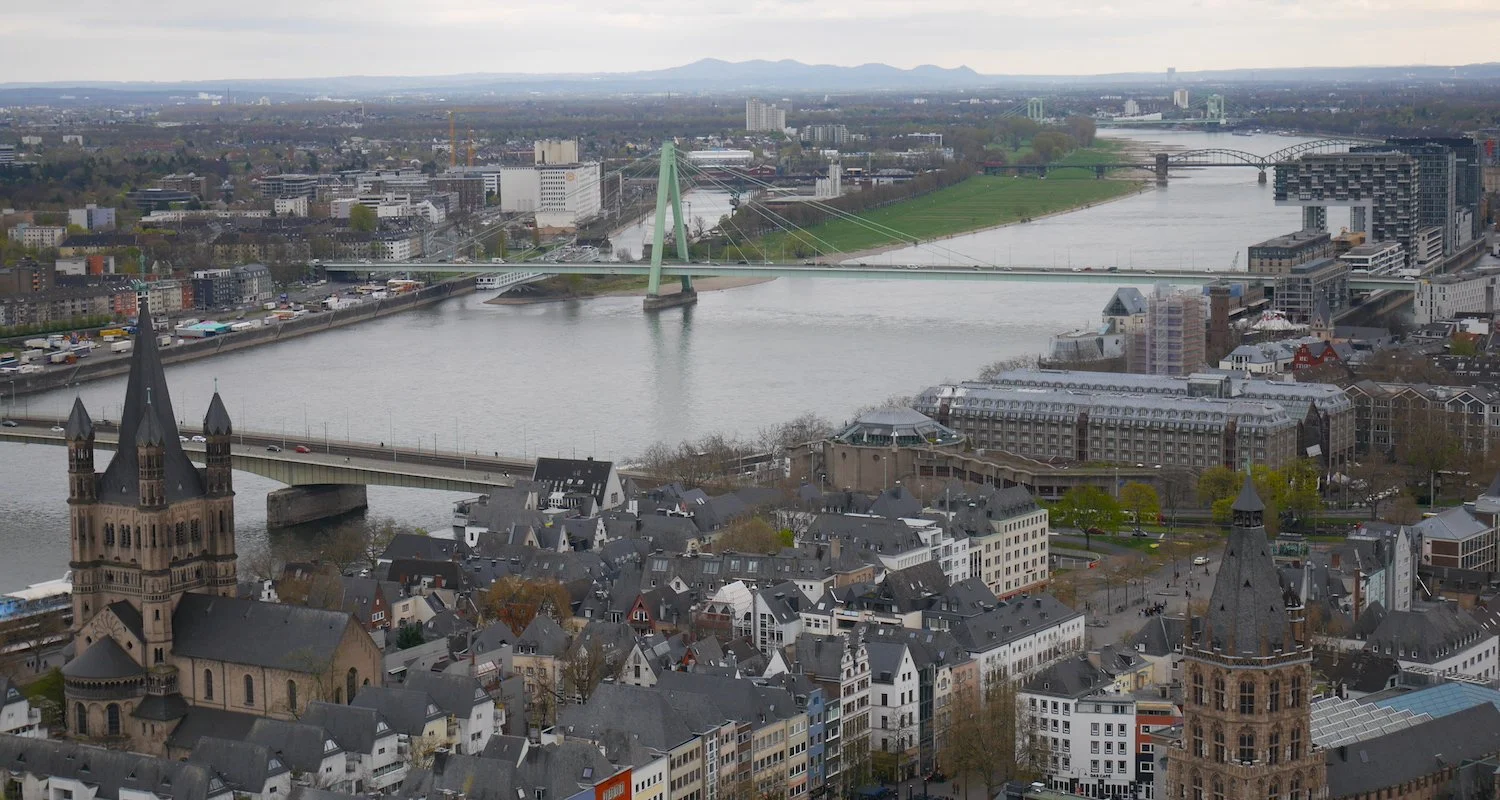
View to the Rhine and its bridges in downtown Köln.
The Rhine: Rome’s New Frontier
From 58 to 50 BC, Rome pursued a relentless policy of conquest across Northern Europe. These campaigns were meticulously documented by Caesar himself in his Commentarii de Bello Gallico (“Commentaries on the Gallic Wars”). By 58 BC, his legions had reached the western banks of the Rhine. Across the churning water lay the Germanic tribes—opponents who were as unpredictable as they were formidable.
Caesar strategically defined the Rhine as the official “frontier” between the Celtic Gauls to the west and the Germanic nations to the east. By drawing this line in the sand, he created the perfect stage for a demonstration of Roman power.
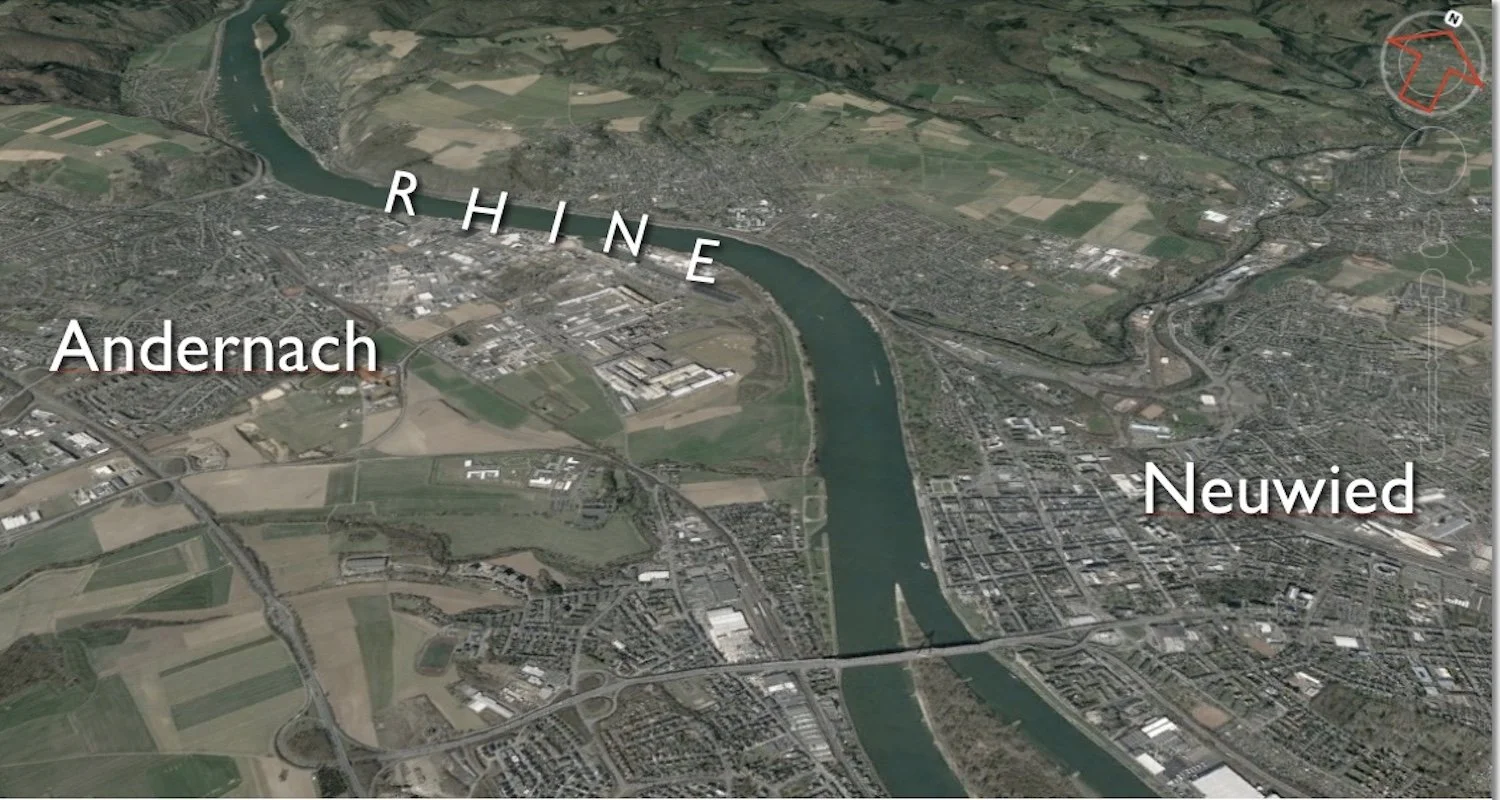
Andernach and Neuwied rest on opposite sides of the Rhine. It is possible that the Army of Julius Caesar chose the point in the river to build their bridge. Credit to Google Earth for the image.
Engineering as Propaganda
This move wasn't just about Roman interests; it was about personal survival. Back in Rome, Caesar’s political enemies were gaining ground, even threatening to try him for war crimes committed during his campaigns. He needed a narrative-shift to silence his critics.
While local allies offered boats to ferry his troops across, Caesar refused. He argued that crossing by boat was beneath his dignity and the honor of the Roman people. Instead, he ordered his engineers to do the impossible: bridge the Rhine River. This was a psychological lesson created for two audiences:
The Germanic Tribes: The bridge sent a message to Rome’s enemies that they could not be protected by the natural barrier of the river. Roman reach was now limitless.
The Roman Public: The sheer scale of the project gave his supporters a marvel of engineering to celebrate, effectively drowning out the political noise in the capital.
The Invasion and the Aftermath
As detailed in The Gallic War (4.16-19),* the Roman legions constructed the massive timber bridge—roughly 1,300 feet long—in a staggering ten days. Caesar marched his army across, spent 18 days burning villages and making his presence felt, and then marched back.**
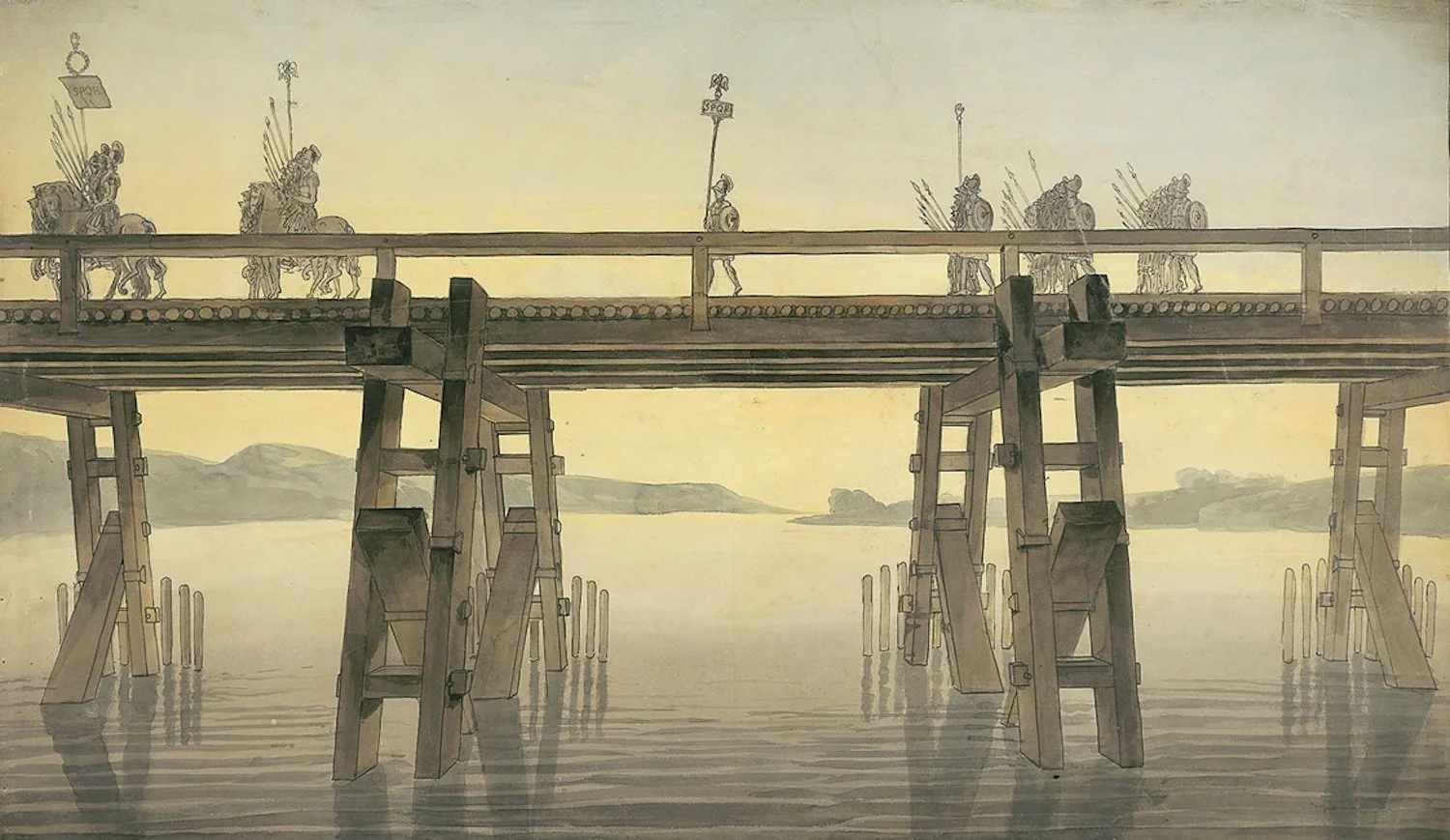
A watercolor depicting the army of Julius Caesar crossing the Rhine by John Soane (1814). The image may be found here: https://upload.wikimedia.org/wikipedia/commons/4/44/Il_ponte_di_Cesare_sul_Reno.jpg (accessed 5/8/2020).

In a final flourish of Roman dominance, he dismantled the bridge behind him. He didn’t need to occupy the territory; he had already proven that he could project Roman power anywhere, at any time, and on his own terms.
*Here is the first-person report of Julius Caesar himself, cast in third person: “He (Julius Caesar) proceeded to construct a bridge on the following plan. He caused pairs of balks eighteen inches thick, sharpened a little way from the base and measured to suit the depth of the river, to be coupled together at an interval of two feet. These he lowered into the river by means of rafts, and set fast, and drove home by rammers; not, like piles, straight up and down, but leaning forward at a uniform slope, so that they inclined in the direction of the stream. Opposite to these, again, were planted two balks coupled in the same fashion, at a distance of forty feet from base to base of each pair, slanted against the force and onrush of the stream. These pairs of balks had two-foot transoms let into them atop, filling the interval at which they were coupled, and were kept apart by a pair of braces on the outer side at each end. So, as they were held apart and contrariwise clamped together, the stability of the structure was so great and its character such that, the greater the force and thrust of the water, the tighter were the balks held in lock. These trestles were interconnected by timber laid over at right angles, and floored with long poles and wattlework. And further, piles were driven in aslant on the side facing down stream, thrust out below like a buttress and close joined with the whole structure, so as to take the force of the stream; and others likewise at a little distance above the bridge, so that if trunks of trees, or vessels, were launched by the natives to break down the structure, these fenders might lessen the force of such shocks, and prevent them from damaging the bridge. The whole work was completed in ten days from that on which the collecting of timber began, and the army was taken across.” (De Bello Gallico 4.17-18).
**For an interesting reenactment of the crossing of the Rhine, see the video here.