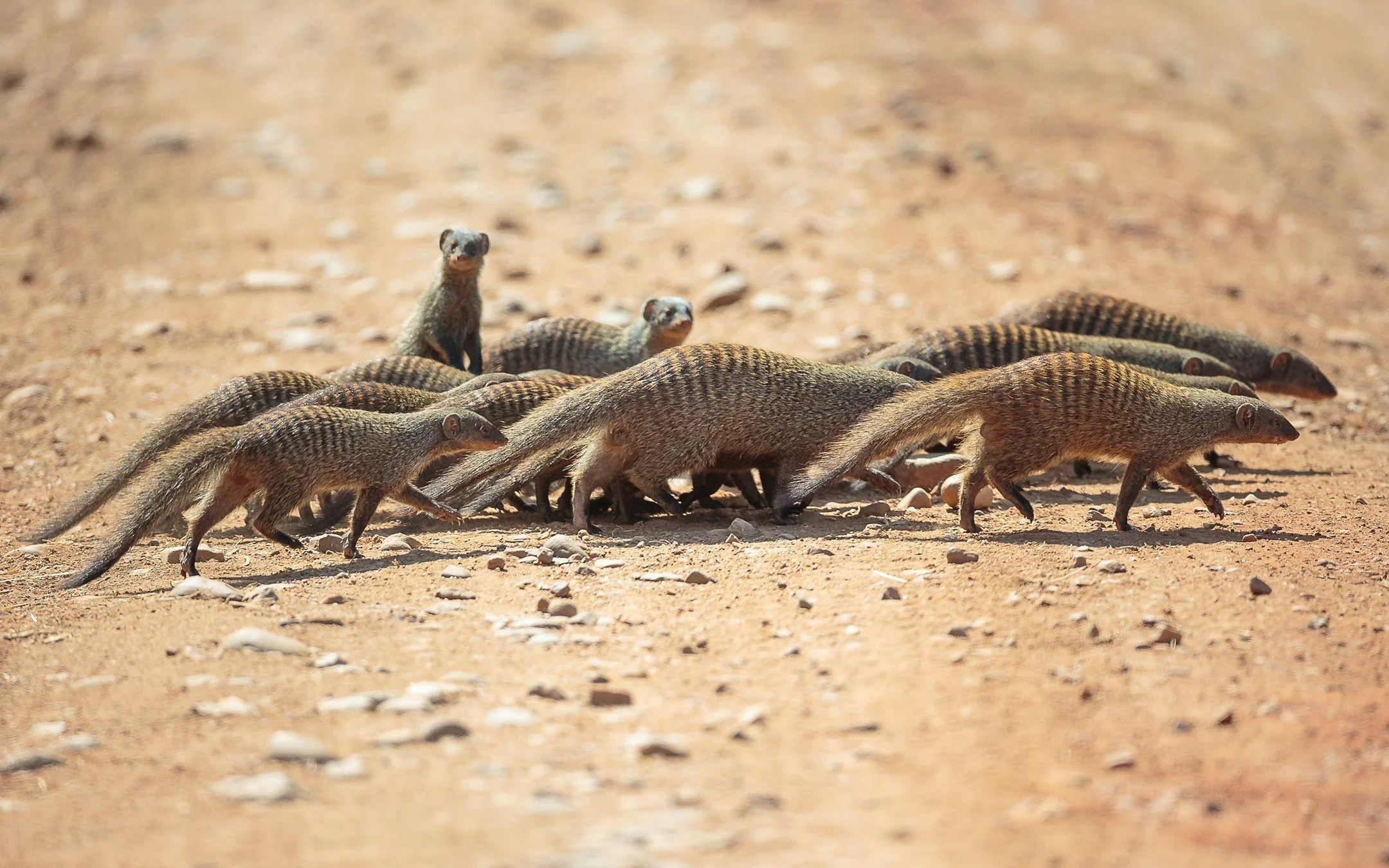
Mongooses scurrying in a tight mob across a dusty road. Their distinctive dark stripes (bands) across their backs should be visible as they move like a "furry wave."
Why Did the Mob of Banded Mongoose Cross the Road?
If you find yourself driving through the dirt traces of the Serengeti, you might be forced to hit the brakes for a peculiar sight: a “mob” of banded mongooses surging in front of you like a furry, synchronized wave.
It’s a charming (and chaotic) roadblock that leaves every traveler asking: Why?
The Method Behind the Mongoose Madness
Banded mongooses are highly social creatures, rarely traveling solo. When they cross the road, they are usually on a mission. What drives them?
The Ultimate Forage: They are constantly on the move for beetles, millipedes, and scorpions.
The Great Snake Hunt: Famous for their agility, they might be tracking a scent or flushing out a cobra.
Territory Expansion: As groups grow, they often seek new dens or foraging grounds, adapting seamlessly to human-dominated habitats.
A Sign of Good Fortune
In many parts of Uganda, seeing a mongoose isn't just a wildlife encounter—it's a spiritual "thumbs up." Local tradition often dictates that a mongoose crossing your path is a sign of good luck and prosperity for the journey ahead. Whether you're headed to Queen Elizabeth National Park or the Kazinga Channel, it’s a welcome omen.
So, the next time a mob halts your safari vehicle, don’t reach for the horn. Reach for your camera, enjoy the “luck,” and watch the fascinating social dynamics of one of Africa's most resilient little predators.
If you enjoyed this post, try this one: “Rikki-Tikki-Tavi in Real Life: Encountering the Banded Mongoose” or this one, “Built in Bellows.”