Ngorongoro Crater

Standing on the Edge: The Breathtaking Rim of Ngorongoro Crater

There is nothing quite like the first time you stand on the rim of the Ngorongoro Crater. Looking out across the vast expanse, you realize you are standing on the edge of the world’s largest intact volcanic caldera.

In the foreground of this shot, you’ll notice a striking member of the aloe family—likely the Krantz Aloe (Aloe arborescens). These resilient plants frame the dramatic view of the crater floor 2,000 feet below.

The Descent to Lake Magadi

Far in the distance, shimmering on the crater floor, you can make out the outline of Lake Magadi. This shallow, alkaline body of water is a focal point for wildlife, often attracting vast flocks of flamingos that tint the shoreline pink.

Getting from the rim to that water is an adventure in itself. The steep drop is navigated via a white-knuckle switchback road in a 4-wheel drive vehicle—a breathtaking (and bumpy!) experience that truly puts the scale of the caldera into perspective.

A Natural Wonder of Tanzania

I shot these images during my first visit to the region back in 2017, and the sense of awe hasn't faded. Whether you are interested in the geology of the caldera or the unique African flora clinging to the rim, Ngorongoro remains one of the most spectacular landscapes on the planet.

The Clever Spotted Hyena: Intelligence & Scavenging at Lake Magadi

A spotted hyena makes its way to the edge of the Lake Magadi.

Clean-Up Patrol: The Surprising Intellect of the Spotted Hyena

Meet the “clean-up patrol” of the African savannah. Here, a spotted hyena (Crocuta crocuta) feeds on a hippo carcass along the stark, alkaline shores of Lake Magadi, Tanzania.

While often maligned, the spotted hyena is one of the most successful and opportunistic scavengers—and hunters—in the world. But their physical toughness isn't their only weapon; their minds are equally sharp.

Entering the lapping waves of this soda lake.

Outsmarting the Great Apes

The hyena's reputation as a mindless scavenger is far from the truth. In laboratory problem-solving tests, the spotted hyena has been shown to outsmart chimpanzees in certain cooperative tasks. They possess a complex social intelligence and a level of strategic thinking that rivals many primates.

I guess these brilliant creatures just need a better PR representative!

Witness the Wild at Lake Magadi

Located in the heart of the Ngorongoro Crater, Lake Magadi is a prime spot to witness the raw drama of the food chain. From hyenas on patrol to vast flocks of flamingos, the biodiversity here is unmatched.

The bloated carcass of a dead hippo rests in the shallows. (Now you know why we’re shooting black and white!).

Safari With Us in 2027

Our 2026 expeditions are currently at capacity, but we are officially angling for a return to the Serengeti and Ngorongoro in 2027.

  • 2027 Booking Status: Early reservations are highly encouraged. Email us here.

  • Experience the Drama: See the clever spotted hyena in its natural habitat.

For a glimpse of travel opportunities, see the list of our future trips here.

To learn more about Ngorongoro, see our post, Standing on the Edge: The Breathtaking Rim of Ngorongoro Crater

To learn more about the Spotted hyena, see our post, Ngorongoro's Matriarchs: The Secret Society of Spotted Hyenas

Hyena and hippo carcass. Scavengers do what scavengers do.

See another post on the Spotted hyena here.

The Kori Bustard: Africa’s Heaviest Flying Bird

The Kori Bustard: Meeting Africa’s Heavyweight Flyer

The Kori Bustard (Ardeotis kori) is an absolute bruiser of the bird world. A mature male can weigh up to 40 pounds, officially making it the heaviest bird in Africa capable of flight.

Watching one take off is like watching a rumbling C-5 transport plane. It isn't exactly a graceful "launch"; the slow, rhythmic beat of its massive 9-foot wingspan takes considerable effort, but it eventually lifts this big boy aloft into the African sky.

Spotting Giants in the Ngorongoro Crater

I spotted this impressive specimen in the Ngorongoro Crater, Tanzania. While I wish I had a scale in the frame to truly illustrate its size, I chose to process this image in black and white to better highlight the bird's incredibly complicated plumage and neck markings.

Witness the "Heavyweight" of the Savannah

Standing 4 to 5 feet tall, the Kori Bustard is a prehistoric-looking marvel that every safari-goer should see at least once.

  • 2026 Expeditions: Our current tour dates are nearly full—check for last-minute availability!

  • 2027 Safari Planning: We are officially booking for our 2027 return to Tanzania. Email for details here.

There’s only one bird on the Serengeti that is bigger than a bustard. Meet him here!

Ngorongoro's Matriarchs: The Secret Society of Spotted Hyenas

A spotted hyena (Crocuta crocuta) walking through the short grass of the Ngorongoro Crater floor in Tanzania.

The Matriarchs of Ngorongoro: Inside Spotted Hyena Society

Meet one of the roughly 550 spotted hyenas (Crocuta crocuta) that call the Ngorongoro Crater in Tanzania home. While they are often misunderstood, these carnivores possess one of the most complex social structures in the animal kingdom.

A World Ruled by Females

The hyenas within the crater are organized into eight distinct, identified clans, each operating under a strict linear hierarchy. At the top of every single clan is an alpha-female.

Unlike many other predator groups, hyena society is entirely matriarchal:

  • Female Loyalty: Female hyenas typically remain with their birth clan for their entire lives, maintaining the family legacy.

  • Male Emigration: Young males often leave their home clan upon reaching maturity, embarking on a journey to join and prove themselves in a new clan.

  • Hierarchical Status: Even the lowest-ranking female is generally dominant over the highest-ranking male.

Experience the “Laugh” of the Crater

The Ngorongoro Crater offers a unique opportunity to witness these social dynamics up close. From their eerie “whoop” calls at dawn to their strategic hunting, the spotted hyena is a highlight of any game drive.

Safari With Us

Are you ready to witness the raw power and complex intelligence of the African bush? We are returning to the Serengeti and Ngorongoro in 2026, and we want you to have a front-row seat.

  • 2026 Expeditions: Limited seats are currently available for our upcoming season. Follow the link here for details.

  • Hear the Wild: Experience the sights and sounds of the crater for yourself.

  • 2027 Expeditions: Email us here to get on the waitlist.

See another of our posts on the Spotted hyena, Redefining the Spotted Hyena: Nature’s Misunderstood Genius

Walking on Stilts: A Close Encounter with the World’s Leggiest Bird in Tanzania

Walking on Stilts: A Day at Lake Magadi, Tanzania

If you ever find yourself on the floor of the Ngorongoro Crater, your eyes will likely be drawn to the massive lions or the rare black rhinos. But if you look toward the shimmering, salt-crusted edges of Lake Magadi, you’ll find one of the most elegant (and slightly comedic) sights in East Africa: the Black-winged Stilt.

The "Supermodel" of the Soda Lake

The first thing you notice about the Black-winged Stilt is the contrast. Their plumage is a sharp, tuxedo-like black and white, topped off with a needle-thin beak. But then, you see the legs.

Bright pink and impossibly thin, these legs look like they shouldn’t be able to support the bird at all. In fact, stilts hold the record for the longest legs relative to body size of any bird in the world. Watching them navigate the slapping waves of Lake Magadi, it’s immediately clear how they earned their name; they truly look like they are walking on wooden poles.

Why Lake Magadi?

Lake Magadi isn't your typical freshwater retreat. It is a soda (alkaline) lake, a harsh environment that most animals avoid. However, for waders like the stilt, it’s a goldmine.

  • Foraging Strategy: Their height allows them to wade deeper than other shorebirds, reaching food sources that smaller birds can't touch.

  • The Menu: They use those sharp beaks to peck at brine flies, larvae, and small crustaceans that thrive in the alkaline waters.

  • Adaptation: While the soda levels can be corrosive, the stilt thrives here, sharing the shoreline with shimmering flocks of Lesser Flamingos.

A Photographer’s Dream

Capturing a Black-winged Stilt in motion is a highlight of any Tanzanian safari. Whether they are delicately picking their way through the mud or taking flight with those long legs trailing behind them like a rudder, they bring a unique grace to the rugged landscape of the crater.

Pro-Tip: If you’re visiting Ngorongoro, bring a pair of high-quality binoculars or a long telephoto lens. The stilts often stick to the muddy shallows of Lake Magadi where the "slapping waves" meet the shore—a perfect spot for action shots.

Wildebeests of the Ngorongoro Crater: Why they Never Leave

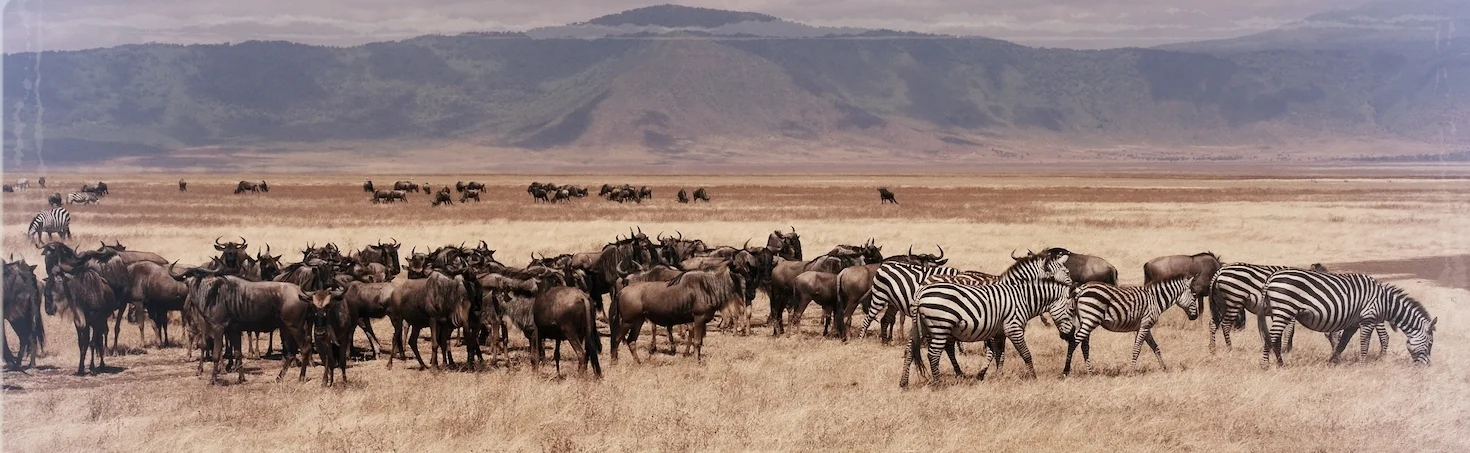
A herd of wildebeests loitering on the floor of the Ngorongoro Crater, Tanzania.

While their cousins are famous for the Great Migration circuit, the wildebeests of the Ngorongoro Crater have a different strategy: they never leave.

A Resident Population

Unlike the massive herds that trek between Tanzania and Kenya, the crater is home to a resident population of roughly 7,000 to 10,000 wildebeests. Because the crater floor offers permanent water sources and lush, nutrient-rich volcanic soil year-round, these Gnus have no reason to risk the treacherous journey across crocodile-infested rivers.

Life in a “Fishbowl”

Living inside the world’s largest intact volcanic caldera is like living in a natural amphitheater. The 2,000-foot-high walls create a self-contained ecosystem where survival is a daily drama.

  • The “Gnu” Chorus: The distinctive low grunting or "Gnu-ing" of thousands of wildebeests is the constant soundtrack of the crater floor.

  • Dense Predator Presence: Because the prey stays put, so do the predators. The crater has one of the highest densities of lions and spotted hyenas in Africa, meaning the wildebeests are always under a watchful eye.

The "Overspill" Guest Stars

While the crater has its own permanent residents, it does get visitors. During the calving season (January to March), hundreds of thousands of migratory wildebeests mass on the nearby Ndutu plains just outside the crater to give birth. Occasionally, some of these migratory herds "overspill" into the crater itself, briefly swelling the local population before heading north again.

Nature’s Landscapers

Wildebeests are essential to the crater’s health. By grazing the tall grass down, they make the landscape suitable for other species like zebras and gazelles. Their movement also helps circulate nutrients back into the soil, keeping the “Garden of Eden” green and vibrant.

Super Drumsticks

Did you know that an ostrich can sprint at speeds beyond 40 miles an hour and can kill a cheetah with just one kick. On the end of each foot are two toes, armed with sharp 4-inch claws.

I photographed this male in the Ngorongoro Crater, Tanzania.

Our 2026 African safaris are full, but will be opening seats for 2027 soon. Stay tuned.

Gossamer Wings

Three ibises hover around the edge of a waterhole in Ngorongoro Crater, Tanzania. Buffaloes lounge in the background.

I’ve posted shots of the African Sacred Ibis (Threskiornis aethiopicus) before. The “forward assembly” of this large wader would make a vulture blanch: bald, dull, wrinkled; unblinking eyes sit behind nostril slits on a downward bending beak. However, I am attracted to the beauty of the ibis wing. it’s gossamer-like feathers with black tips fan open and close elegantly. Viewed in black and white, the texture may be appreciated.

Safari with us in Africa next year. There is a seat in a knobby-tyred 4x4 waiting for you.

Gnu-uuu-uuuu!

Herds of blue wildebeest or brindled gnu (Connochaetes taurinus) spread across the floor of Tanzania’s Ngorongoro crater. Although they look like a frankinstein of animal parts, the wildebeest is a member of the antelope family.

During the rut (at the end of the rainy season) the bull will tirelessly protect his herem of cows, preventing other would-be suitors from approaching. Bellows and snorts (which sound like “gnuuuu”) are issued, ground is plowed with hooves or horns, and if all that display doesn’t work, charges and horn thrusts are exchanged.

There’s never a dull moment in Africa.

Can play Offense or Defense

The behavior of the African buffalo (Syncerus caffer) is unpredictable. Unlike its cousins, the American bison, yak, or Asian water buffalo, this animal has never been domesticated. In human whispers, buffalos are called "black death" and may kill more people than lions or hippos.

A big bull, like this one in Ngorongoro Crater, Tanzania, weighs as much as a small car.

To protect themselves from predators, a herd of African buffalo play team defense. The young, elderly, or sick are encircled by the others, butts in, horns out!

Come safari with us in 2025 or 2026! We'll keep our distance from the African buffalo. Promise!

Fearless Parent

Do you know that this boldly-colored bird will risk everything to protect its young? The lapwing (or plover) will attack raptors, rollers, or even an elephant perceived as threat!

Its call--"tink, tink, tink"--sounds like the hammer of a blacksmith, hence the name: the Blacksmith lapwing (Vanellus armatus).

Big Boy

Easy there, big boy!

This photo doesn't offer a sense of scale, but realize that this dude is more than a meter tall! That makes the Kori Bustard (Ardeotis kori) the largest flying bird in Africa (the ostrich is bigger, but doesn't fly). Mature bustards can weigh 40 pounds and are possibly the heaviest creature capable of flight today.

Kori Bustards are rare outside of protected areas. The species is considered "vulnerable" on the endangered list. I was delighted to find this one striding along (like a T-Rex!) looking for a meal on the edge of Lake Magadi (Ngorongoro Crater, Tanzania).

Farm of Dream

Farm of Dream

The Farm of Dream is a lodge nestled in purple hills above the Great Rift Valley. The nearby town, Karatu, is conveniently positioned between Lake Manyara and Ngorongoro Crater. Knobby-tyred rigs like TIK regularly rattle down its mudded street like a military convoy. Karatu’s nickname, unsurprisingly, is “Safari Junction.”

Serengeti chicken

Serengeti chicken

Safari operators often speak of the "Big Five." This is a linger-longer from the blood-sport days. The phrase does not identify Africa's largest species, but rather the five most difficult/dangerous animals to hunt on foot.

Noah's ark (sortof)

Noah's ark (sortof)

In the story of Noah's Ark, a portion of the living world finds sanctuary in a pinch. I thought about that as our rig bounced down the steep track into Ngorongoro Crater, Tanzania.

The eighth wonder of the world

The eighth wonder of the world

The land yawned like a Wyoming dawn. The opportunity in front of us was equally wide. We had a full day to spend in Ngorongoro Crater and I was pumped.