Exploring Tanzania

The Facultative Nomad: Birdwatching in Tanzania

The Facultative Nomad: Tracking the Yellow-Billed Stork

A "facultative nomad" is a creature that lives a settled life when it can, but moves around when required. Whether applied to birds, bugs, or even people, it describes a perfect balance of stability and survival.

This description fits the Yellow-billed stork (Mycteria ibis) of sub-Saharan Africa perfectly. These striking birds are staples of African wetlands and mudflats. Because of their specialized wading and feeding tactics, Yellow-bills avoid deep water, preferring the shallow edges where prey is easier to snatch.

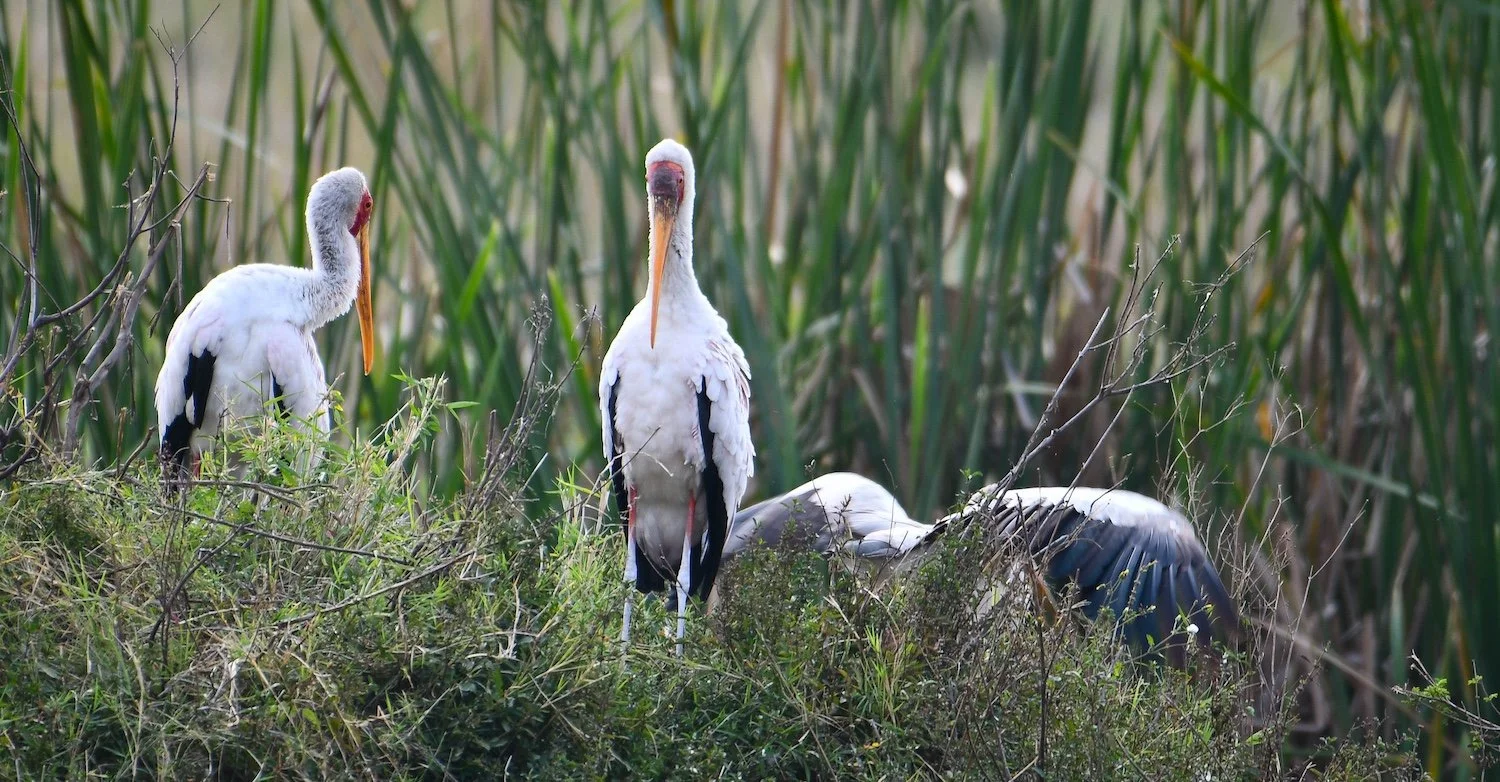
As long as food is plentiful, they stay put. However, their larger patterns of migration remain largely unstudied and unclear—they simply follow the resources. I spotted this "gang" lingering in the reeds during a trip through northwest Tanzania.

Safari with Us in Africa

Are you ready to be a facultative nomad for a few weeks? While our 2026 African Safari offerings are currently full, we are already angling for our 2027 expeditions.

Don't miss the chance to see Tanzania’s incredible wildlife—from the Great Migration to the hidden life in the reeds—up close.

  • View our current travel opportunities: https://mark-ziese.squarespace.com/find-my-trip

  • Get on the 2027 Waitlist: Contact BibleLandExplorer@gmail.com

Interested in learning more about the Yellow-billed stork? Check out our posts here and here.
Ostrich Brain-to-Body Ratio: Wisdom, Job 39, and the Assfish

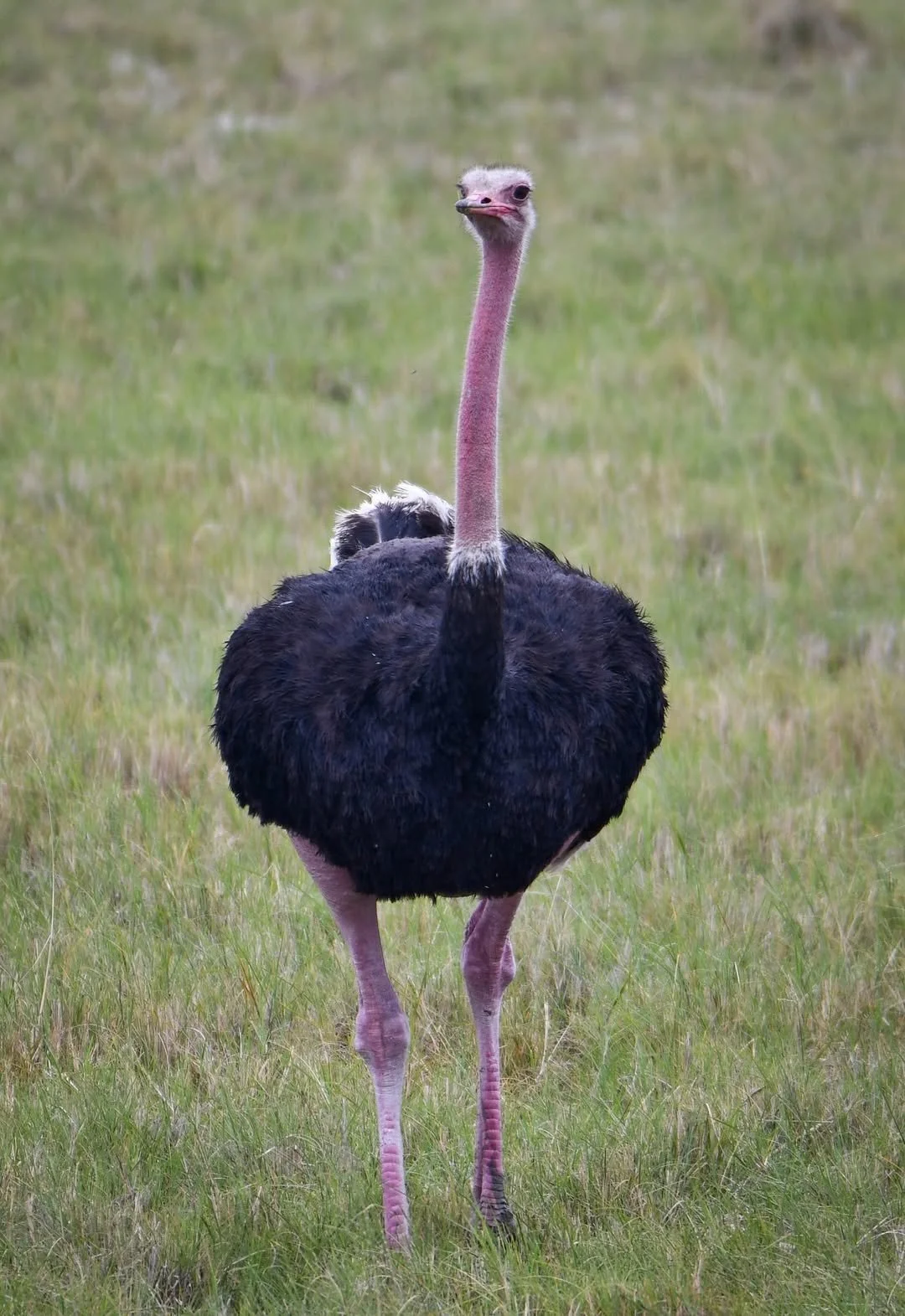
We encountered this large male ostrich standing in the expansive grasslands of Tanzania during a wildlife safari.

The Ostrich: A Masterclass in Brain-to-Body Ratio

When it comes to the brain-to-body ratio, the ostrich isn't quite at the bottom of the list, but it’s certainly in the neighborhood. An ostrich possesses a tiny 1.5-ounce brain to steer a massive 250-pound bird. To put that in perspective, an ostrich's eye is actually larger than its brain!

Which animal actually holds the title for the lowest ratio? Scientists aren't entirely certain, but the debate usually swerves between the Bony-eared Assfish and—well, I’ll let you fill in the blank for the second candidate. (I mainly included that detail because I wanted to type the word assfish a second time).

A Biblical Perspective on the Ostrich

This lack of "intellectual firepower" was noted long before modern biology. As Job 39:17 reminds us:

"God did not endow her with wisdom or give her a share of good sense."

Despite their lack of "good sense," seeing a big male ostrich like this one in the Tanzanian grasslands is a highlight of any trip. They are powerful, prehistoric-looking, and endlessly entertaining to watch in the wild.

See the Wildlife of Tanzania for Yourself

Ready to witness the "silly" side of the savannah? We specialize in having fun while responsibly bringing history and nature to life!

  • View Our Travel Opportunities: Click here for an updated list.

  • Join the 2027 Safari Waitlist: Email me here with your questions.

If you enjoyed reading about this ostrich, check out these three birds here.

Seeking Shade

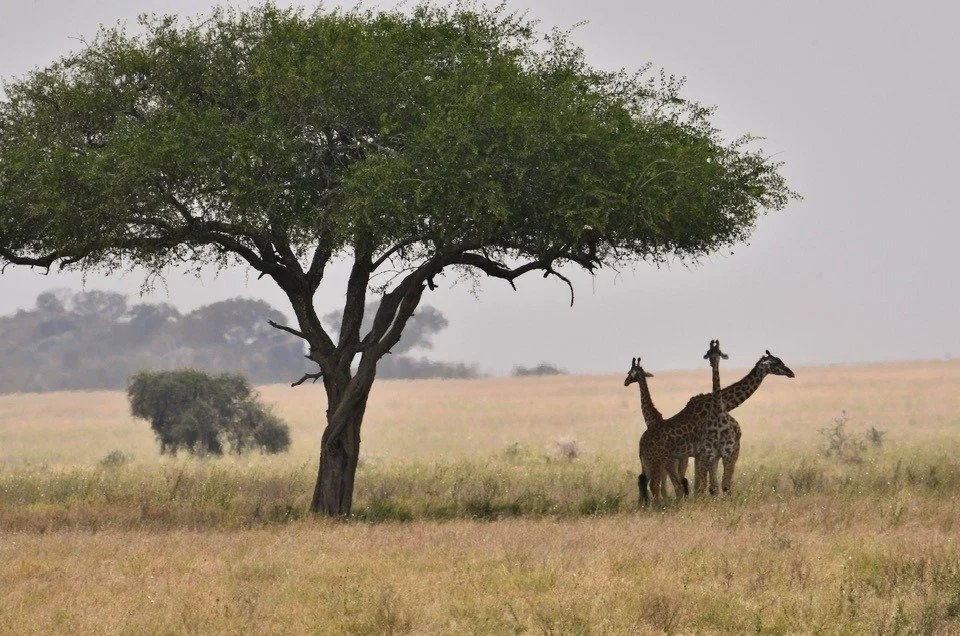
A trio of giraffes seek shade to escape the sun in the African savannah

Shade Seekers: The Social World of the Giraffe

A trio of giraffes pauses to escape the heat of the midday sun.

Giraffes are highly social animals, often found living in groups—a collective appropriately known as a “tower.” Beyond their towering height, their social sophistication is truly fascinating. They aren't just silent giants; they communicate with one another through a complex array of sounds and physical signals.

In the wild, you might observe a variety of giraffe communication methods, including:

  • Vocalizations: Chirps, barks, and even low-frequency hums.

  • Visual Signals: Head bobbing and tail wagging.

  • Breath: Powerful "blows" or snorts to signal alarm or presence.

Watching these interactions in person is a highlight of any trip to the savannah.

Join Our Upcoming AfricaN Safaris

Want to see a tower of giraffes in their natural habitat? We invite you to wander over to Africa and safari with us!

  • 2026 Expeditions: Now closed. All seats taken.

  • 2027 Bookings: Email us here to get on a waitlist.

For more on giraffes, check out our post here.

The Secret of Cheetah Tear Lines: Malar Stripes & Serengeti Safaris

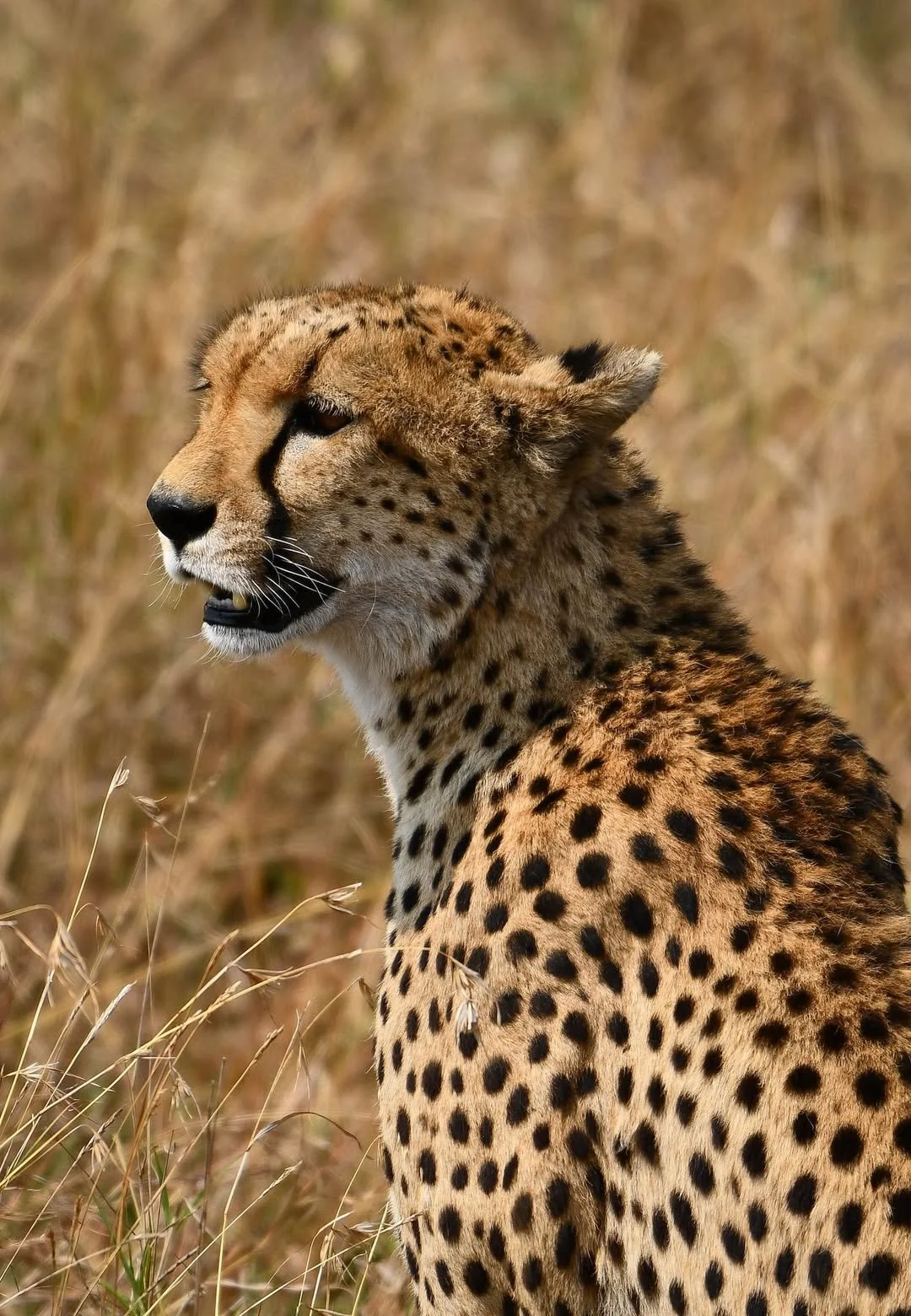
Close-up of a cheetah in the Serengeti showing the dark malar stripes (tear lines) from its eyes to its mouth.

More Than a Pretty Face: The Function of Cheetah Tear Lines

Tear lines give the cheetah a distinctive and adorable face. These dark marks stand in sharp contrast to the tawny fur of this fast feline, connecting the inner corner of the eye directly to the mouth. But in the wild, these lines are far more than just a beauty mark.

The Science of Malar Stripes

Wildlife specialists refer to these markings as malar stripes (malar being the Latin word for "cheek"). Much like the black greasepaint football players apply under their eyes, it is believed these lines function to:

  • Reduce Glare: Absorbing sunlight to prevent snow-blindness or sun-glare on the open savannah.

  • Enhance Focus: Helping cheetahs, falcons, and other "tear-lined" predators spot, track, and pursue prey across long distances.

A Serengeti Encounter

We recently encountered this beautiful cheetah—and could hear the hidden chirps of her cubs—in the heart of the central Serengeti. Watching a mother cheetah navigate the tall grass is a masterclass in focus and stealth.

Spot a Fast Feline in the Wild

If seeing the world's fastest land animal in its natural habitat sounds like your kind of adventure, we invite you to join us.

  • 2026 Tours: Our current offerings are filling fast. See our destinations here.

  • 2027 Planning: Get on our waitlist. Email BibleLandExplorer@gmail.com

Like cheetahs? Here’s a link to a view.

Giants of Tarangire: Baobabs, Elephants, and the Tree of Life

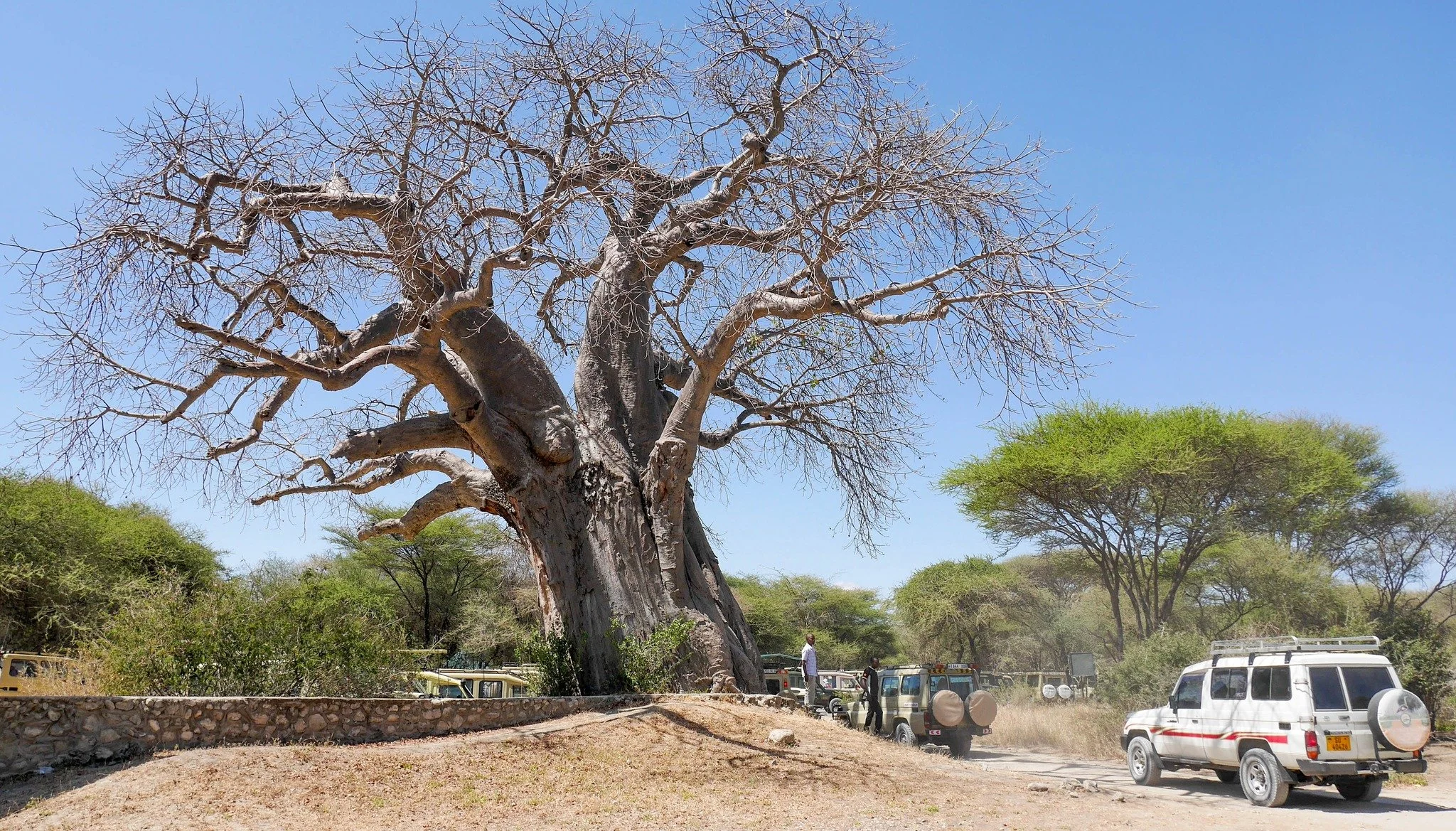
A massive, 1,000-year-old baobab tree at the Boundary Hill Gate entrance of Tarangire National Park, Tanzania.

Entering the Realm of Giants: The Baobabs of Tarangire

The Boundary Hill Gate serves as the primary entrance for most safarists arriving at Tarangire National Park in Tanzania. Standing guard at the gate is a truly remarkable baobab tree, an iconic specimen of the African landscape estimated to be at least a thousand years old.

The "Upside-Down" Tree

The baobab's silhouette is unmistakable. Local legends often call it the "upside-down tree" because, if you squint, its gnarled branches look exactly like roots reaching toward the sky.

Africa's True "Tree of Life"

Others revere the baobab as the "Tree of Life," a title earned through its incredible biological resilience:

  • Massive Water Storage: A mature baobab can store up to 120,000 liters (32,000 gallons) of water in its spongy, fibrous trunk to survive harsh droughts.

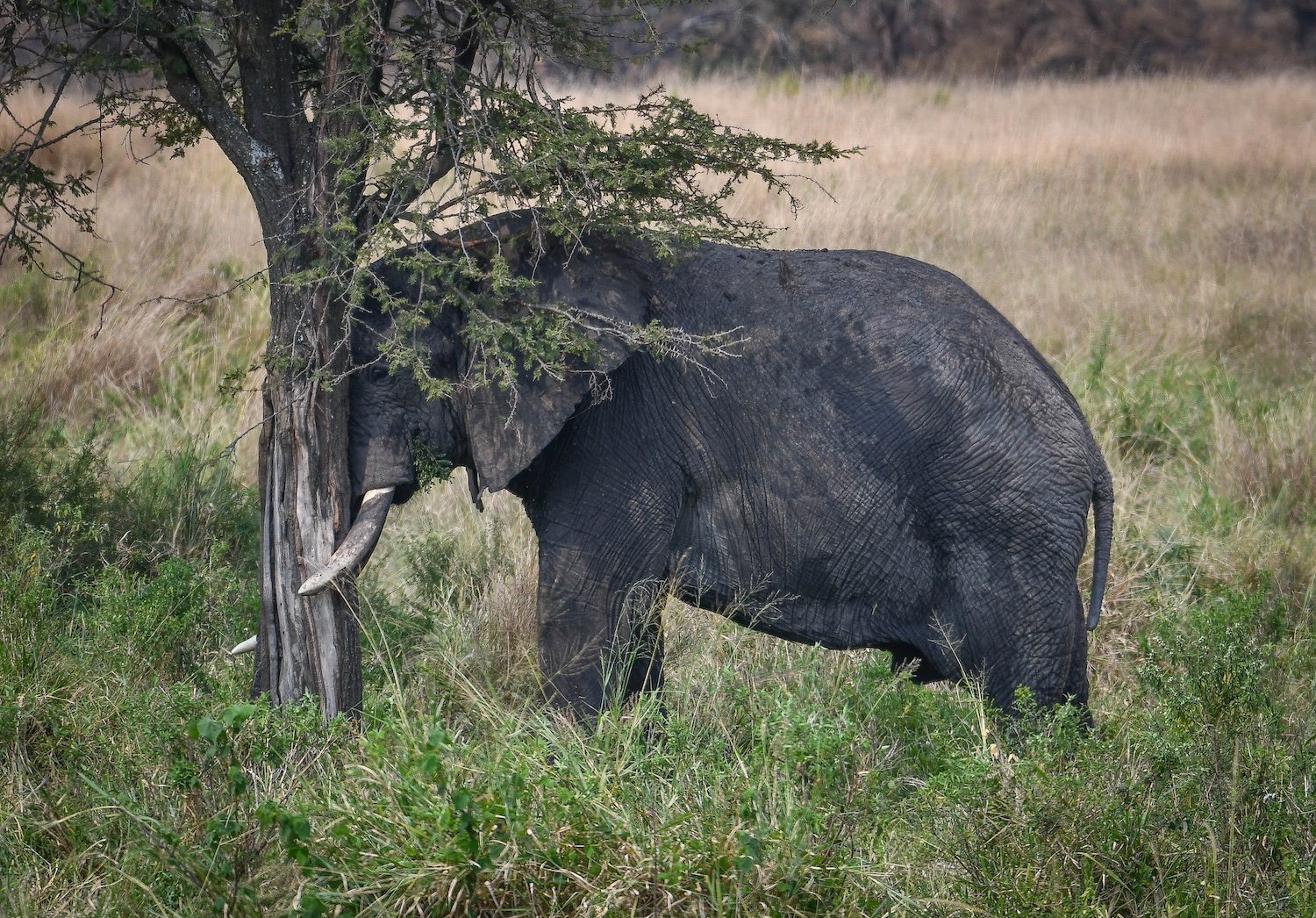
  • Elephant Lifeline: During the dry season, elephants use their tusks to gouge the bark, chewing the moisture-rich wood to stay hydrated.

  • Longevity: These prehistoric giants can live for over 2,000 years, outlasting almost every other living thing on the savannah.

Tarangire National Park is world-famous for having the highest density of both baobabs and elephants in Tanzania. Seeing these two giants interact against the golden grasslands is an experience unlike any other.

Join Us on Safari

Ready to stand in the shadow of a thousand-year-old giant? We invite you to explore the wild heart of Africa with us.

  • 2026 Expeditions: All seats taken. Registration closed.

  • 2027 Planning: Email us here and get on the waitlist. Be ready when registration opens.

The Serengeti Hippo Pool: "Bloats," Bacteria, and Safari Perfume

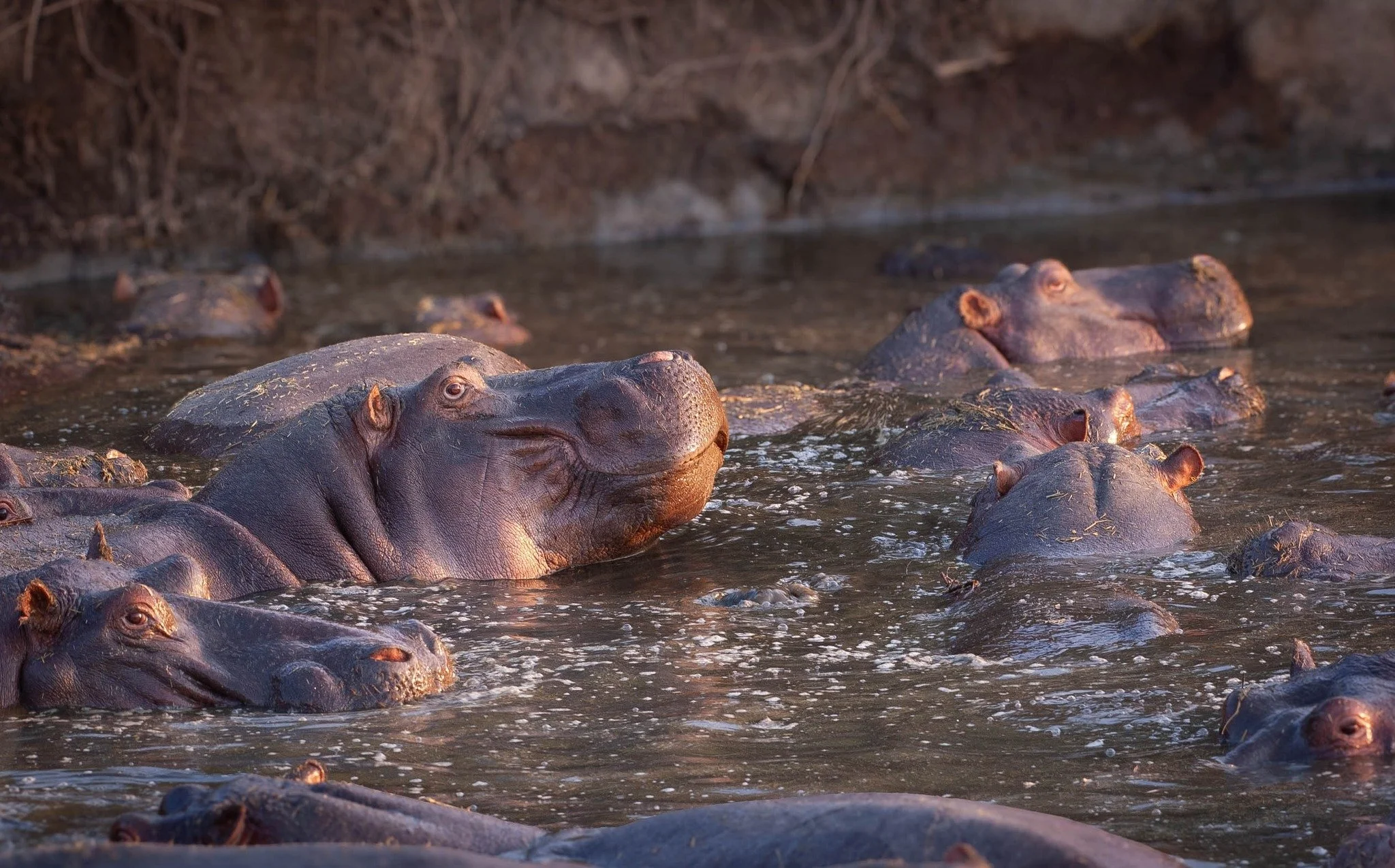
A large group (bloat) of hippos crowded together in a muddy water hole in the African savannah.

The Bloat Smell

Stopping on the edge of a hippo pool in the African savannah usually produces two distinct responses.

The first is pure amazement. This is especially true if you encounter a group of fifty or more individuals—appropriately known to biologists and guides as a "bloat." They splash, fuss, grunt, and jostle for position in the crowded water.

The second response—revulsion—follows quickly behind. “Eww! What’s that smell?” someone inevitably gasps.

We watch in a mix of horror and fascination as fecal matter is flung into the air by hippo tails rotating like the windshield wipers on a car. This "muck-spreading" isn't accidental; it's a way for hippos to mark their territory. My usual response to our gasping guests? “Serengeti perfume.”

The Biological Super-Power of the Hippo

Hippos are massive creatures that eat a staggering amount of vegetation every night. Naturally, they poop a lot, too—and they don't seem to mind "wallering" (wallowing) in the resulting mixture.

While it is often said that hippos have poor digestion, their real marvel is their immune system. Living in water thick with bacteria and waste, hippos possess a "bullet-proof" biological resilience that allows them to heal from territorial gashes and wounds without succumbing to infection.

Experience the Wild with Us

If you want to experience the sights, sounds, and—yes—the smells of the Serengeti up close, we’d love to have you on our next expedition.

  • 2026 African Safaris: Registration closed. All seats taken.

  • 2027 Safari Planning: We are currently angling for our 2027 dates. Get on the waitlist to secure your spot! Email us here.

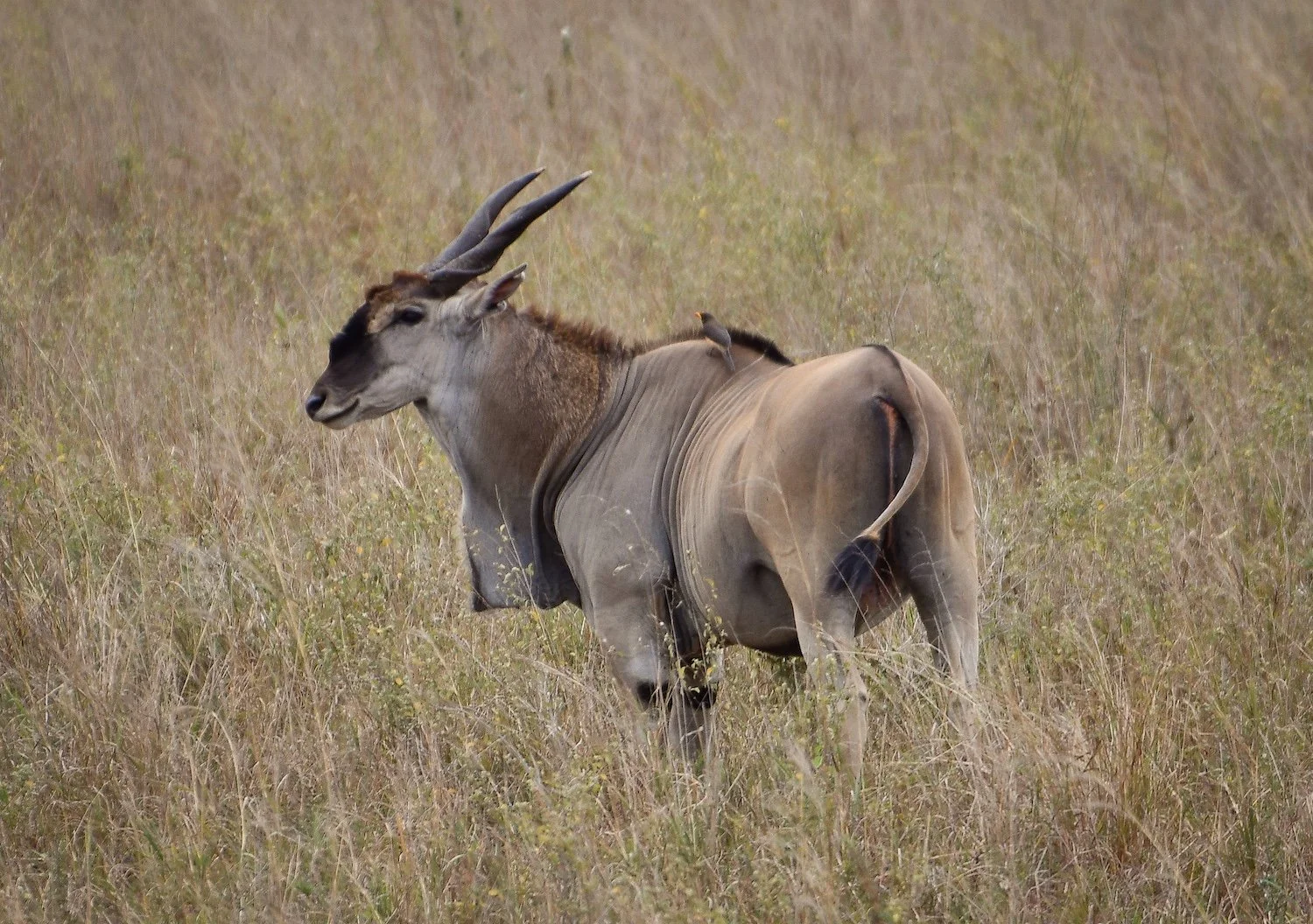
The Smiling Eland: Secrets of Africa’s Largest Antelope

A close-up of a large eland antelope with spiral horns and an oxpecker bird on its back in the Serengeti.

The Eland Smiles: Secrets of the Serengeti’s Gentle Giant

Does the eland know a secret? Looking at that expression, it certainly seems so.

The eland is the undisputed heavyweight champion of the antelope family. While it is the largest of its kind, it is also one of the slowest. Because of its calm nature and massive size, humans have occasionally domesticated them—though it’s important to remember they are still wild antelopes and world-class fence-jumping specialists, capable of clearing heights that would baffle a high-jumper.

The "Liquid Eyes" of the Savannah

Sitting quietly in our jeep, we watch these docile creatures munching on the rich Serengeti grasses. From this vantage point, you can truly appreciate their beauty:

  • Spiral Horns: Both males and females carry these tightly twisted, elegant weapons.

  • Liquid Eyes: Adorned with incredibly long lashes, their eyes have a depth that invites whispered conversations among our travelers.

  • Symbiotic Friends: If you look closely at the photo, you’ll notice an oxpecker hitched a ride on his back—a tiny feathered sentry that cleans away parasites.

Join Us for Tanzania 2027
Our safari expeditions continue to attract a special kind of traveler—those who find as much joy in the "smile" of an eland as they do in the roar of a lion.

Because our 2026 dates are already full, we have officially scheduled a return to Tanzania in 2027. Email us here to get a spot on the waitlist. Information TBA.

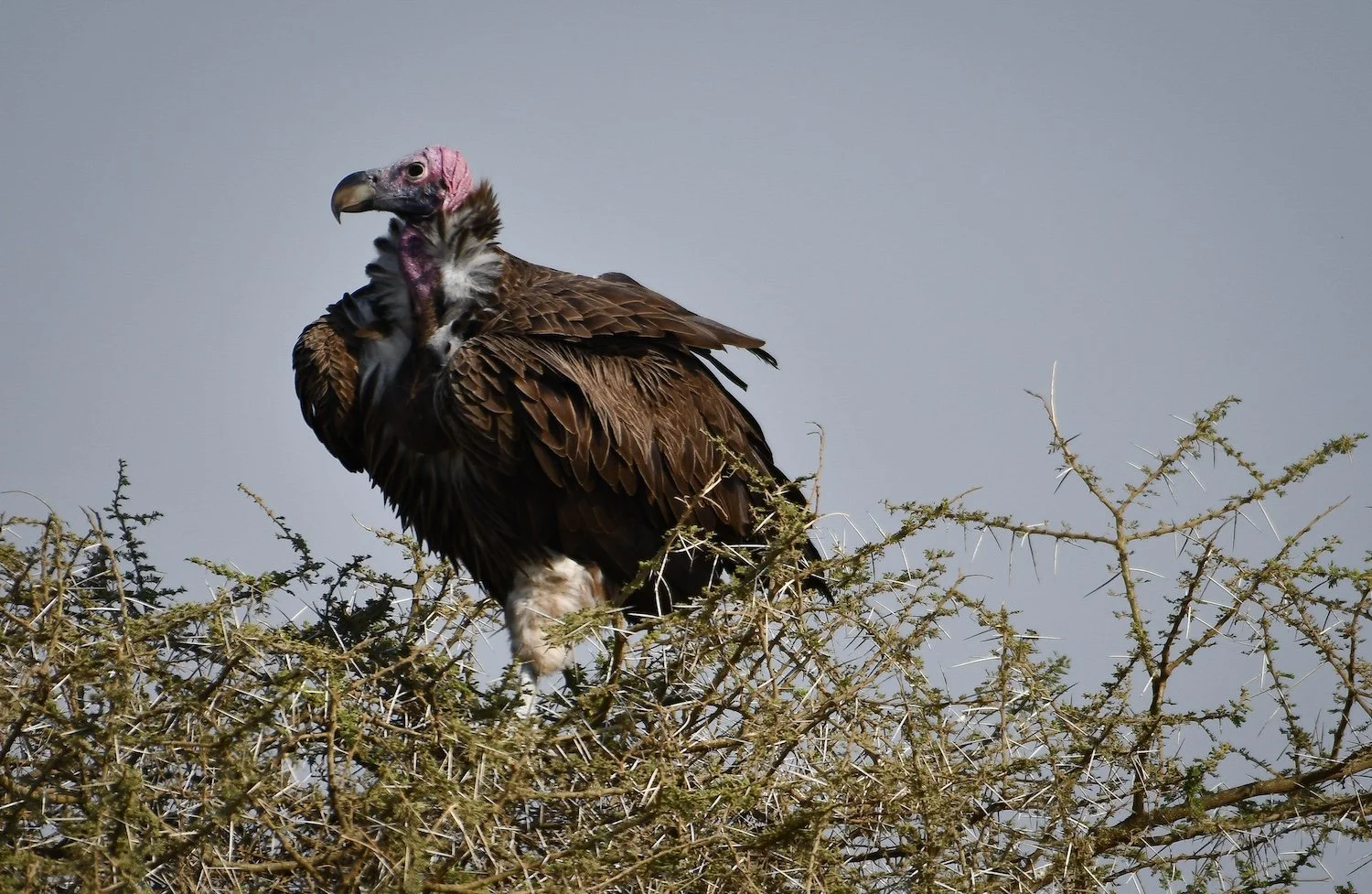
The Noble Lappet-faced Vulture: Africa’s Largest Scavenger

A Lappet-faced vulture showing its distinctive skin folds and massive beak in the African savannah.

The Noble Scavenger: Meeting Africa’s Largest Vulture

Well, almost noble. In the world of textiles, a "lappet" is a fancy fold of fabric—the kind you might see draped in an elegant scarf or head covering. But in the wild, the term takes on a much more rugged meaning.

The Lappet-faced vulture (Torgos tracheliotos) is named for the distinctive fleshy folds of skin on its head and neck. While the look might seem "fancy-schmancy," these features are part of a formidable biological toolkit. This is Africa's largest vulture, boasting a massive wingspan that can reach up to 9 feet.

A Critical Member of the Clean-Up Crew

Despite its commanding presence, this member of nature’s sanitation team is in serious trouble. The Lappet-faced vulture is currently listed as Endangered on the IUCN Red List.

Their survival is threatened by several modern challenges:

  • Pesticide Ingestion: Often through accidental secondary poisoning.

  • Habitat & Nest Destruction: The loss of the isolated trees they require for nesting.

  • Persecution: Misunderstandings of their vital role in the ecosystem.

Recent estimates suggest only about 6,500 mature individuals remain in the wild. Losing these birds would be a catastrophe for the savannah’s health.

See Them in the Wild

Spotting one of these rare giants is a bucket-list experience for any wildlife lover. We are heading back to the heart of Africa, where you can witness the raw power of the "noble" vulture for yourself.

  • 2026 Safari Booking: Registration closed. All seats taken.

  • 2027 Inquiries: For those looking down the road, email us here for more information.

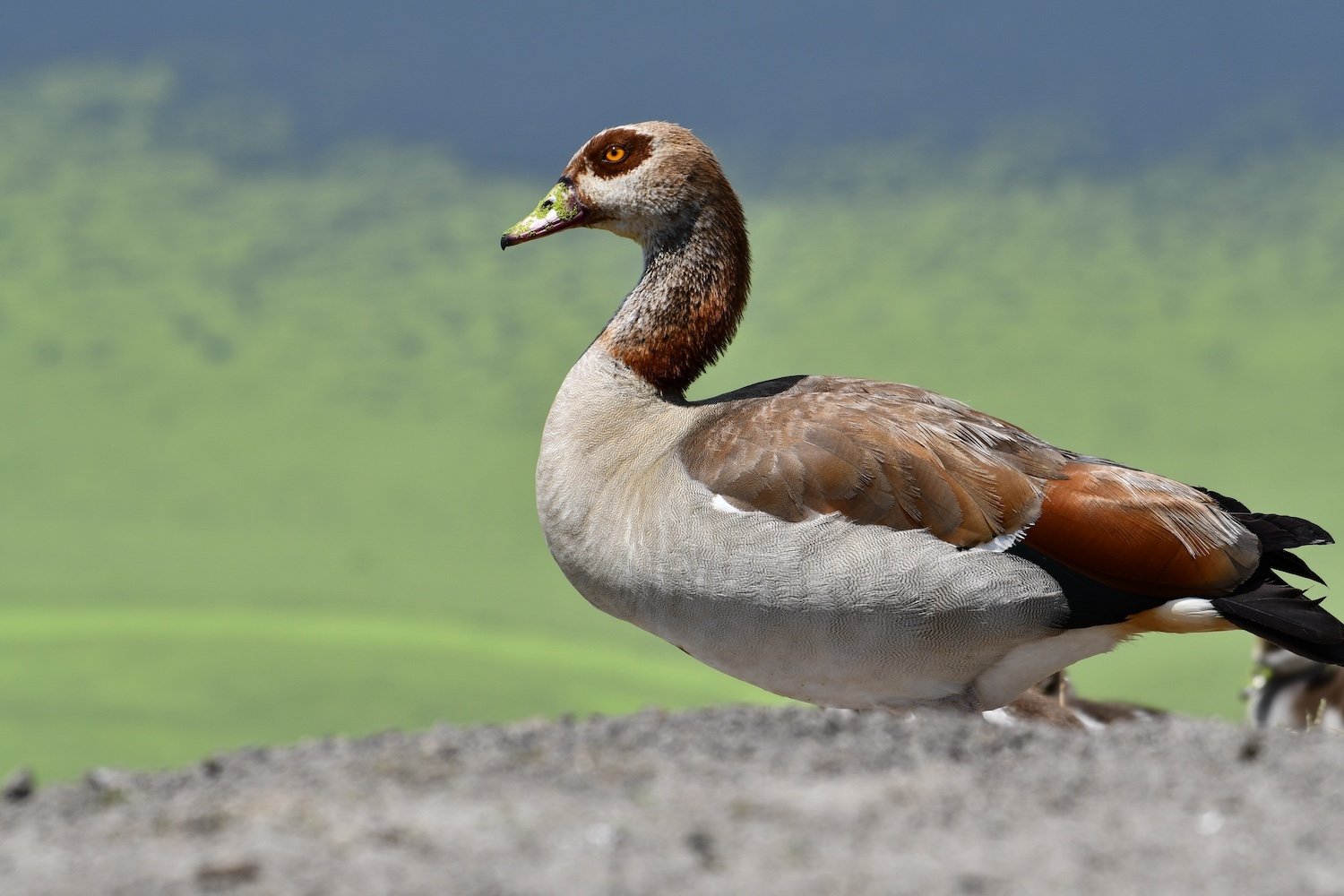
Duck-Duck-Goose: A Case of Mistaken Identity

An Egyptian Goose with its distinctive brown eye patches (bandit mask) standing near a water-hole in Africa.

The Egyptian Goose: A Case of Mistaken Identity

If it looks like a duck, walks like a duck, and quacks like a duck, it must be... an Egyptian Goose!

Despite the common name, Alopochen aegyptiaca is not a true goose at all. This large, vocal waterbird is actually a member of the shelduck sub-family, Tadorninae. While they are native and widespread across Africa, they’ve also become a famous (and sometimes controversial) invasive species in British gardens and European parklands.

The "Bandit" of the Water-Hole

The Egyptian Goose is easy to identify once you know what to look for:

  • The Look: A stocky build with a surprisingly colorful palette of brown, red, and white plumage.

  • The "Mask": Their most striking feature is the dark, "bandit mask" patches around their eyes, giving them a perpetually sneaky appearance.

  • The Flight: Their takeoff can look a bit awkward, but they are incredibly hardy and adaptable.

Safari Sightings: Trees and Trenches

On safari, we often spot these "quackers" congregating around water-holes. Interestingly, they aren't just ground-dwellers; it is very common to see them roosting high in trees or taking over the abandoned nests of other large birds.

Spot an Egyptian Goose for Yourself!

Whether you’re a serious birder or just love the wildlife of the savannah, the Egyptian Goose is a staple of the African landscape that never fails to entertain.

  • 2026 Safari Dates: Registration closed. All seats taken.

  • 2027 Waitlist: Our schedule fills fast—get your name on the waitlist for our 2027 expeditions. Email us here.

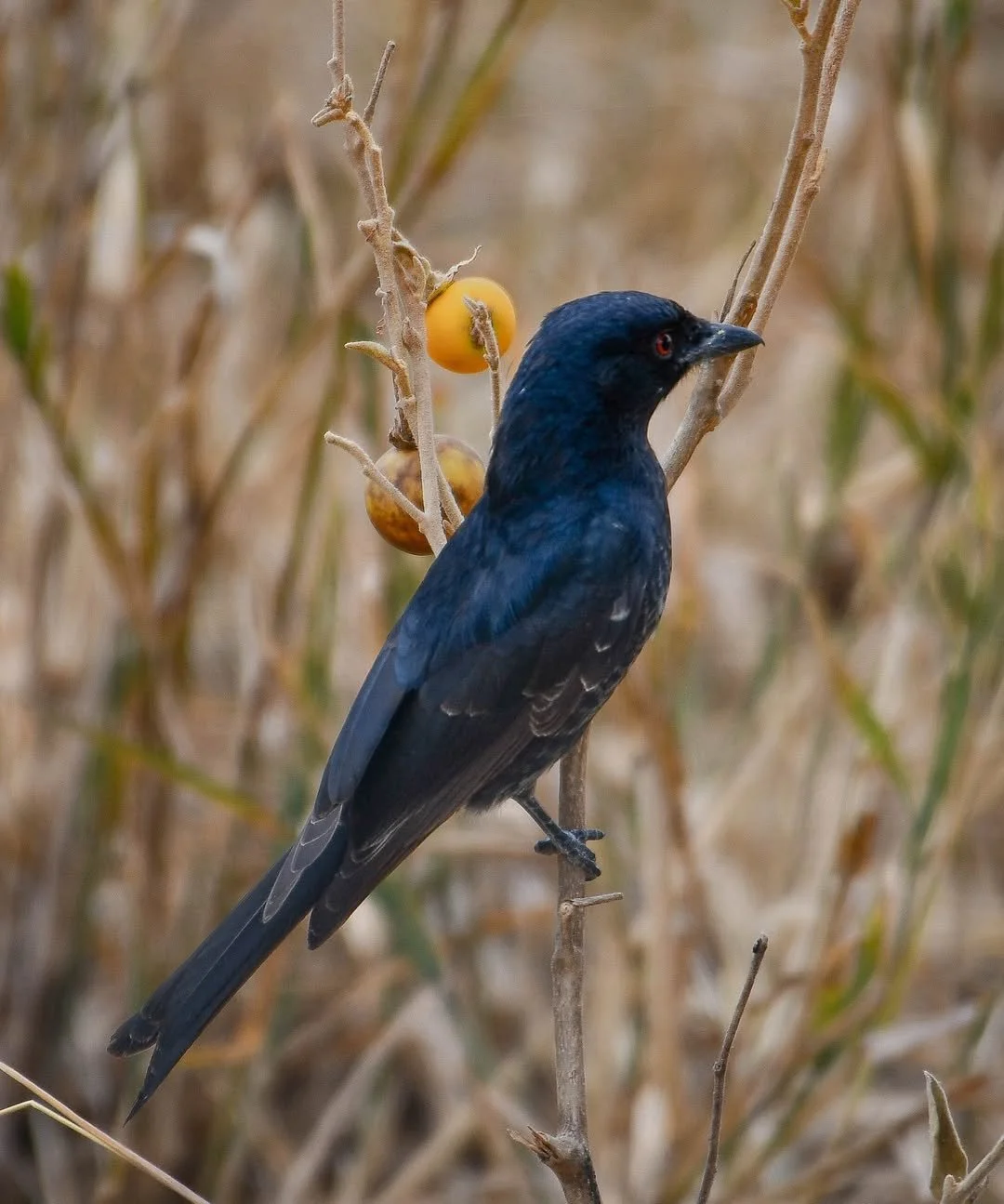
The Fork-tailed Drongo: Africa’s Greatest Kleptoparasite

A black Fork-tailed drongo, known for its predatory mimicry, perched on a branch in the African savannah.

Kleptoparasite

That’s a word you don’t hear every day, but it perfectly describes one of the most calculating characters on the African savannah. In the animal kingdom, a kleptoparasite is a creature that specializes in stealing food gathered or caught by another.

This description fits the Fork-tailed drongo (Dicrurus adsimilis) to a tee. This medium-sized black bird is a master of deception and vocal mimicry.

The "False Alarm" Strategy

The drongo has a fascinating—and highly effective—tactical maneuver:

  • The Mimic: It can accurately mimic the alarm calls of various predators or even the warning cries of other birds and meerkats.

  • The Heist: When the drongo gives a "false alarm," other animals drop their hard-earned insects or small prey and bolt for cover.

  • The Reward: The drongo swoops in and claims the abandoned meal.

It’s a sophisticated level of tactical deception that reminds me of the kind of stunts we used to pull in Junior High!

See a Sneaky Drongo for Yourself

Watching a drongo "at work" is a highlight for anyone interested in animal behavior. Experience the intelligence of the African bush firsthand on our upcoming expeditions.

  • 2026 Africa Safaris: All seats taken. Registration closed.

  • 2027 Travel Planning: We are currently working toward 2027—reserve your seat before they disappear! Email us here.

The Secretarybird: Africa’s Fierce Snake-Hunting Raptor

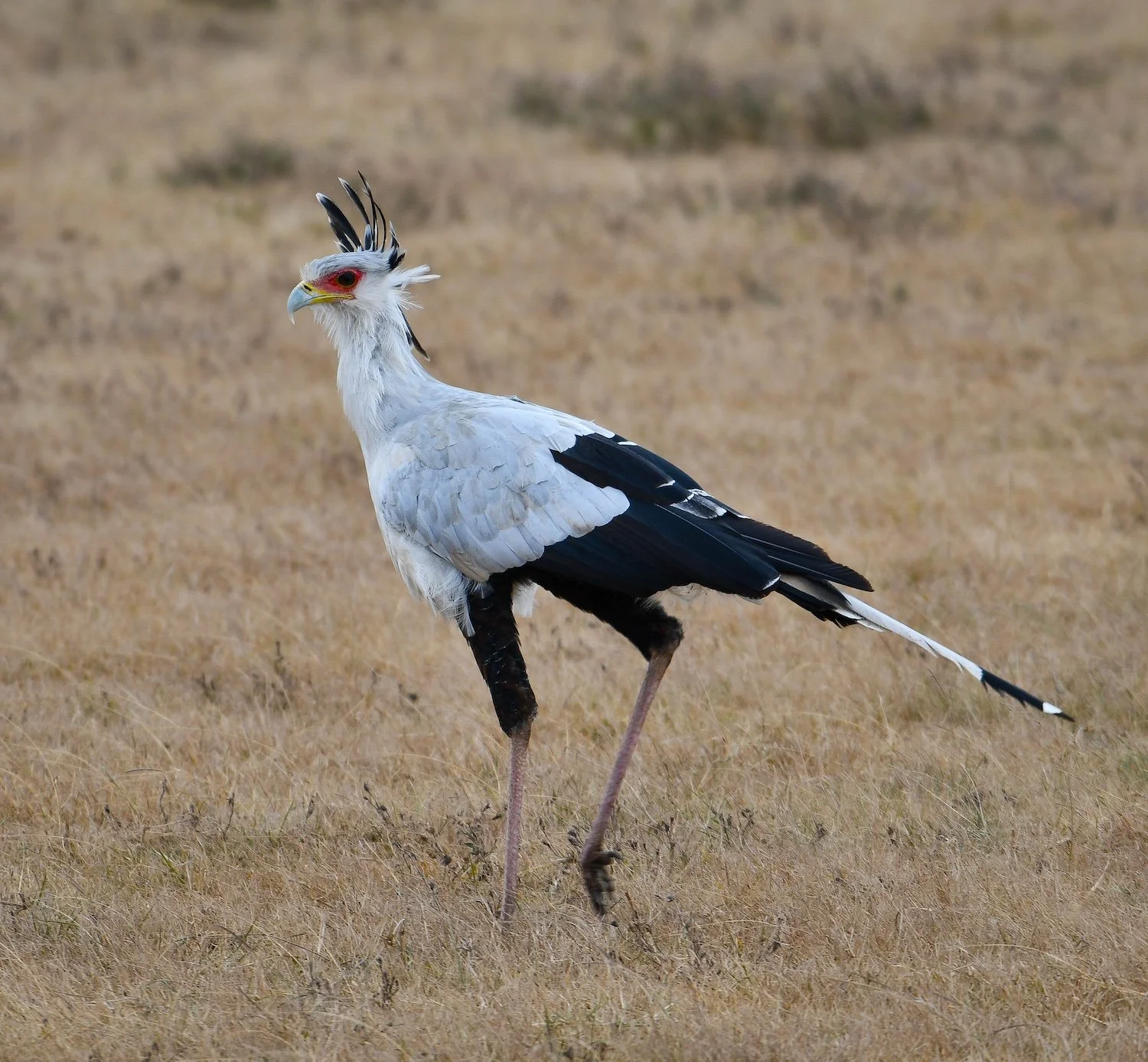
A tall Secretarybird with distinctive black head plumes walking through the tall grass of the African savannah.

The Secretarybird: An Eagle on the Legs of a Crane

Imagine the body of an eagle perched atop the long, powerful legs of a crane. That is the Secretarybird (Sagittarius serpentarius)—a fascinating biological mishmash designed for a very specific job: hunting on the savannah.

The Ultimate Snake-Fighter

Unlike most raptors that hunt from the air, the Secretarybird is a terrestrial specialist. It lopes across sub-Saharan grasslands with incredible speed, standing over one meter (3.3 feet) in height. Its hunting strategy is as effective as it is brutal:

  • The Stomp: It captures and kills snakes, rodents, and insects by delivering high-speed, powerful stomps with its dinosaur-like legs.

  • The Headgear: Easily identified by its ornate, quill-like feathered crest, it looks like a 19th-century clerk with pens tucked behind its ears—hence the name.

A Race Against Extinction

Sadly, this marvelous creature is facing a difficult future. Due to rapid habitat loss and degradation, the Secretarybird was officially added to the Endangered species list in 2020. Protecting the vast grasslands they call home is more critical now than ever.

Witness the Secretarybird in 2026

Spotting a Secretarybird strutting through the grass is a highlight for any traveler. We invite you to join us on an African safari in 2026 to see this unique raptor in its natural habitat before it's too late.

  • 2026 Safari Dates: Full. No seats are available.

  • 2027 Inquiries: We are now accepting early interest for our 2027 return to Tanzania.

For details on these and other trips, click the link here.

Why does the Stork Lack a Feathered Face?

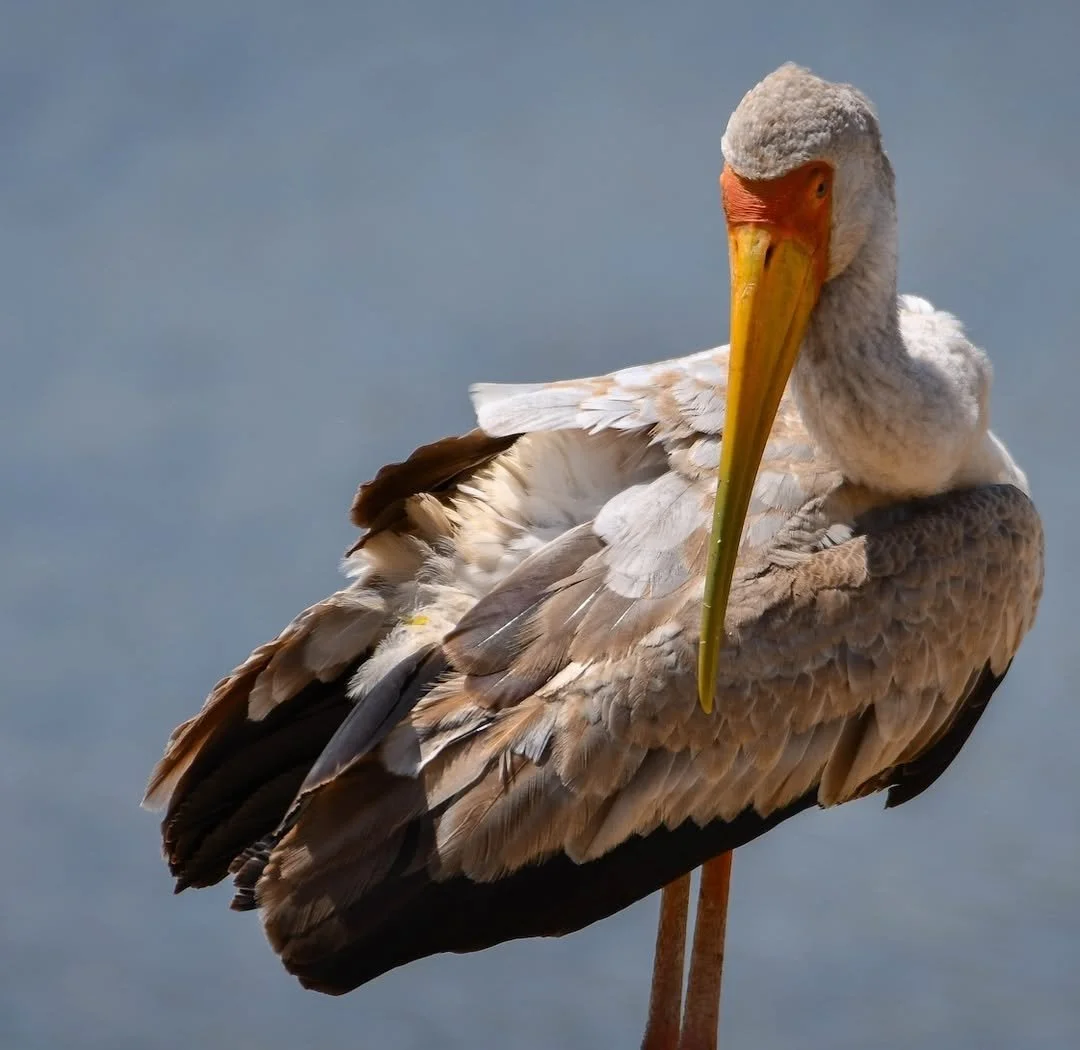
Close-up of a Yellow-billed stork in Tanzania showing its red facial skin and specialized yellow bill.

Designed for the Wild: The Secrets of the Yellow-Billed Stork

Have you ever wondered why some birds have featherless skin around their faces? This striking feature in the Yellow-billed stork (Mycteria ibis) is a masterclass in functional design, serving three critical purposes:

  1. Hygiene: Bare skin is far easier to keep clean for wader-hunters and carrion-eaters. For a bird frequently probing muddy wetlands, avoiding matted feathers is a vital health advantage.

  2. Communication: During the breeding season, the stork undergoes a dramatic transformation. Its facial skin deepens to a rich red, the yellow bill intensifies in color, the legs turn bright pink, and even the feathers take on a subtle rosy tinge.

  3. Thermoregulation: Featherless skin helps dissipate heat. While perhaps less significant on a small face, this heat-dumping strategy is a well-documented factor in the bare skin of their long legs.

All in all, it is a brilliant design that allows this bird to thrive in the heat of the East African savannah.

Spot the Yellow-Billed Stork in Tanzania

I photographed this vibrant specimen in Tanzania, where they are a staple of the local wetlands. If you want to witness the "pinkish tinge" and brilliant red faces of these birds for yourself, we invite you to join us on the trail.

  • 2026 Safari: Our current schedule is fully booked, but we are maintaining a waitlist.

  • 2027 Expeditions: We are officially accepting reservations for a 2027 Tanzania Safari. Email us here.

And of course, if you want to read more about the Yellow-billed stork, check out our posts here and here.
Stuck in the Mud on Safari

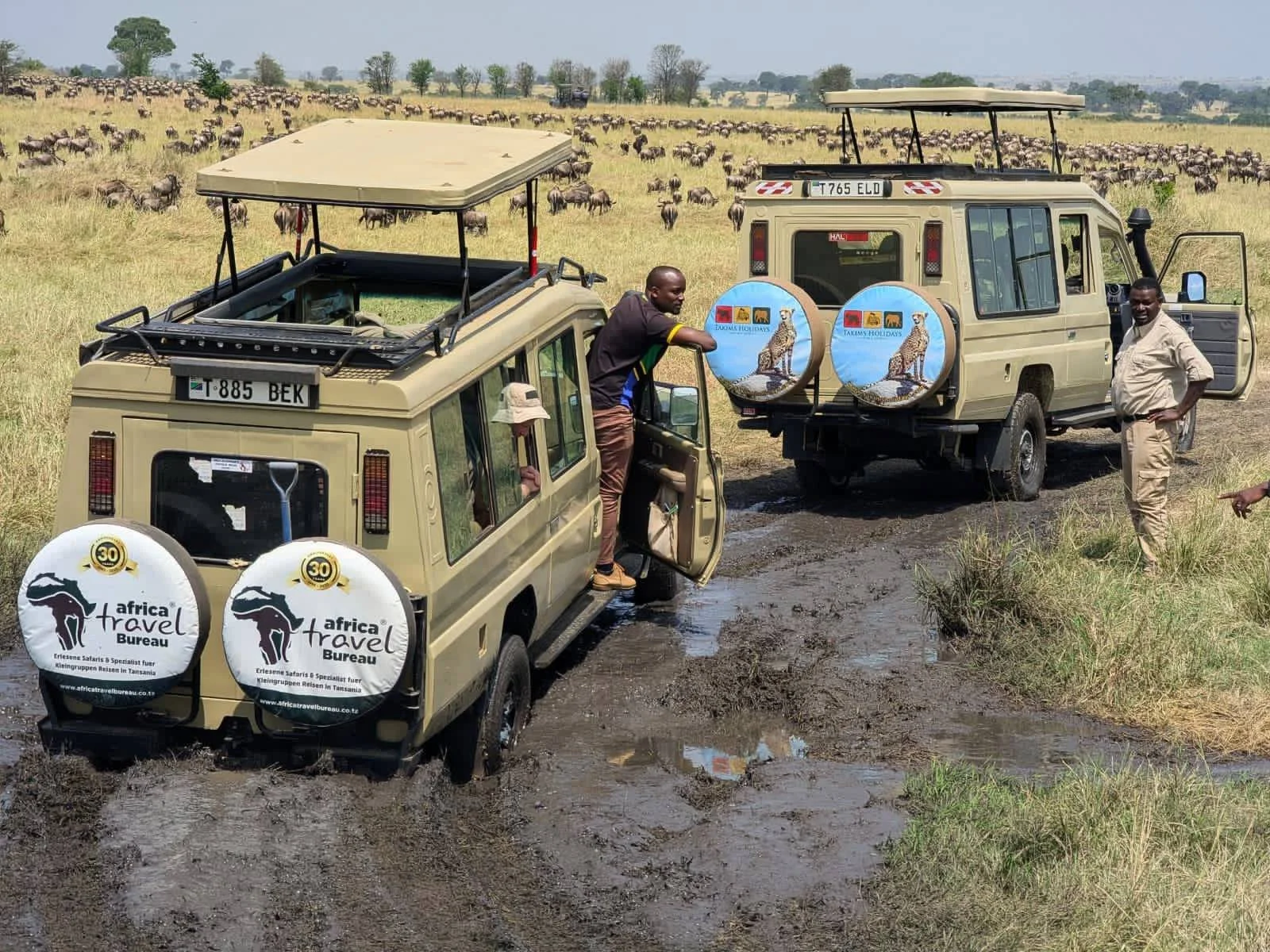
Sometimes it happens.

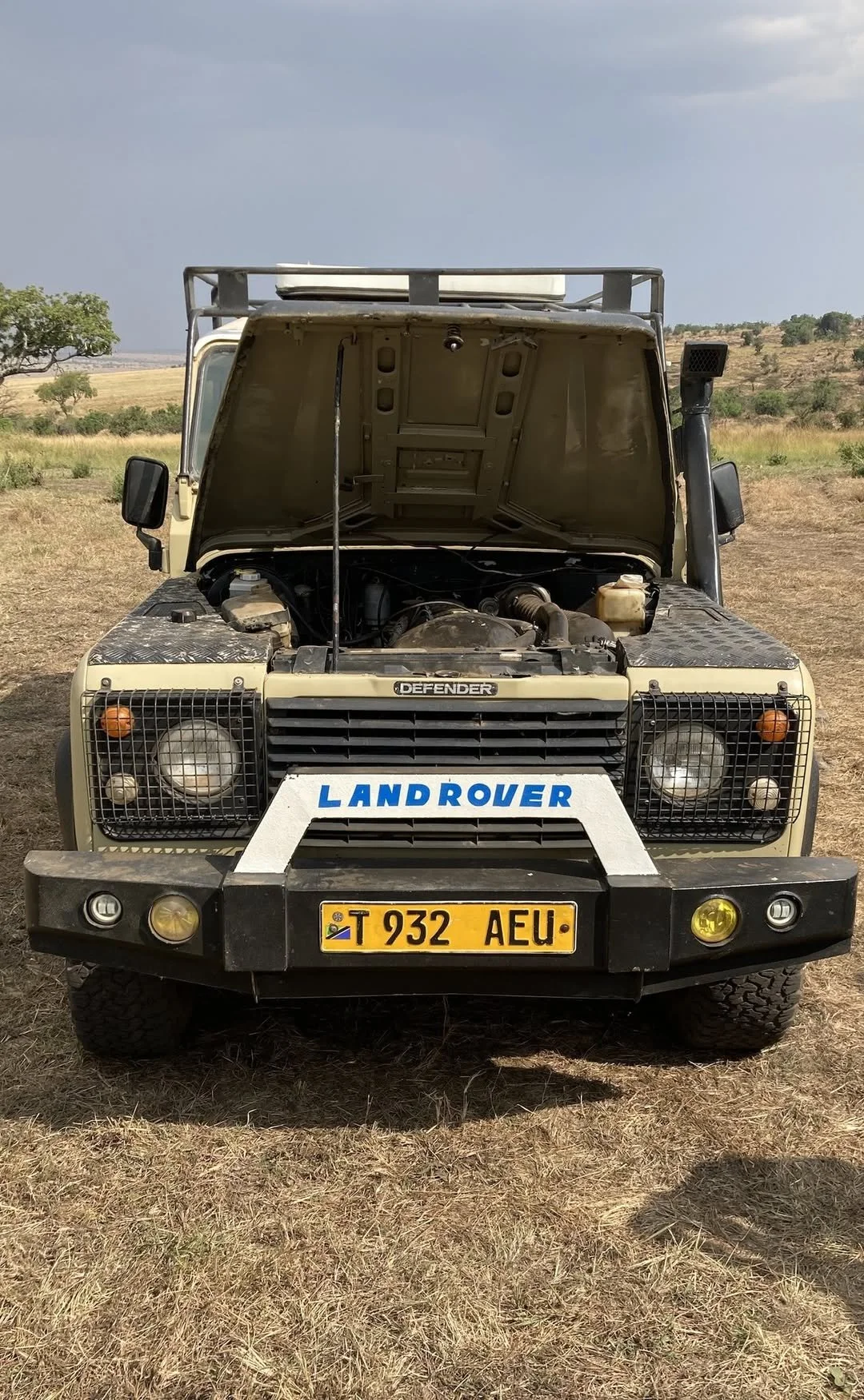
Yes, that is us stuck in the mud. And yes, the wildebeests in the distance are a part of "the Great Migration."

Fortunately, we found one friend to pull us out and another to celebrate our predicament with a photograph. Our driver, Emmanuel, endured a few chuckles and chortles.

I helped by providing keen analysis from the side window.

If you have a keen eye for bush rigs, check out this post here.

The Clever Spotted Hyena: Intelligence & Scavenging at Lake Magadi

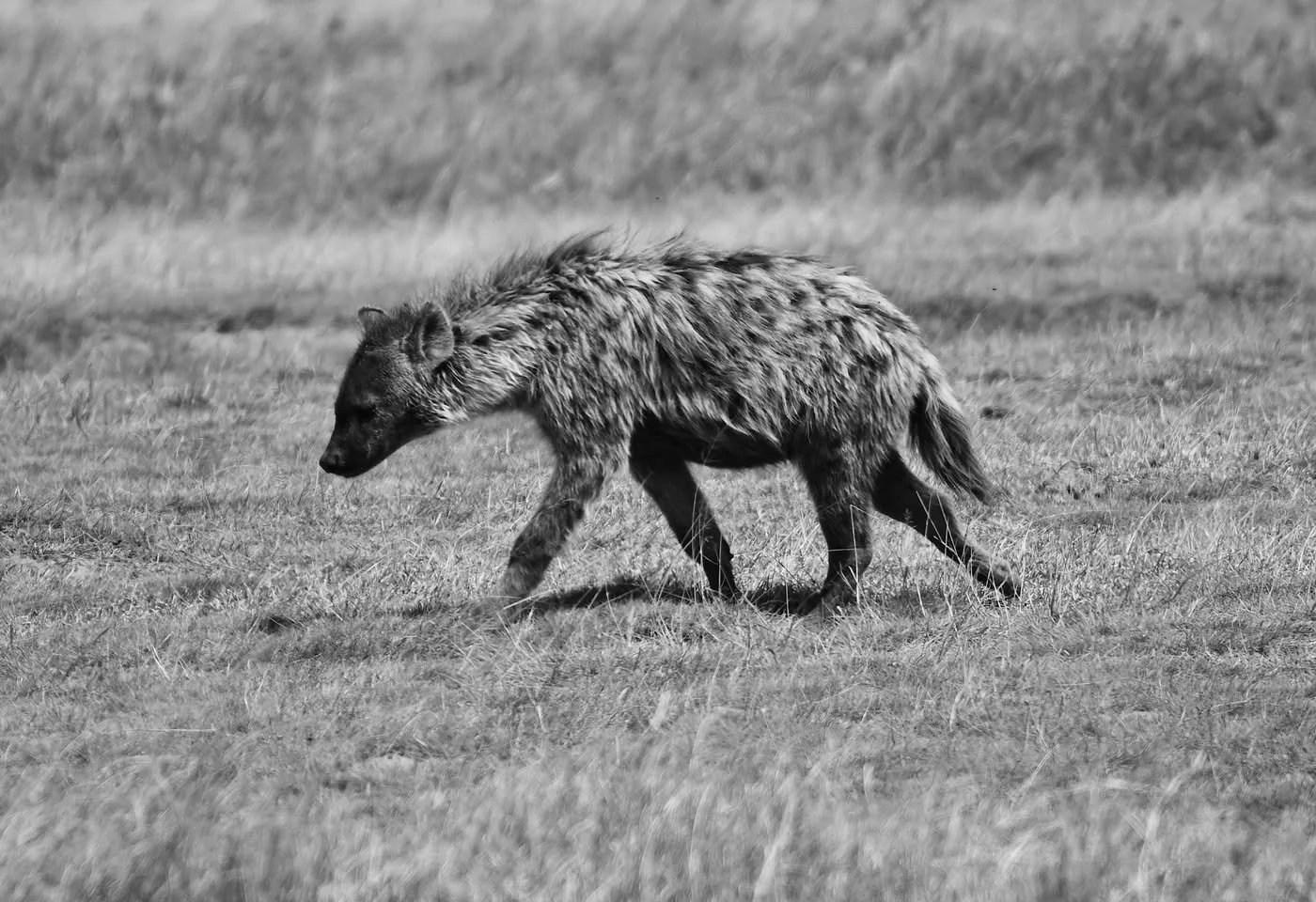
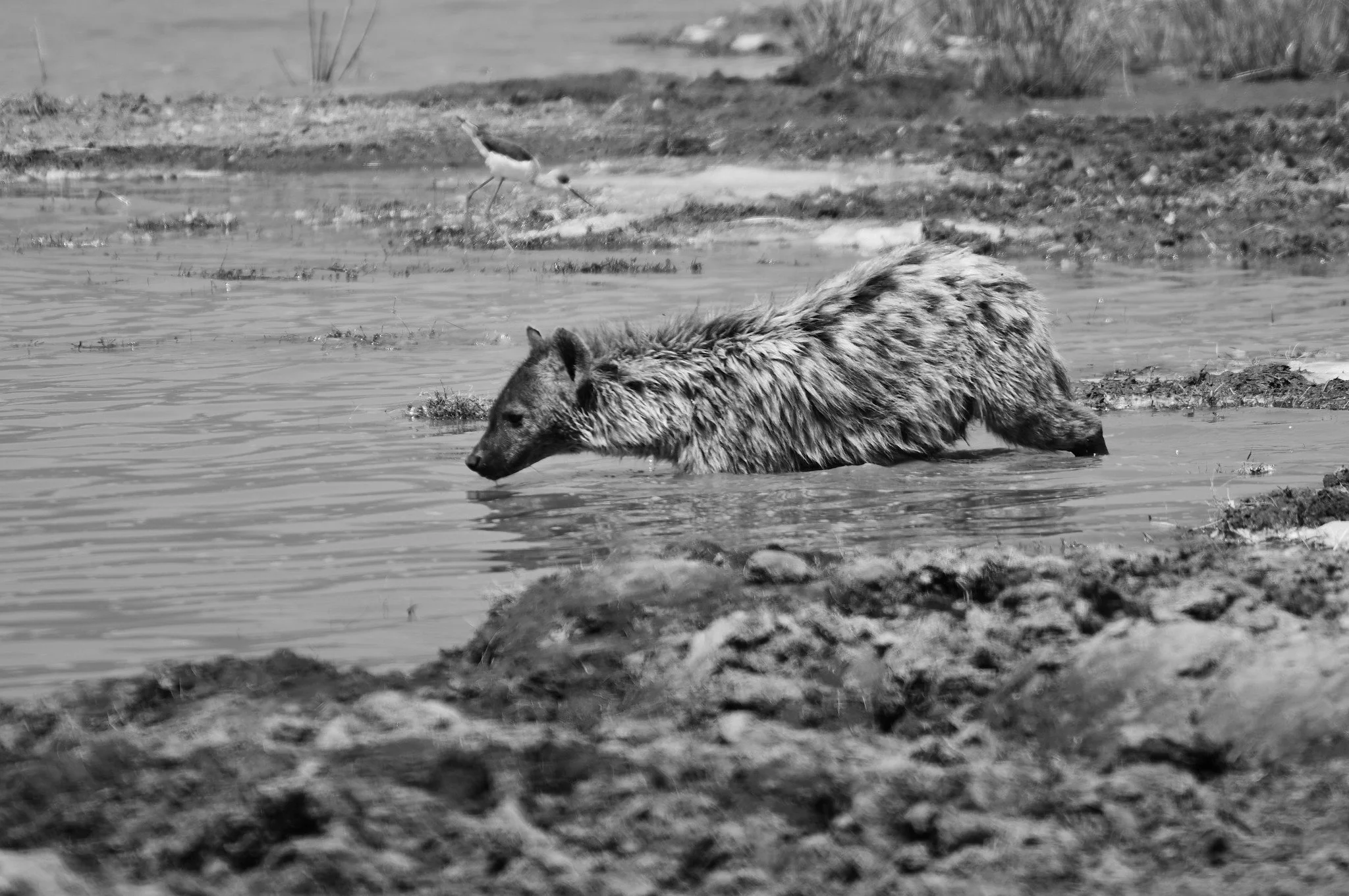
A spotted hyena makes its way to the edge of the Lake Magadi.

Clean-Up Patrol: The Surprising Intellect of the Spotted Hyena

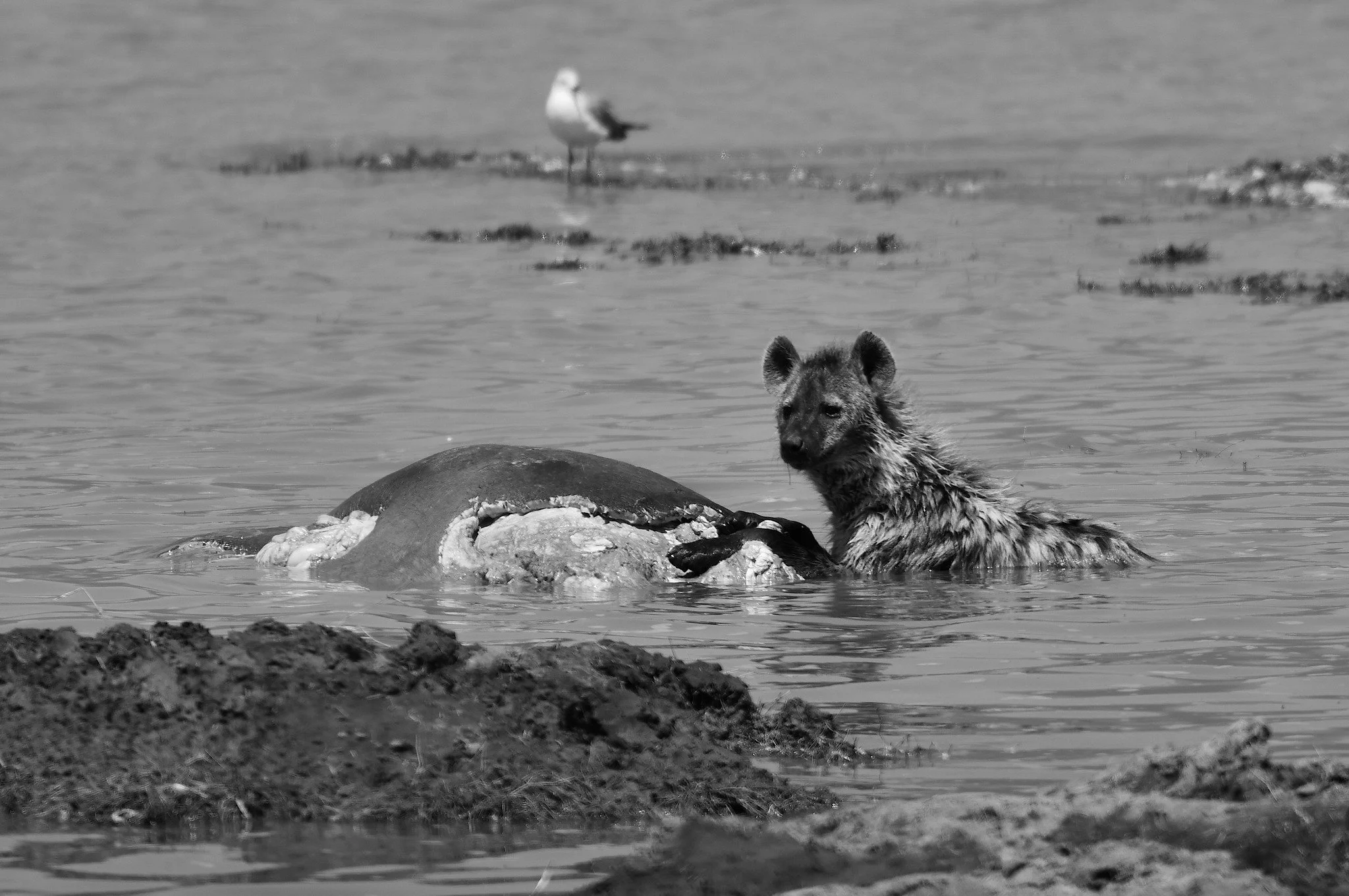
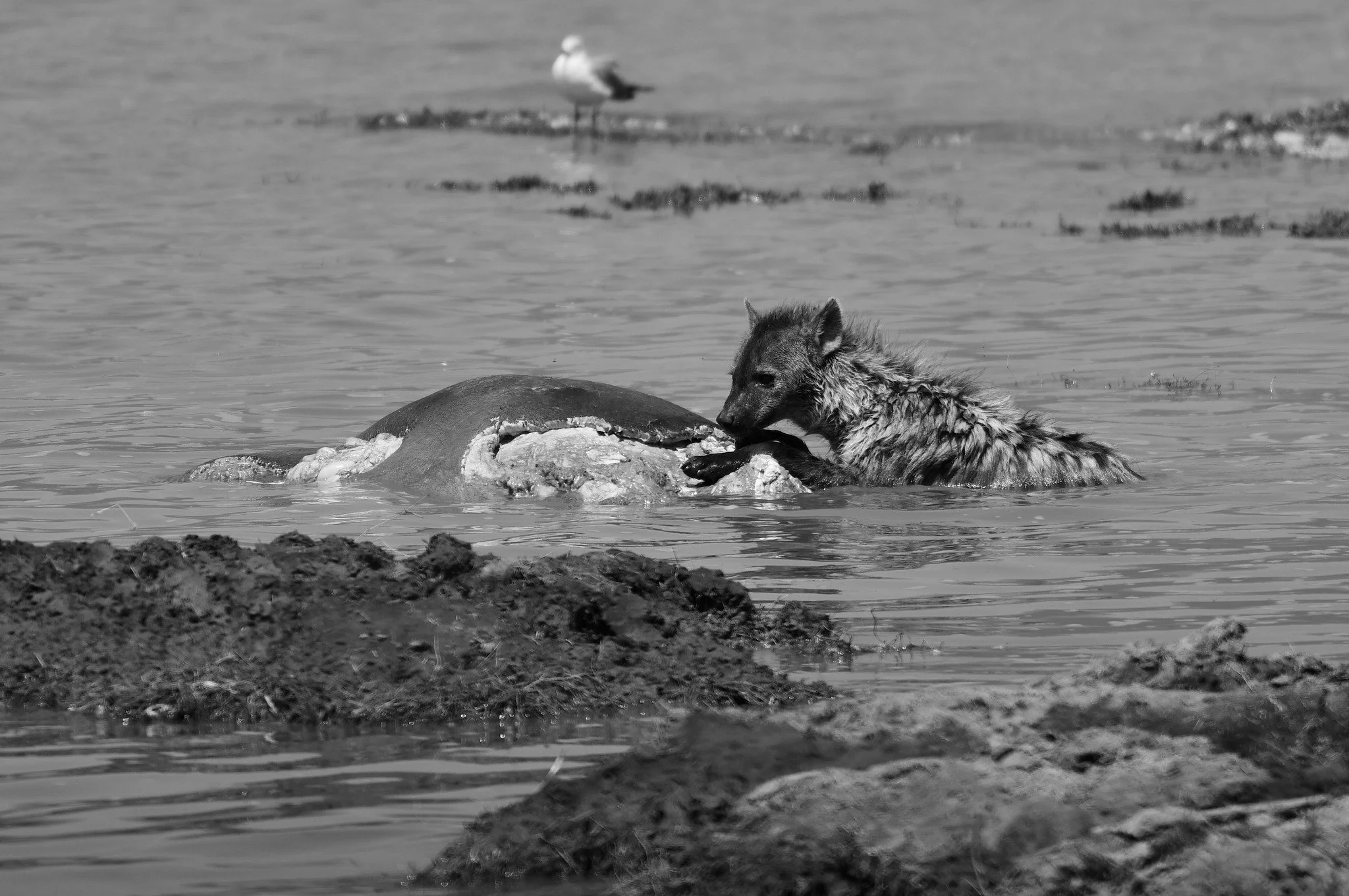
Meet the “clean-up patrol” of the African savannah. Here, a spotted hyena (Crocuta crocuta) feeds on a hippo carcass along the stark, alkaline shores of Lake Magadi, Tanzania.

While often maligned, the spotted hyena is one of the most successful and opportunistic scavengers—and hunters—in the world. But their physical toughness isn't their only weapon; their minds are equally sharp.

Entering the lapping waves of this soda lake.

Outsmarting the Great Apes

The hyena's reputation as a mindless scavenger is far from the truth. In laboratory problem-solving tests, the spotted hyena has been shown to outsmart chimpanzees in certain cooperative tasks. They possess a complex social intelligence and a level of strategic thinking that rivals many primates.

I guess these brilliant creatures just need a better PR representative!

Witness the Wild at Lake Magadi

Located in the heart of the Ngorongoro Crater, Lake Magadi is a prime spot to witness the raw drama of the food chain. From hyenas on patrol to vast flocks of flamingos, the biodiversity here is unmatched.

The bloated carcass of a dead hippo rests in the shallows. (Now you know why we’re shooting black and white!).

Safari With Us in 2027

Our 2026 expeditions are currently at capacity, but we are officially angling for a return to the Serengeti and Ngorongoro in 2027.

  • 2027 Booking Status: Early reservations are highly encouraged. Email us here.

  • Experience the Drama: See the clever spotted hyena in its natural habitat.

For a glimpse of travel opportunities, see the list of our future trips here.

To learn more about Ngorongoro, see our post, Standing on the Edge: The Breathtaking Rim of Ngorongoro Crater

To learn more about the Spotted hyena, see our post, Ngorongoro's Matriarchs: The Secret Society of Spotted Hyenas

Hyena and hippo carcass. Scavengers do what scavengers do.

See another post on the Spotted hyena here.

Thomson’s Gazelle: The Serengeti’s Speedster

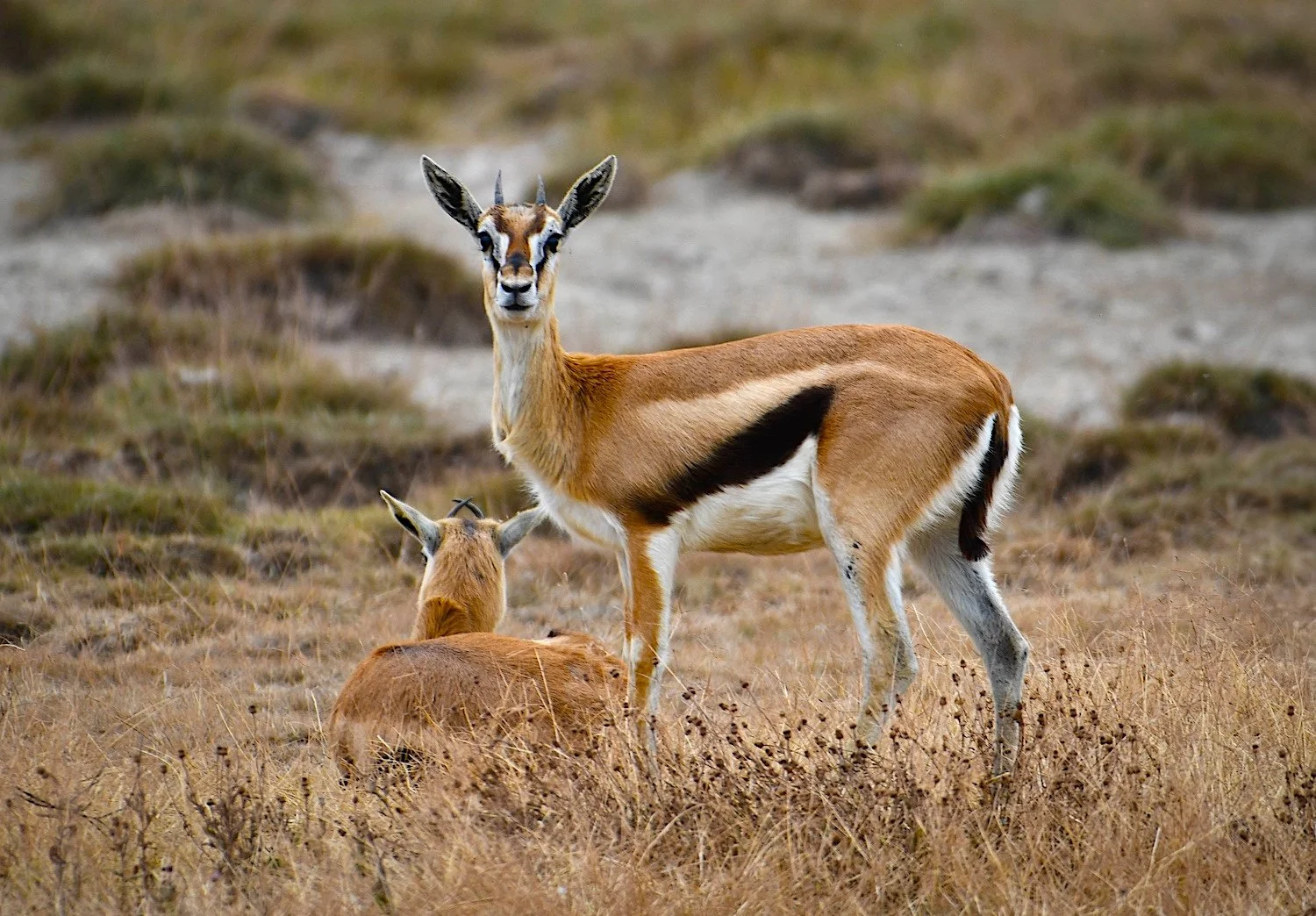
A group of Thomson’s gazelles (Tommies) with distinct black side stripes resting in the golden grass of the Serengeti.

The Serengeti Speedsters: Racing Stripes and 40 MPH Sprints

They have racing stripes for a reason.

Clocked at a blistering 40 mph, the Thomson’s gazelle (Eudorcas thomsonii) is officially the fourth fastest land animal on the planet. It’s no coincidence that these spry antelopes thrive in the same habitat as the cheetah—the world’s fastest animal, capable of bursts exceeding 65 mph.

In the open plains, speed is a survival requirement. For these "Tommies," a well-timed juke, a sudden jump, or a high-speed "stotting" leap can mean the difference between life and death. I spotted this particular group recharging their batteries in the heart of the Serengeti after a morning of high-stakes grazing.

Witness the Great Migration Sprints

Watching a Thomson’s gazelle evade a predator is one of the most electric sights on an African safari. If you want to cheer on these sprinters in person, the clock is ticking for our next expedition.

  • Final Call for Registration: Enrollment for our upcoming safari closes on December 5, 2025.

  • Limited Availability: Only a few seats remain for this 2026 journey into the wild.

  • Plan now for 2027. Email here to reserve your seat for the fastest show on earth.

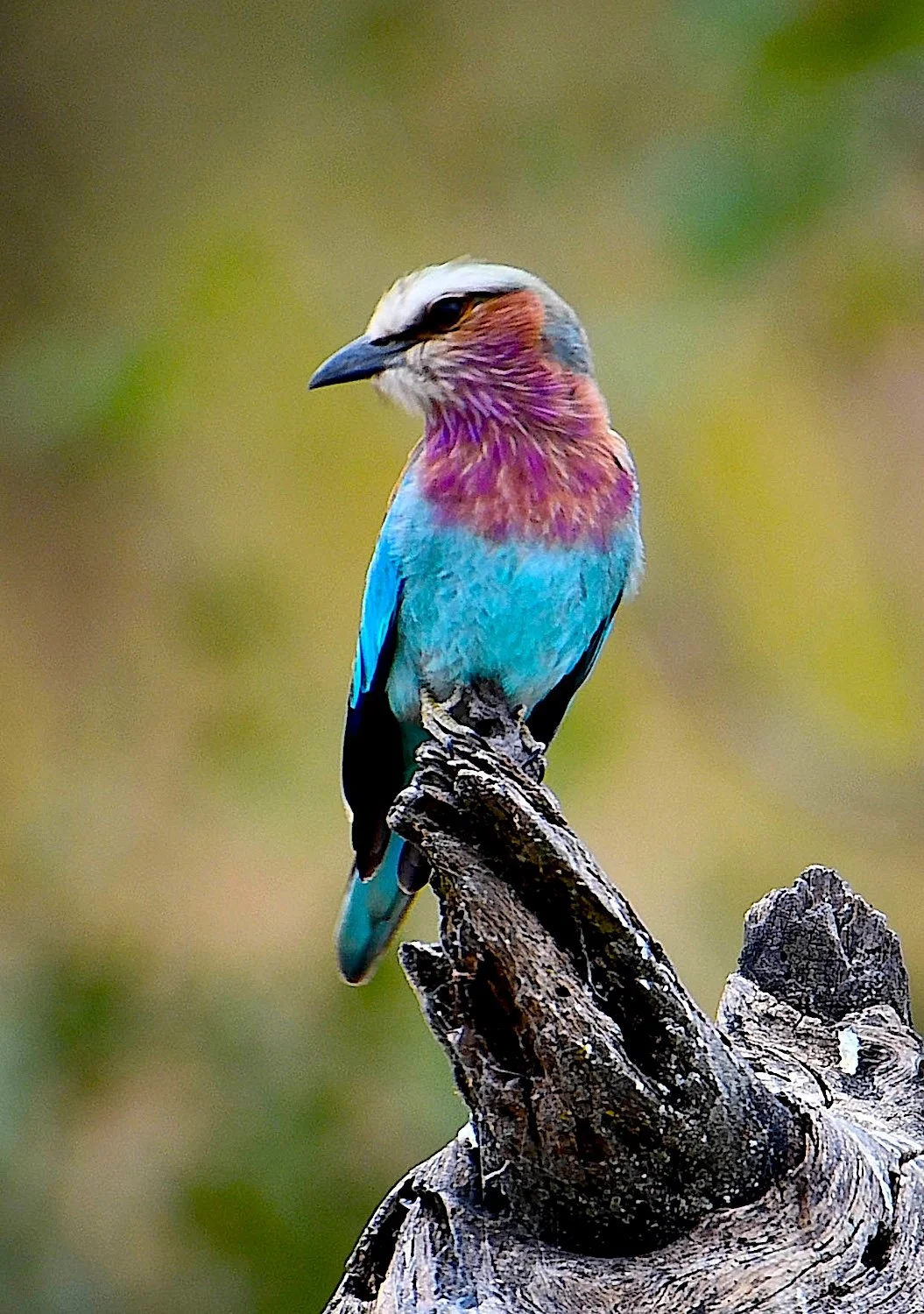
The Lilac-breasted Roller: Africa’s Eight-color Bird

A Lilac-breasted roller perched on a branch, showcasing its vibrant lilac chest and turquoise wings in the African sunlight.

The Eight-Colored Wonder: Africa’s Lilac-Breasted Roller

The Lilac-breasted roller (Coracias caudatus) is a living rainbow of the savannah. This stunning bird sports eight distinct colors: green, white, black, yellow, turquoise, dark blue, reddish-brown, and—of course—its namesake lilac.

On the National Geographic Wildlife Guide, it's often noted that these birds are as fierce as they are beautiful, frequently diving from high perches to snatch up insects and even small lizards.

In my experience, it is the only "little bird" that consistently provokes safarists to "oooh and aaah" with the same intensity they save for a cheetah or a lion! Whether it’s perched stoically on a thorn bush or showing off its brilliant blue wings in flight, it is a photographer’s dream.

Photograph the "Gem of the Savannah" in 2026

Are you ready to capture the vibrant colors of the African bush through your own lens? We are returning to the best birding habitats in East Africa next year.

  • 2026 Safari Dates: Join our Tanzania Safari Expedition to see birds and more.

  • Booking Info: Limited spots remain for our upcoming season. Check our list of destinations and dates for future curated travel here.

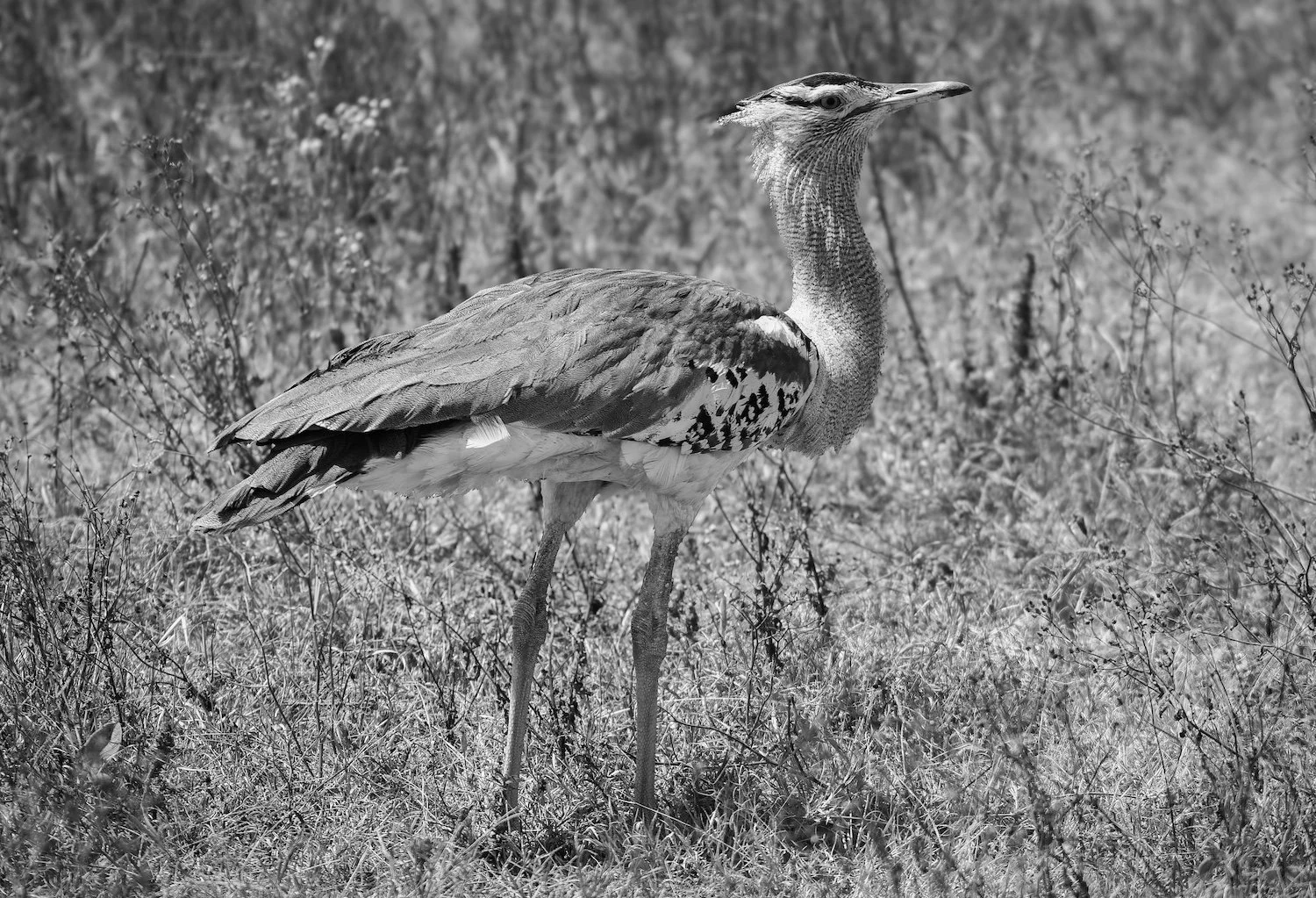
The Kori Bustard: Africa’s Heaviest Flying Bird

The Kori Bustard: Meeting Africa’s Heavyweight Flyer

The Kori Bustard (Ardeotis kori) is an absolute bruiser of the bird world. A mature male can weigh up to 40 pounds, officially making it the heaviest bird in Africa capable of flight.

Watching one take off is like watching a rumbling C-5 transport plane. It isn't exactly a graceful "launch"; the slow, rhythmic beat of its massive 9-foot wingspan takes considerable effort, but it eventually lifts this big boy aloft into the African sky.

Spotting Giants in the Ngorongoro Crater

I spotted this impressive specimen in the Ngorongoro Crater, Tanzania. While I wish I had a scale in the frame to truly illustrate its size, I chose to process this image in black and white to better highlight the bird's incredibly complicated plumage and neck markings.

Witness the "Heavyweight" of the Savannah

Standing 4 to 5 feet tall, the Kori Bustard is a prehistoric-looking marvel that every safari-goer should see at least once.

  • 2026 Expeditions: Our current tour dates are nearly full—check for last-minute availability!

  • 2027 Safari Planning: We are officially booking for our 2027 return to Tanzania. Email for details here.

There’s only one bird on the Serengeti that is bigger than a bustard. Meet him here!

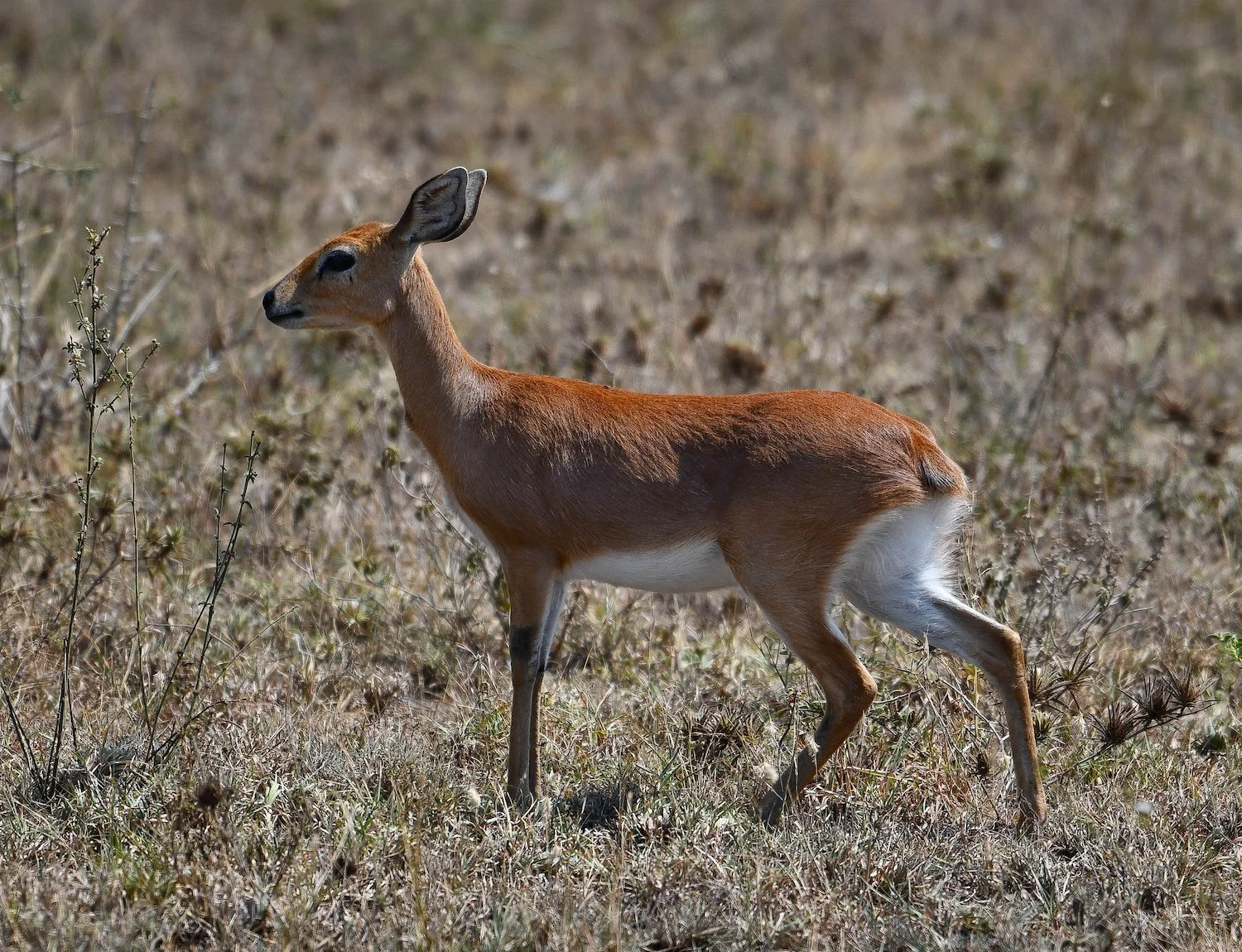
The Steenbok: Discovering Africa’s "Brick" Dwarf Antelope

A petite female Steenbok with large ears standing in the grass of the Serengeti, Tanzania.

The Steenbok: A Petite Treasure of the African Savannah

The Steenbok (Raphicerus campestris) is one of Africa’s most charming "petite treasures." Its name is derived from the Afrikaans word for "stone" or "brick," a nod to the distinct reddish-brown (brick-colored) coat that helps it blend into the arid landscapes.

Tiny but Tough: Steenbok Facts

Don’t let its size fool you. While a mature adult stands only about 20 inches at the shoulder and weighs roughly 25 pounds, the Steenbok is a master of survival.

  • Distinctive Features: They are easily identified by their oversized, sensitive ears and—in the case of males—short, needle-like upright horns.

  • Survival Tactics: When threatened, a Steenbok’s first instinct is to crouch low and hide in the grass. If discovered, it utilizes a high-speed zig-zag sprint to evade predators.

Spotting the "Small Five" in the Serengeti

We spotted this beautiful female during our recent trek through the Serengeti, Tanzania. While most people come for the lions and elephants, it’s often these smaller, delicate creatures that provide the most magical moments on a game drive.

Safari With Us in 2026 & 2027

Are you ready to discover the hidden side of the African bush? We are currently finalizing our upcoming expeditions:

  • 2026 Safaris: All seats reserved. Reservations closed.

  • 2027: We are officially fielding early inquiries for 2027. Email us here to reserve your seat.