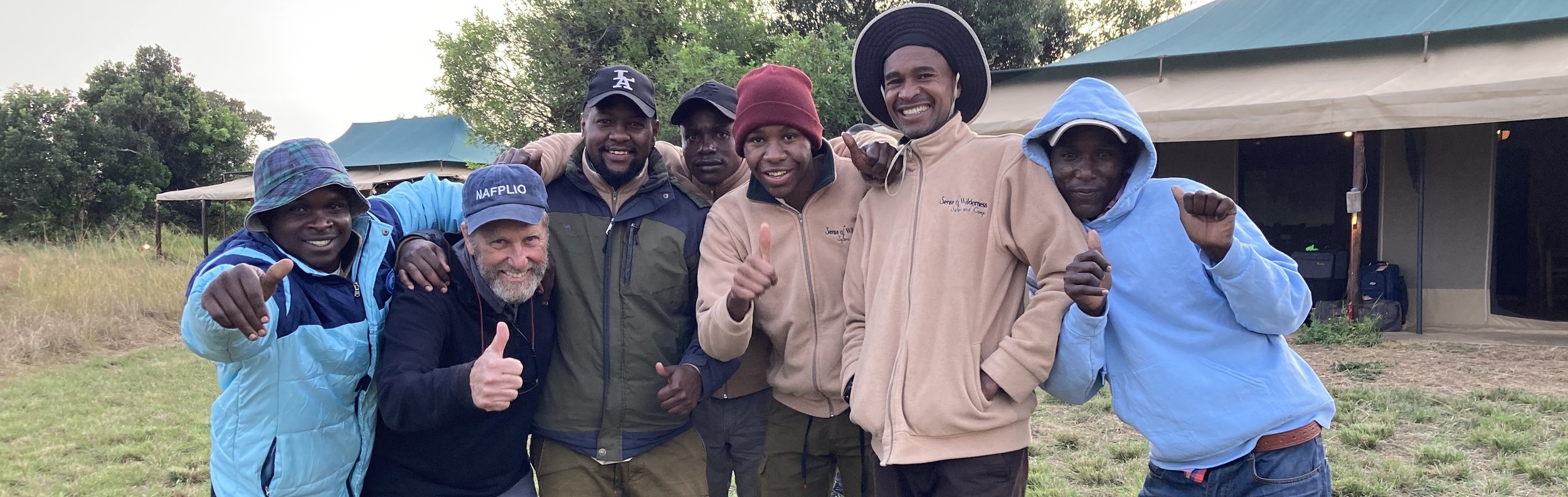
A big rain knocks us down on Safari. Now we wait for the river to drop before we move.
Sunset Cruise off the coast of Stone Town, Zanzibar
Our musicians on the water created a memorable moment for us on this sunset Dhow ride.
David Livingstone's House
Livingstone's House is a symbol of the era of exploration and empire. It reminds us of a time when Zanzibar was the gateway to an entire continent.
Hildebrandt’s Starling: The Colorful African Cousin of the Common Starling
Hildebrandt’s Starling with orange eyes and iridescent blue feathers in Serengeti National Park, Tanzania.
Meeting the Hildebrandt’s Starling: An Uncommon African Beauty
Sometimes a change in geography will change your perspective on a “pest.” Moving from the muted, iridescent black of the North American starling to the vivid burnt-orange and iridescent blues of Hildebrandt’s Starling is quite the visual upgrade!
Where to Find Hildebrandt’s Starling
This lovely avian (Lamprotornis hildebrandti) is found only in the the modern countries of Kenya and Tanzania. While some call it uncommon, the IUCN considers the population stable and of “Least Concern.” I spotted the one pictured above loitering in a picnic park in the central Serengeti.
This starling is a medium sized bird (about 7 inches in length). It sports a purple-blue head and wings. Chest, belly, and—most strikingly—its eyes, are orange.
History and Habitat
Hildebrandt’s starling is named after Johann Maria Hildebrandt, an east African explorer, naturalist, and collector of the 19th century. He was the first to identify this species, often found in woodlands and savannahs between 1,600 and 7,200 ft.
This colorful forager eats insects and fruit and often feeds on the ground. This one was watching for picnic crumbs.
Hildebrandt’s vs. Superb Starling: How to Tell Them Apart
Hildebrandt’s starling should not be confused with the Superb starling, though they may be confused at a glance.
How to distinguish a Hildebrandt’s from a Superb Starling:
Eye Color: Hildebrandt’s has striking orange eyes, whereas the Superb has bright white eyes.
Chest Marking: The Superb starling features a distinct white breast band; the Hildebrandt’s chest is solid orange-buff.
Plumage: Hildebrandt’s typically displays a more uniform, deep iridescent blue-purple on the upperparts.
Compare them yourself by checking our posts on the Superb starling here and here.
See Hildebrandt’s starling for yourself
If birds are of interest to you, East Africa needs to be on your bucket list. Email us here for details about our 2027 Tanzania safari.
Why does the Stork Lack a Feathered Face?
Close-up of a Yellow-billed stork in Tanzania showing its red facial skin and specialized yellow bill.
Designed for the Wild: The Secrets of the Yellow-Billed Stork
Have you ever wondered why some birds have featherless skin around their faces? This striking feature in the Yellow-billed stork (Mycteria ibis) is a masterclass in functional design, serving three critical purposes:
Hygiene: Bare skin is far easier to keep clean for wader-hunters and carrion-eaters. For a bird frequently probing muddy wetlands, avoiding matted feathers is a vital health advantage.
Communication: During the breeding season, the stork undergoes a dramatic transformation. Its facial skin deepens to a rich red, the yellow bill intensifies in color, the legs turn bright pink, and even the feathers take on a subtle rosy tinge.
Thermoregulation: Featherless skin helps dissipate heat. While perhaps less significant on a small face, this heat-dumping strategy is a well-documented factor in the bare skin of their long legs.
All in all, it is a brilliant design that allows this bird to thrive in the heat of the East African savannah.
Spot the Yellow-Billed Stork in Tanzania
I photographed this vibrant specimen in Tanzania, where they are a staple of the local wetlands. If you want to witness the "pinkish tinge" and brilliant red faces of these birds for yourself, we invite you to join us on the trail.
2026 Safari: Our current schedule is fully booked, but we are maintaining a waitlist.
2027 Expeditions: We are officially accepting reservations for a 2027 Tanzania Safari. Email us here.
And of course, if you want to read more about the Yellow-billed stork, check out our posts here and here.
The Mara River Crossing
Large herd of wildebeest and zebra gathering at the edge of the Mara River during the Great Migration.
The Greatest Show on Earth: Witnessing the Great Migration
There is no sound quite like it—the thunder of over two million hooves hitting the dust-baked earth of East Africa.
We recently stood on the banks of the Mara River, the natural border between Tanzania’s Serengeti and Kenya’s Maasai Mara, to witness the Great Migration. Known as the largest mass movement of land mammals on the planet, this isn't just a trek; it’s a high-stakes drama of survival, instinct, and raw power.
The Chaos of the Mara River Crossing
The herds of wildebeest and zebra gather by the thousands at the river’s edge. There is a palpable tension in the air as they wait for one brave leader to take the plunge. When they finally go, it’s a spectacle of:
Adrenaline: Watching thousands of animals navigate steep cliffs and "slapping waves."
Nature’s Gauntlet: The Mara River is home to some of Africa’s largest Nile crocodiles, waiting for the crossing to begin.
The Symbiosis: Notice how the zebras and wildebeests travel together; zebras have excellent memory for the migration route, while wildebeests can scent water from miles away.
A massive herd of blue wildebeest and zebras charge up and out the Mara River during the Great Migration.
North for Feeding, South for Birthing
The Great Migration is a relentless circular journey of about 1,200 miles. The herd follows the rains in a constant search for greener pastures:
The North (Feeding & Breeding): During the winter months, the herd pushes north into the Maasai Mara to graze and breed.
The South (Birthing): In the summer, the rhythm shifts as they move south into the Serengeti for the calving season.
At either end of the calendar, it is a spectacle to behold. In 2024 and 2025, we had the incredible opportunity—as the photo above demonstrates—to witness the intensity of the Mara River crossing. Looking ahead, we anticipate arriving in 2026 specifically for the birthing season (stay tuned for future posts on that incredible sight!), intense for a different set of reasons.
Join Us on Safari!
We don't just want to tell you about it; we want you to see it for yourself. The sight of the herd stretching across horizon is a soul-stirring experience that stays with you forever.
Ready to check the Serengeti off your bucket list?
We are currently making plans to witness the Great Migration again in 2027, and we’d love for you to join our caravan. Email us here to get the first opportunity at seats when registration opens!
Our Knobby Tyres
The success of our African safaris rests on knobby tires and good wheelmen.
On the trail of the Great Migration
The stream of wildebeests and zebras flowed north toward the Kenyan border. We followed it.