Discover the Blacksmith lapwing, one of Southern Africa’s most iconic waders. Learn about the unique "flopping" flight of the Vanellus genus and why these blunt-tipped birds are a challenge for predators and photographers to track.
Green Theology from Ngorongoro
Colonel Coke’s Hartebeest: Africa’s Unusual Antelope
The Night Shift: Getting to Know the Black-crowned Night-Heron
Why do Leopards Dangle So?
The Grey Crowned Crane: A Royal Portrait
Klaus vs. the Cheetah: The Surprising Engineering of a Big Cat’s Face
Left-Handed or Right-Handed? The Secret of the African Elephant’s “Master Tusk”
And Then Our Eyes Met: A Serengeti Encounter
The leopard's face is defined by a mesmerizing pattern of black “rosettes” and spots of various sizes that provide the perfect camouflage against the dappled light of the African bush. Its piercing eyes are built for precision, containing a specialized layer that reflects light to grant the cat extraordinary night vision . . .
What’s a Hippo Tail good for?
The Bill of the Pied Avocet
Spotted on the Serengeti: A Rare Moment with a Cheetah Mother and Her Cubs
The Outlandish Outfit of the Topi
The Price of Preservation: The Serengeti's Complex History
Why So Fluffy? Understanding the “Rouse” of the Grey Crowned Crane
Welcome to the Mob: Mongoose Style
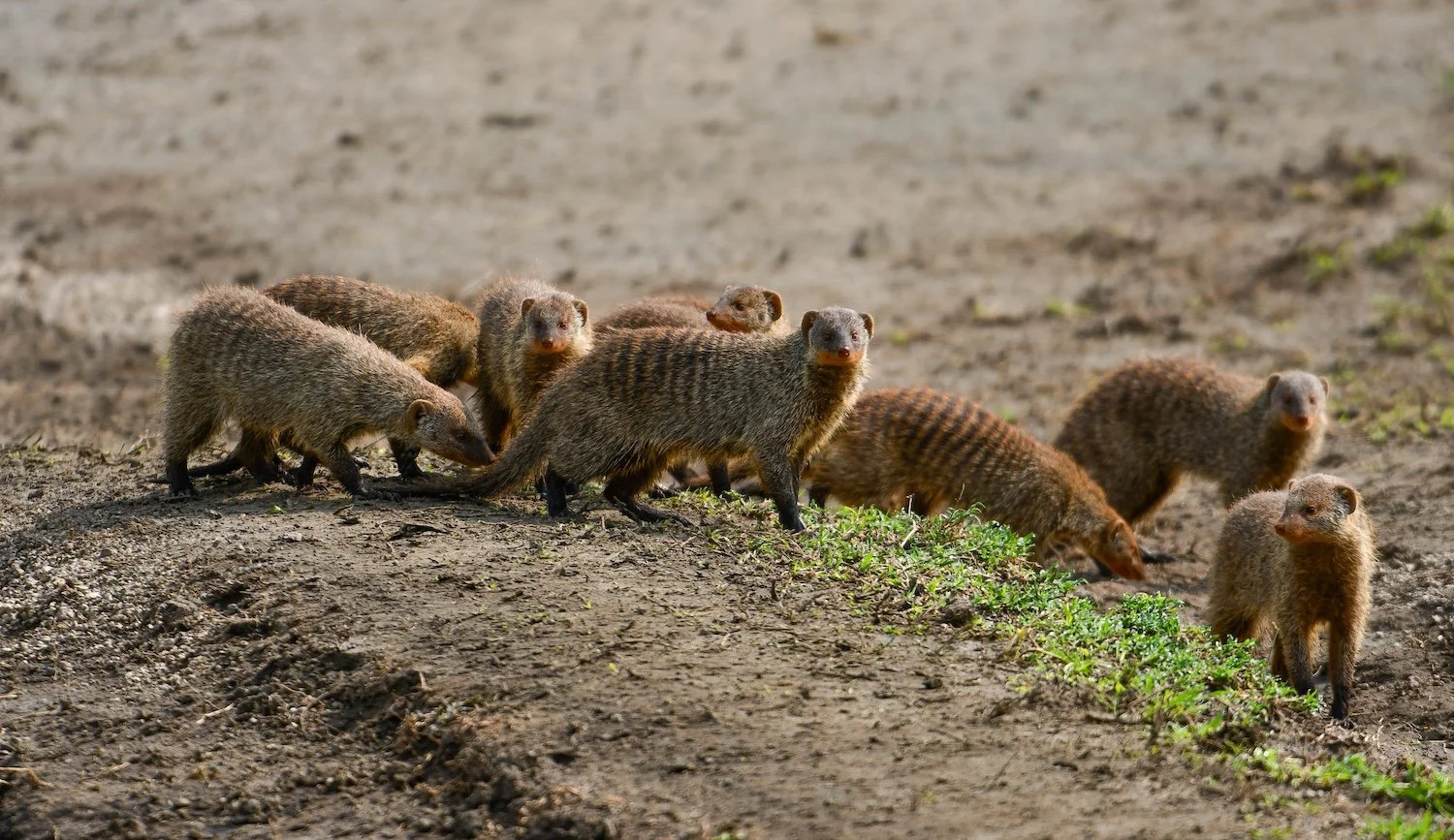
A banded mongoose mob pauses for a look on the Serengeti.
Odd Mob behavior
So a group of Banded Mongooses (Mungos mungo) is called a “mob.” And the size of a mongoose mob averages about 20 individuals. But when birthing time rolls around, mongoose mob behavior is, shall we say, most interesting.
For starters, males have no luck trying to control female reproduction. During estrus, females aggressively seek out multiple partners—sometimes even making daring trips to rival mobs to find a mate!
A One-Night Birthing Extravaganza
All this friskiness makes the next fact even more amazing: all females in a single mob give birth to their young in the same night. Just imagine!
Reasons for this can be guessed at of course, but the end result is that mongoose mob moms don’t seem to mind. They may even be slightly relieved because in this odd mob world, care for the young is shared by all the group. Because all the pups are born on the same night and share a communal den, mongoose moms can't tell which pups are biologically theirs. No pup gets preferential treatment, since nobody seems to remember who belongs to whom.
I know what you’re thinking: those little weasels!* But consider this.
Enter the “Consigliere”
When a pup is about a month old it seeks out a mentor. Usually an older male. Experts in this stuff call this mentor an “escort.” The pup and his/her escort are then inseparable for the next two months. During this time, the escort tutors his little cugine in all sorts of wonderful things like how to wack insects, throw eggs/shells against rocks to break them open for yumminess (curiously, they hike them between their rear legs like a football), social communication skills, warning signals and fleeing tactics (eagles and jackals lurk everywhere) and other critical survival skills (I just want to know about snake fighting).
After graduation, the two part ways. Bada bing, bada boom. This youngsta is a gangsta.
So while the start-up in the world of the mongoose mob is a bit unsettling, don’t you think the mentoring relationship is rather keen?
*Mongooses and weasels look alike but belong to separate biologica families. Mongooses are “cat-like” carnivores from the Feliformia family and are related to meerkats. Weasels are “dog-like” carnivores in the Mustelidae family, which also includes badgers, otters, and wolverines.
For more on this interesting animal, see our post “Snakes, Bugs, and a Biblical Mystery. Meet the Banded Mongoose.”
Bible Land Explorers are headed back to Tanzania June 3-13, 2027. Lake Victoria, the Serengeti, and Ngorongoro Crater, are on our agenda as we photo-hunt big cats, small birds, and everything in-between. We are now receiving early registrations for this exclusive small-group adventure. See the link here for brochure and more information or email us at BibleLandExplorer@gmail.com.