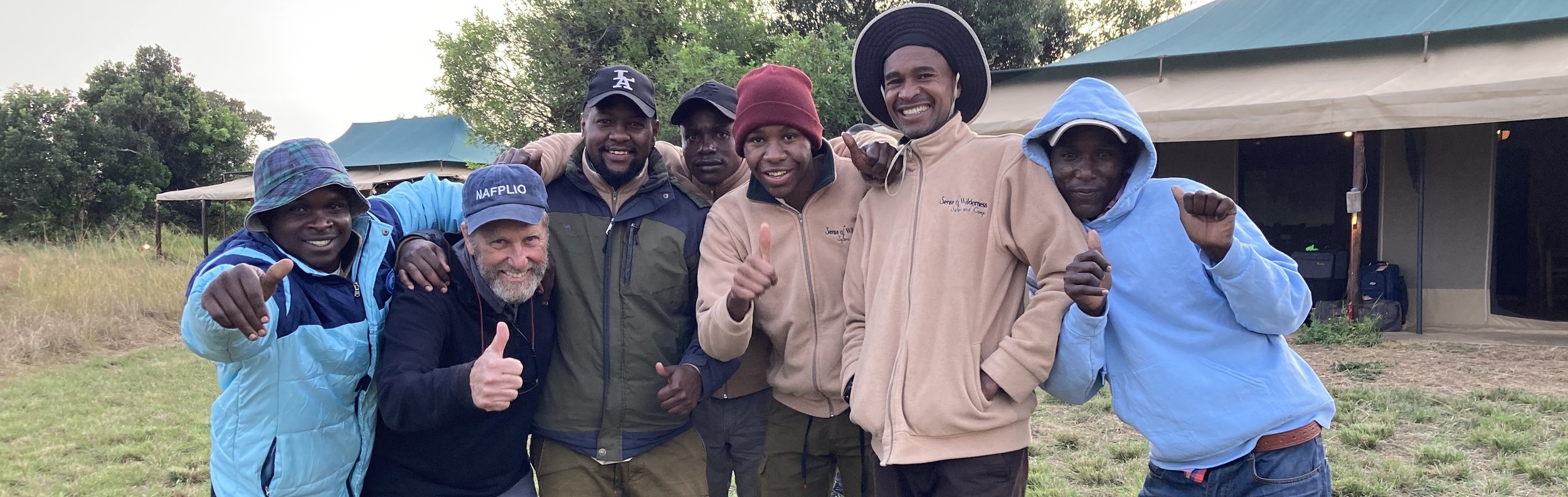
In some pretty good company here. The smiles say it all.
Richard is a driver/guide with the Africa Travel Bureau, our Tanzanian travel partners.
People, like novels, have themes.
Our Stories
In some pretty good company here. The smiles say it all.
Richard is a driver/guide with the Africa Travel Bureau, our Tanzanian travel partners.
This bad-tempered fella would have preferred to dine alone on the Serengeti. Unfortunately, he couldn't drive everybody off at the same time. As soon has he chased off one friend, another moved in for a bite.
We watched, amused, as this greedy game of "get your head out of my cape buffalo" went on and on.
Rüppell's Vulture (Gyps rueppelli) is an efficient garbage collector of East Africa. While preferring fresh kills, this scavenger will fuss over rotting ones too.
Yuck.
A Grant's gazelle (Nanger granti) watches as a Land Cruiser drops over a ridge in the Serengeti.
These gazelle thrive in dry environments, getting moisture from the plants that they eat. They also have a very efficient digestive system that allows them to eat tough plants avoided by other grazers/browsers.
See you later buddy. Keep an eyes out for the cheetahs.
Experience a Grant's gazelle (or a cheetah chase) for yourself on safari in February, 2026!
How about a Tanzanian Red-billed hornbill for your Tuesday morning? Watch him bob and listen to him cry: kok kok kok kok kok kok kokok kokok kokok kokok!
Hornbills are tropical, colorful and widespread. This particular bird (Tockus ruahae) is native to central Tanzania. Red-bills are often found on the ground, using their strong beaks to dig for bugs (and occasionally, seeds).
I always think of Zazu from the Lion King when I see these guys!
Experience a Tanzanian red-billed hornbill for yourself. Join us on an African safari next February.
A network of tradings zones in the Indian Ocean developed between 300 BC and AD 300. This network not only generated awareness of the larger world in the NT period, but introduced luxury goods to those who could afford them.
When it comes to antelopes, no place on earth has a greater variety than Africa. Some 72 native species have been identified on the continent. Antelope are smooth-haired, hollow-horned, grass-eaters. They are nimble and known for their speed.
Below is a juvenile Coke's hartebeest (Alcelaphus buselaphus cokii), spotted on the great plains of the Serengeti. The hartebeest is one of Africa's larger antelopes. Mature adults can run at speeds up to 55 km/h (and turn on a dime!).
African or Cape Buffalo (Syncerus caffer) in stream, West Tanzania.
Vicki and I were drifting off to sleep the other night when we were startled by one of these Dagga Boys ("Mud boys") scratching against the wood frame of our tent platform. From inside the canvas, we listened to him breathe heavily and munch wet grass. Eventually he wandered off. We slipped away under the covers. All's well that ends well.
Never mind the lions, an excommunicated old bull is the most feared animal of the Serengeti. Its power, speed, and unpredictable nature have given it the nickname, "Black Death."
The shaggy, smelly Waterbuck (Kobus ellipsiprymnus).
The shaggy part is obvious. Hair is brown to grey and darkens with age.
The smelly part has to be imagined. I read (can't say that I was close enough to sniff this herd) that the glands of the waterbuck produces an oil that smells of musk. The odor is strong enough to repel predators, greasy enough to "water-proof" this big antelope when in rivers and swamps (where waterbucks like to hang out), and potent enough to function as an insecticide. The oil even protects the animal from the dreaded tsetse fly!
Maybe next year I'll forgo the DEET in Africa and just go with a waterbuck hair and body mist. Waddaya think?
The call of the variable sunbird (Cinnyris venustus), tew-tew-tew-tew-tew, is a common sound in equatorial Africa. These flashy little avians perch in the highest branches of the trees and are not shy in announcing their presence.
The male, shown here, is brilliant. His blue-green "metallic" head and nape is contrasted by a yellow belly.
The needle-like curved beak of the sunbird is perfect for extracting nectar from flowers, as is its tubular tongue.
I spotted this one enjoying the sprinkler in the yard of our lodge, just outside Arusha, Tanzania.
I've always found the "dog face" of the Olive Baboon to be a little threatening. Its teeth even more so!
This species is commonly called "olive" because of the color of its fur (kinda grey-greenish).
The official name for the Olive Baboon is Papio anubis. Papio is just the genus marker for baboon. Anubis, however, is a Greek rendering of the name of the Egyptian god of the underworld! Check out Anubis. He has a "dog face" too!
The French naturalist Jean-Baptiste Audebert named this primate in 1797.
I'm thinking big about a great sea south of the Biblical Heartland. Its contours are less familiar to many, but its influence is significant.
I spotted this Black-winged Stilt in the slapping waves of Lake Magadi in Ngorogoro Crater, Tanzania. The sharp beak, black-white contrasting feathers, and long spindly legs make this bird memorable--and well suited for mud foraging.
Lake Magadi is a soda (or alkaline) lake, favored by stilts and other African waders.
(I wish you could see how goofy long his legs are. You would know why he is called a "stilt"!)
New friends. Meet Makuna Saruni, son of a Masai chief living near Mto Wa Mbu (Mosquito River), Tanzania. Mukuna is bright and articulate and wants to begin college next year. Young people like Mukuna inspire hope for our future.
Herds of wildebeest and zebra approach the Mara River between Tanzania and Kenya. It is the Great Migration, the largest mass movement of land animals on the planet.
Come safari with us in 2026!
Our group from White Oak Christian Church arrives at the boundary to the Serengeti National Park, Tanzania.
Shooting big game on safari. Thanks to Les Riley for the photo!
Why do zebras stand with their chins resting on the back of their mates? Social bonding? Watch for predators in two directions? Grooming? Tired necks?
Hmmm. Why do people hold hands?
Come to Tanzania with us next February and discover for yourself.
More specifically, an unstriped ground squirrel (Xerus rutilus), common to the grasslands of East Africa. Ground squirrels like this live lives of solitude in dry areas (hence the name xerus) eating seeds, pods, and leaves. They burrow into the ground, or, in the case of this fellow, find ready habitation in termite mounds. Underground they are safe from predators like raptors, leopards, and jackals.
A traditional East African logboat. An outrigger like this is known locally as a Nagalawah. I spoke with its owner yesterday (his father built it). I learned that this particular craft is about seven years old and hewn from a single mango tree trunk. It was modified with a frame of eucalyptus and mangrove poles lashed together with nylon rope.
The nagalawah is the workboat of the east Indian Ocean with a design tradition that goes back a thousand years or more.
It's low tide on the east coast of Zanzibar right now. This one is not going anywhere soon.
What happens in Zanzibar, stays in Zanzibar.