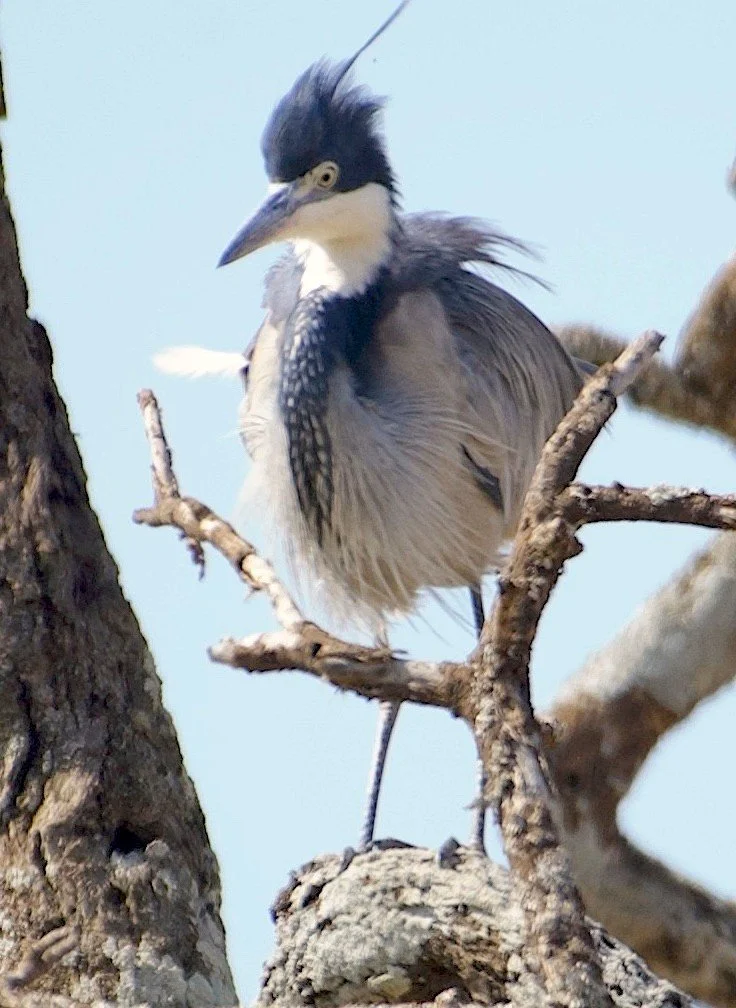
Not sure what this gangly Black-headed heron is up to, but he's all scrunched-up and fluffed-out! Ardea melanocephala is a solitary hunter, but roosts in groups. I found the individual below with 10-15 companions in a tree in the northern Serengeti.
Frog Legs, Anyone?
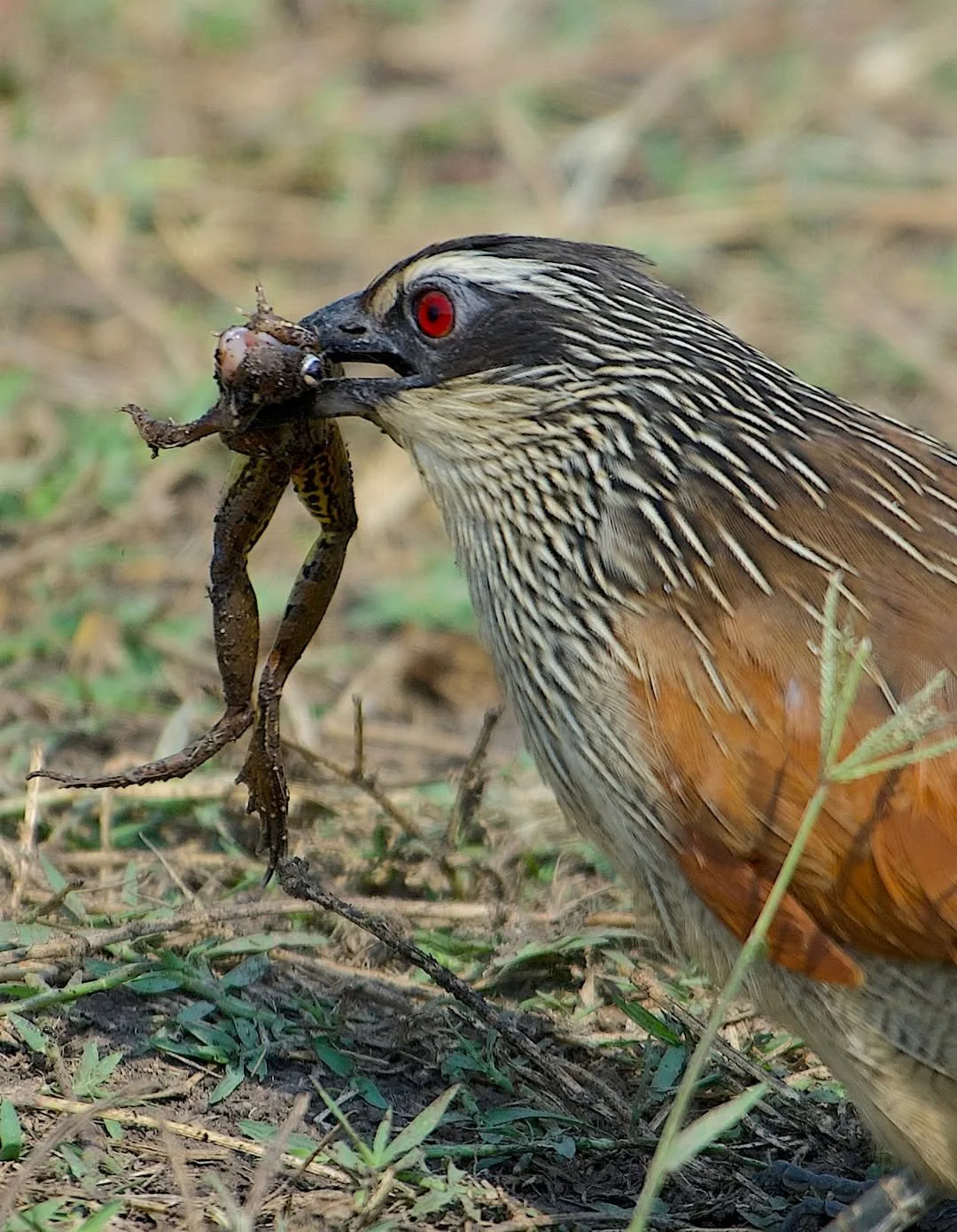
The White-browed coucal (Centropus superciliosus) is an opportunistic eater. While insects are high on the menu, other smallish creatures can become a target.
I zoomed in on this coucal and was surprised to find a frog in its beak--still kicking. I was even more surprised a moment later when he tipped his head back and swallowed it whole!
The circle of life can be tough.
The coucal is an African member of the cuckoo family.
Sparring Partners
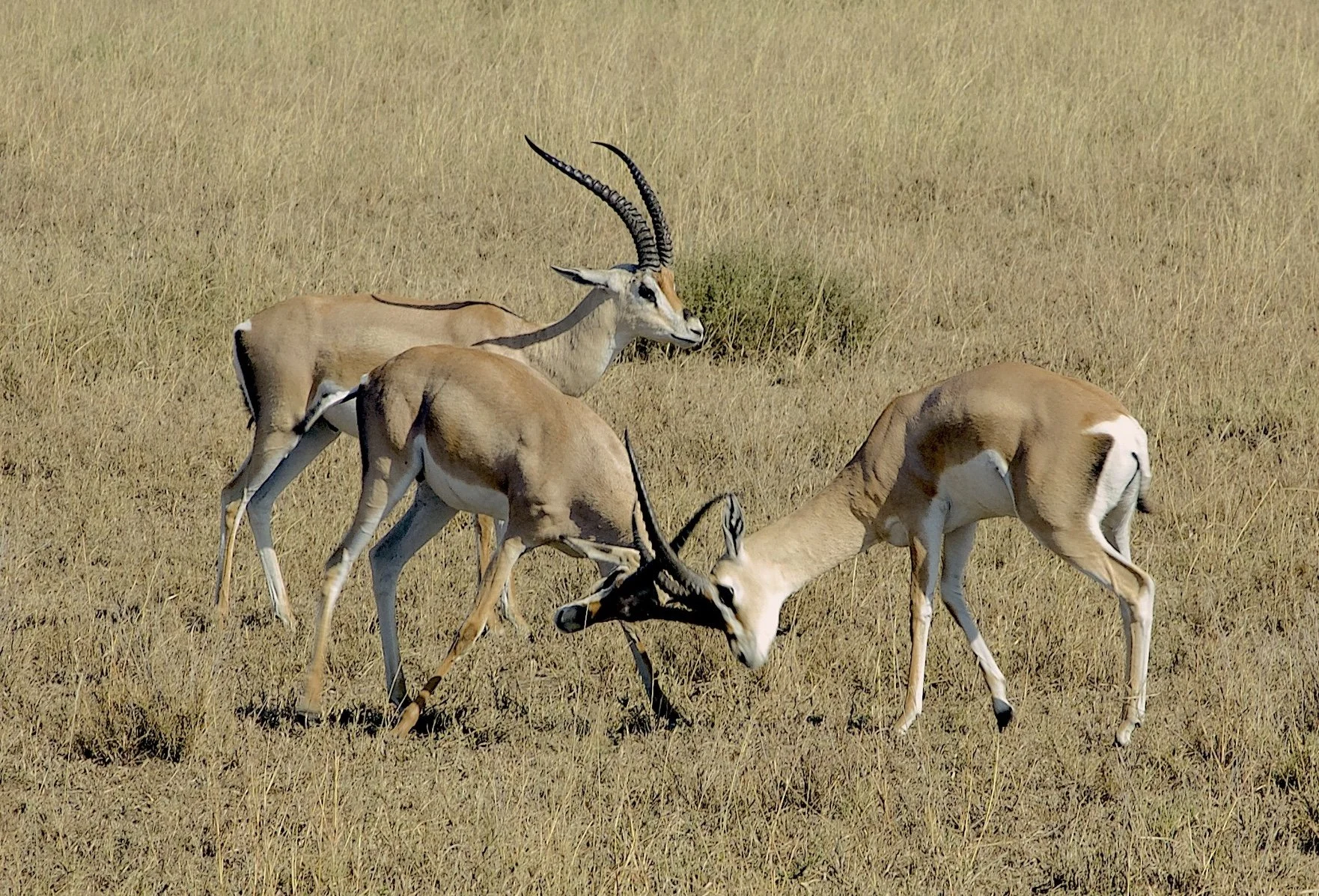
A herd of Grant's gazelle (Nanger granti) is a common sight on the Serengeti. The gazelle's lyre-shaped horns not only bequeath a graceful appearance, but give it formidable tools for defense. Unlike antlers (that are shed annually), gazelle horns are permanently affixed, corrugated, and unbranched.
This species is named after James Grant, a preacher's son who worked with John Speke in the quest to discover the source of the Nile. I'm enjoying Tim Jeal's account of this pioneering work right now in his Explorers of the Nile: The Triumph and Tragedy of a Great Victorian Adventure. Its a good read for folks with a strong stomach (!) who are interested in the story of East Africa.
Endless
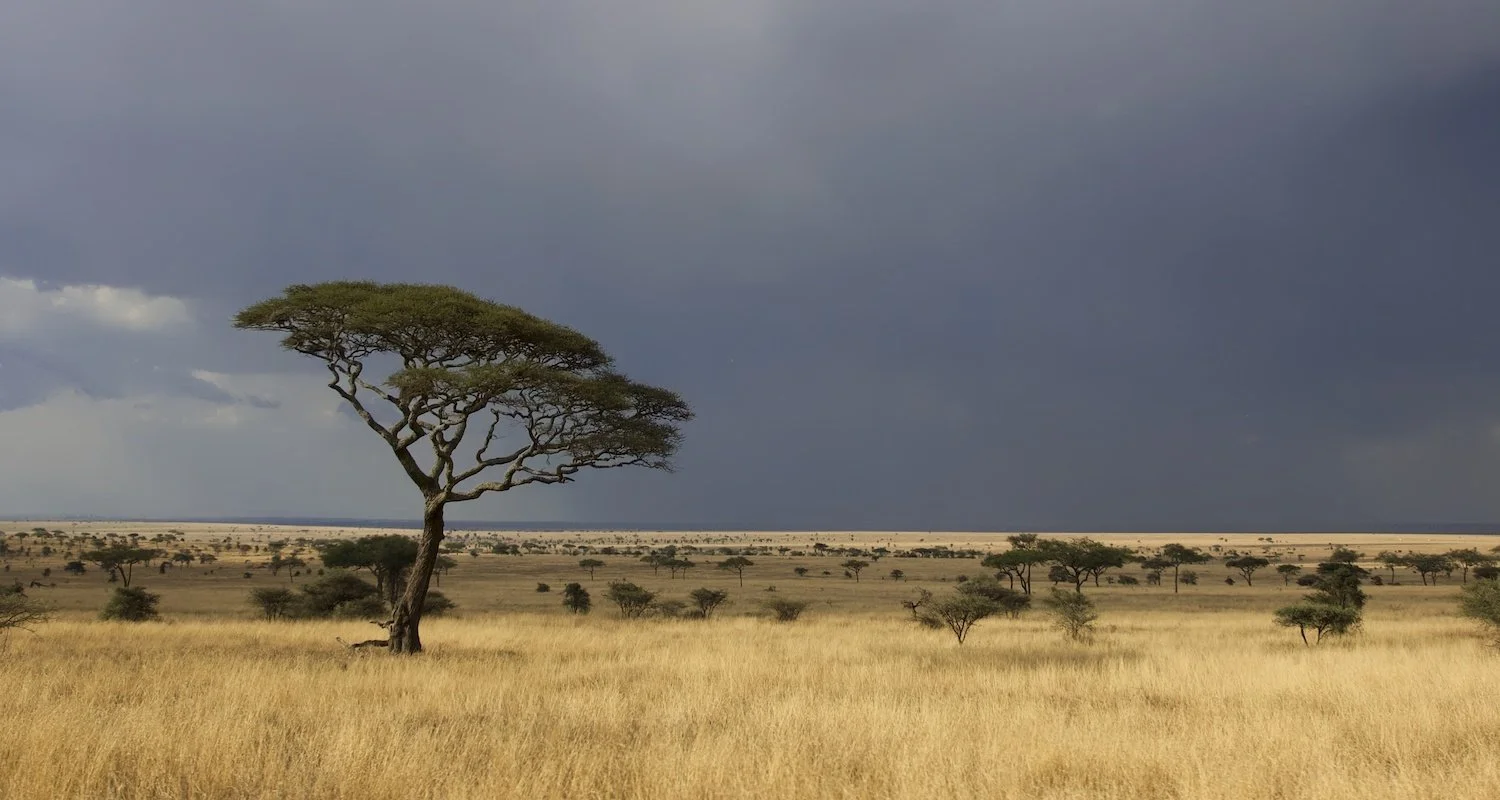
When looking to the horizon you can understand why the Maasai referred to the this as serengeti, or "endless land."
Lose yourself here in 2025.
A Little Cockoo
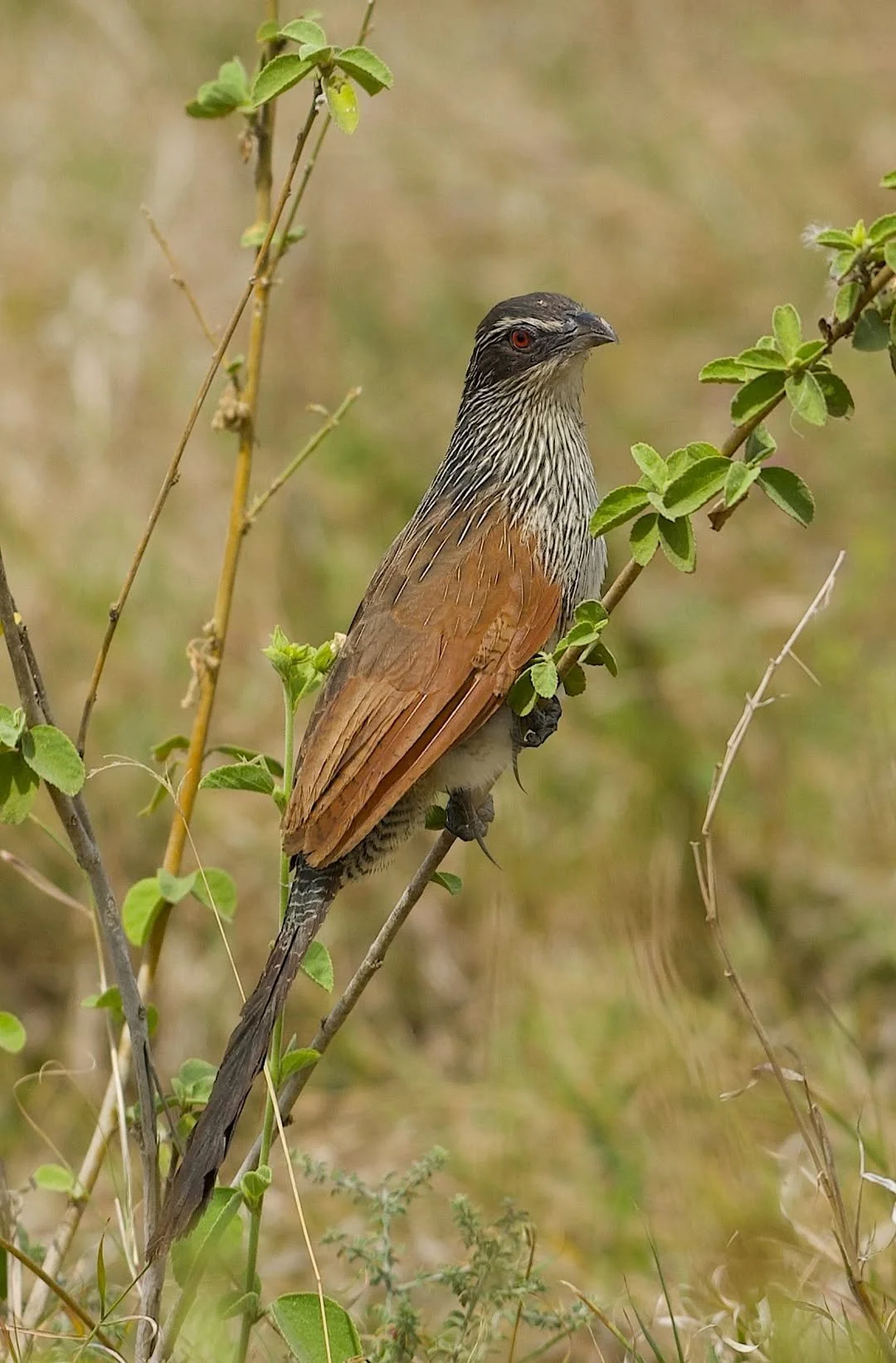
It's a little cuckoo, because it's Friday.
The White-browed coucal (Centropus superciliosus) is a member of the cuckoo family. These birds catch and eat insects but fly awkwardly. Some might say a little cuckoo!
Doesn't the red eye look sinister?
The White-browed coucal is native to eastern and southern Africa.
Hey! Who's coming on safari with us next year?
Black and White
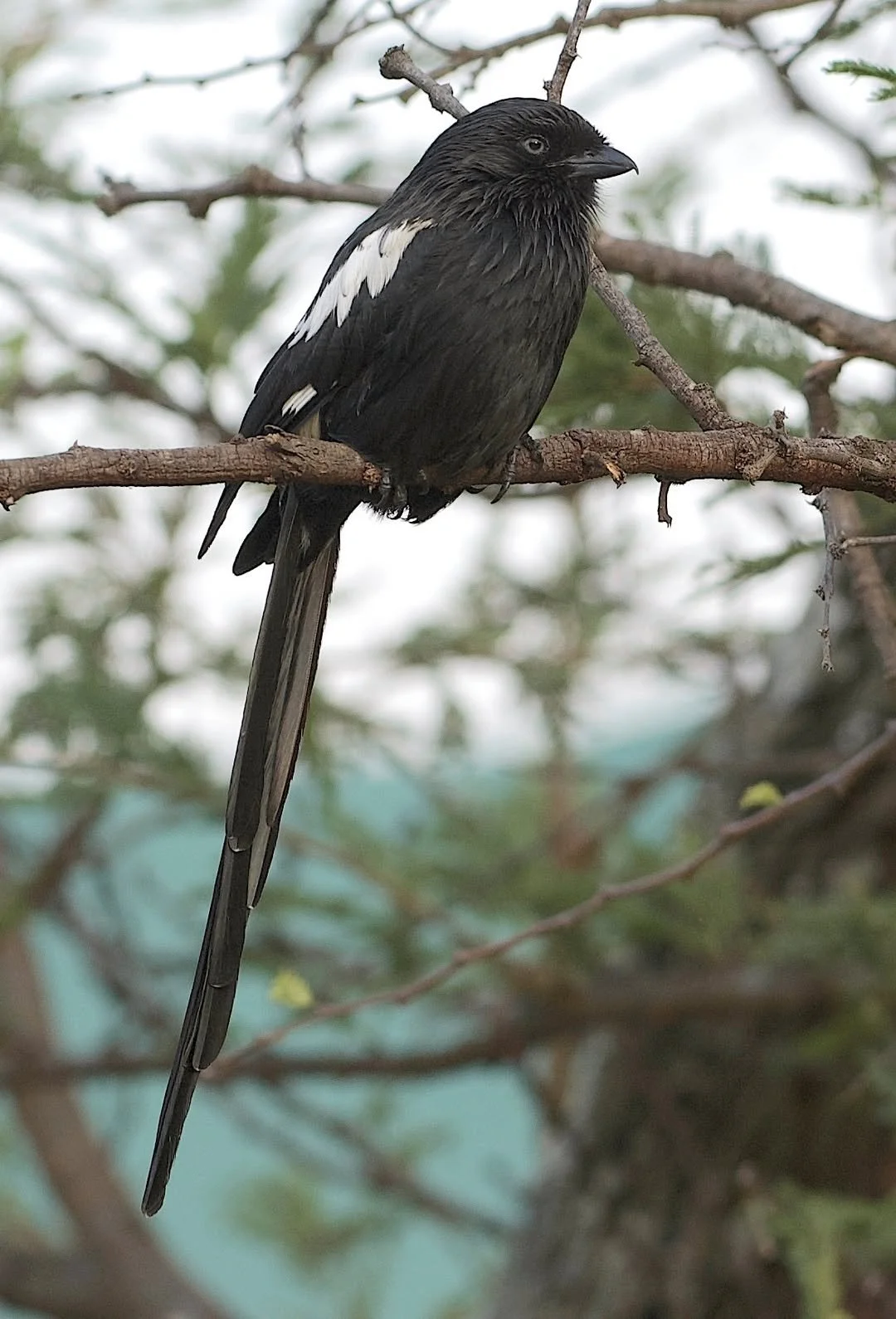
The Magpie shrike (Lanius melanoleucus) or "Long-tail shrike" is fidgety and shy. I snuck up on this one near the kitchen tent of our camp in the central Serengeti.
It is certainly more fun to "hunt" birds on foot.
The scientific name for this shrike is appropriate. Melanoleuca (melas + leucos) is Greek for “black and white."
Safari Food
Discover fabulous eats on an African safari!
Fearless Parent
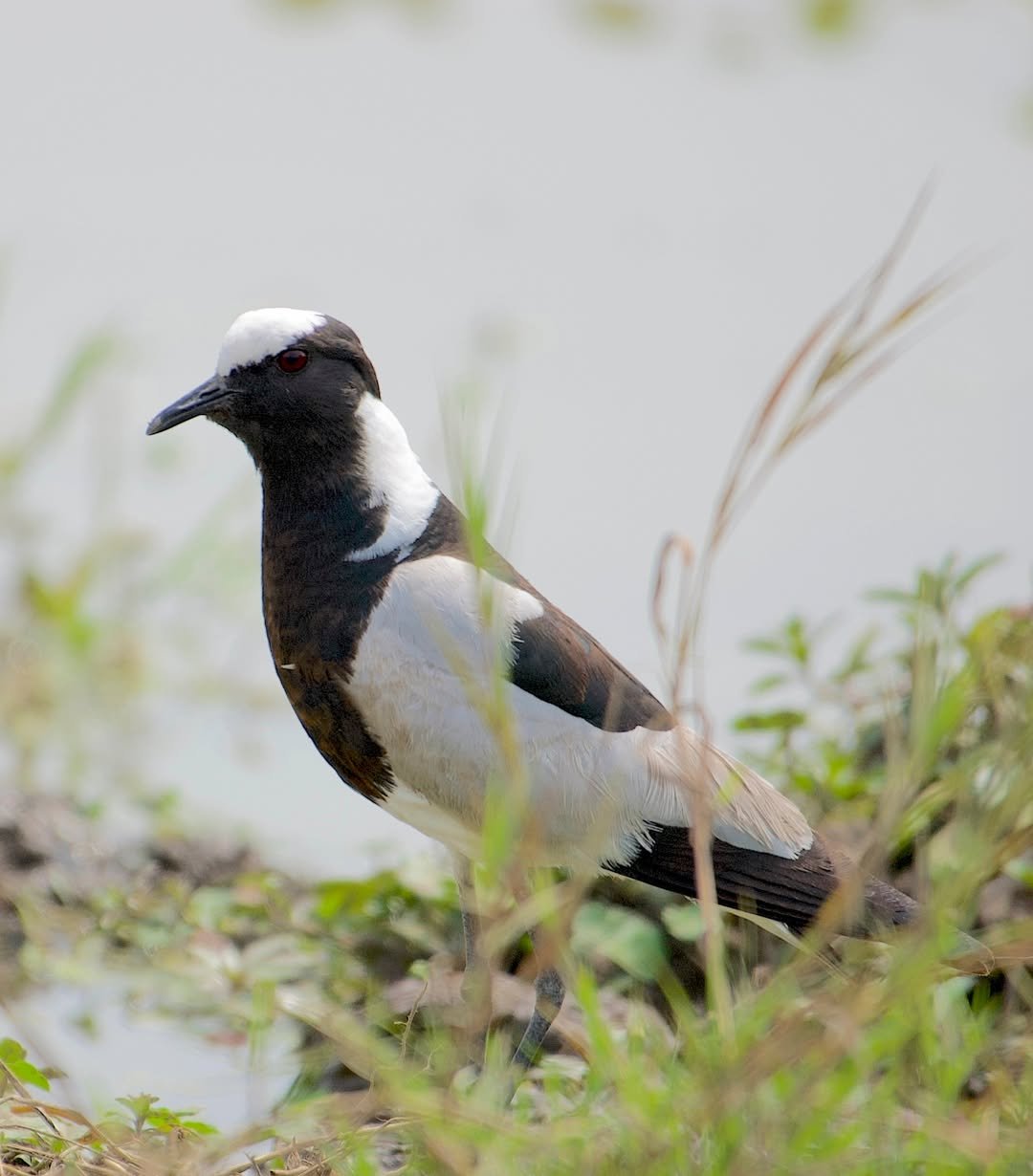
Do you know that this boldly-colored bird will risk everything to protect its young? The lapwing (or plover) will attack raptors, rollers, or even an elephant perceived as threat!
Its call--"tink, tink, tink"--sounds like the hammer of a blacksmith, hence the name: the Blacksmith lapwing (Vanellus armatus).
Why do Hippos Yawn?

Why do hippos yawn?
Maybe because they are sleepy?
Unlikely.
It is a display of aggression ("back off"), dominance ("my lawn"), or display ("look what a handsome fellow I am!).
On safari I learned that hippos can spread their jaws wide open, 180 degrees. That's a serious stretch! Look at those teeth!
I already knew to keep my distance. Hippos are one of the most dangerous animals on the Serengeti. Wowzer.
Critically Endangered
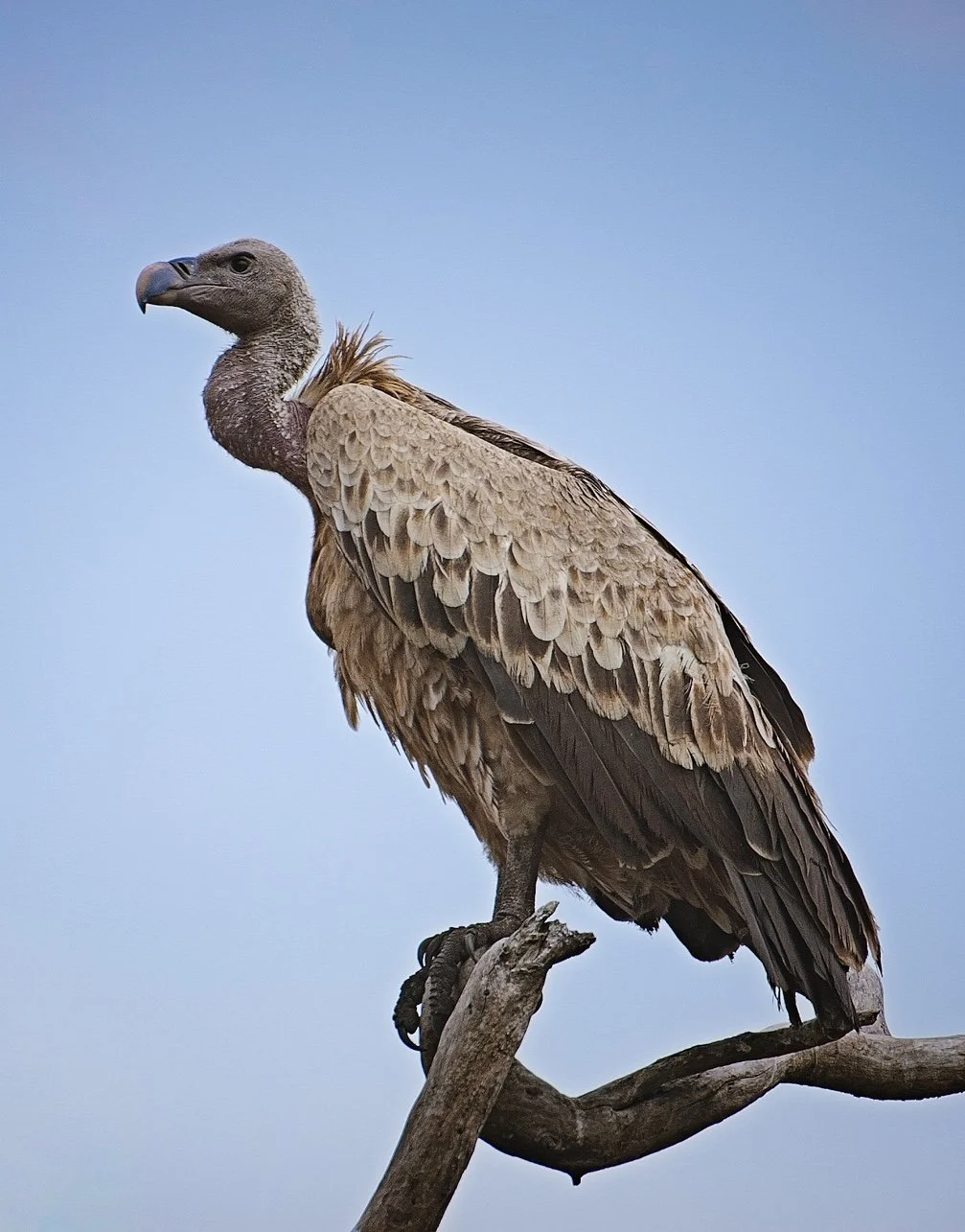
A couple of weeks ago, I posted a shot of two vultures sitting on the ground by a kill. Here's another one sitting on a dead tree in the Serengeti.
A mature Rüppell's griffon vulture (Gyps rueppelli) is huge. Individuals like this can have a wingspan of 8 feet and live up to 50 years!
I know he's not very cuddly, but he needs help. This species is considered critically endangered.
(HT to Ken Gawne for his photo assistance!)
What is Glamping Anyway?
Glamping should never be confused with camping. We glamp on safari in the Serengeti.
Co-workers, Friends, Brothers
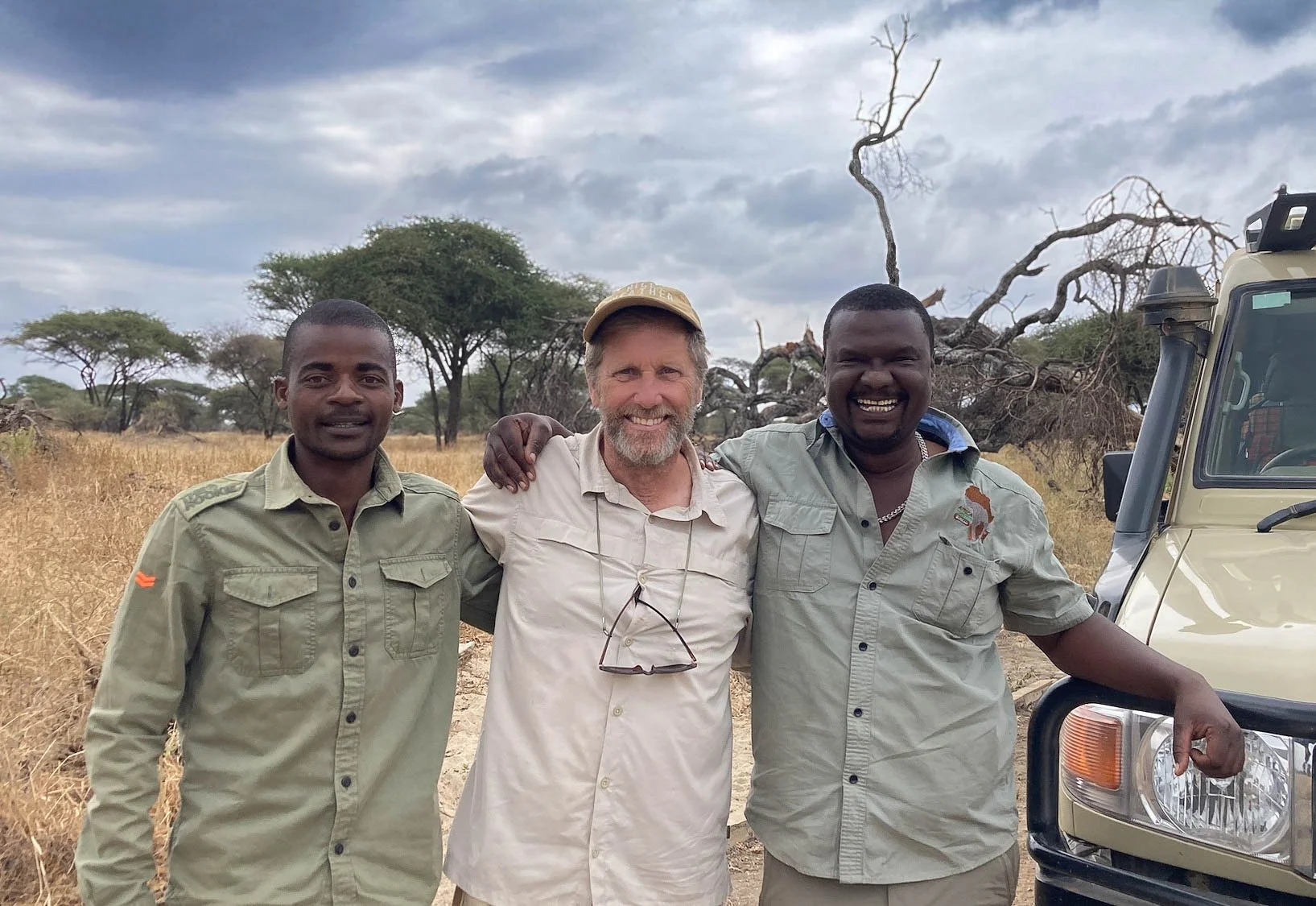
Counting co-workers as dear friends is a blessing. I can't say enough good things about Godwin (L), Ellie (R), Simon (not pictured), and the front office of the Africa Travel Bureau (ATB) in Arusha, Tanzania. Arusha is the "safari capital" of the world; the ATB plays at the highest levels of that game.
Big Boy
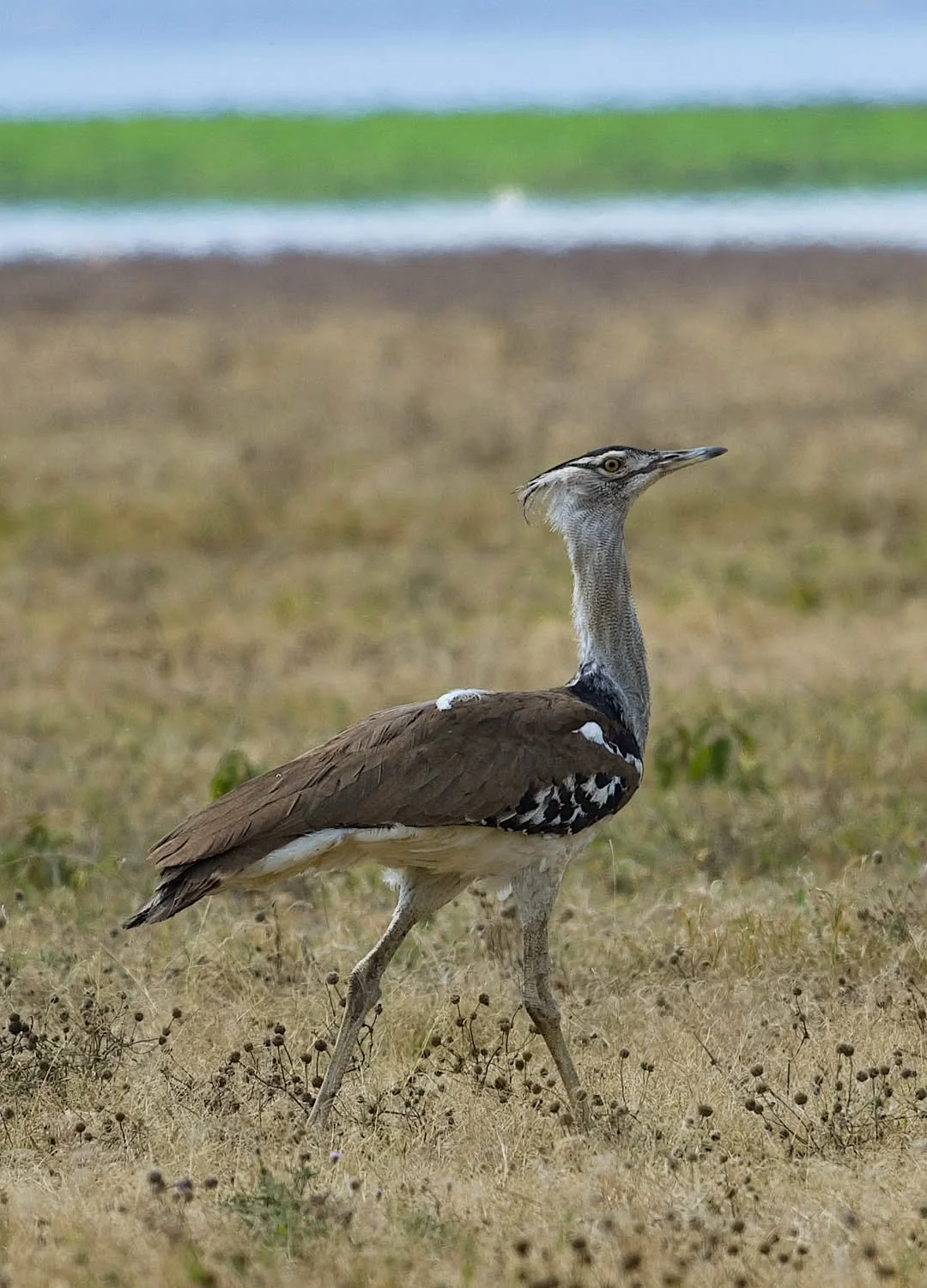
Easy there, big boy!
This photo doesn't offer a sense of scale, but realize that this dude is more than a meter tall! That makes the Kori Bustard (Ardeotis kori) the largest flying bird in Africa (the ostrich is bigger, but doesn't fly). Mature bustards can weigh 40 pounds and are possibly the heaviest creature capable of flight today.
Kori Bustards are rare outside of protected areas. The species is considered "vulnerable" on the endangered list. I was delighted to find this one striding along (like a T-Rex!) looking for a meal on the edge of Lake Magadi (Ngorongoro Crater, Tanzania).
On the trail of the Great Migration
The stream of wildebeests and zebras flowed north toward the Kenyan border. We followed it.
Backside Stripes
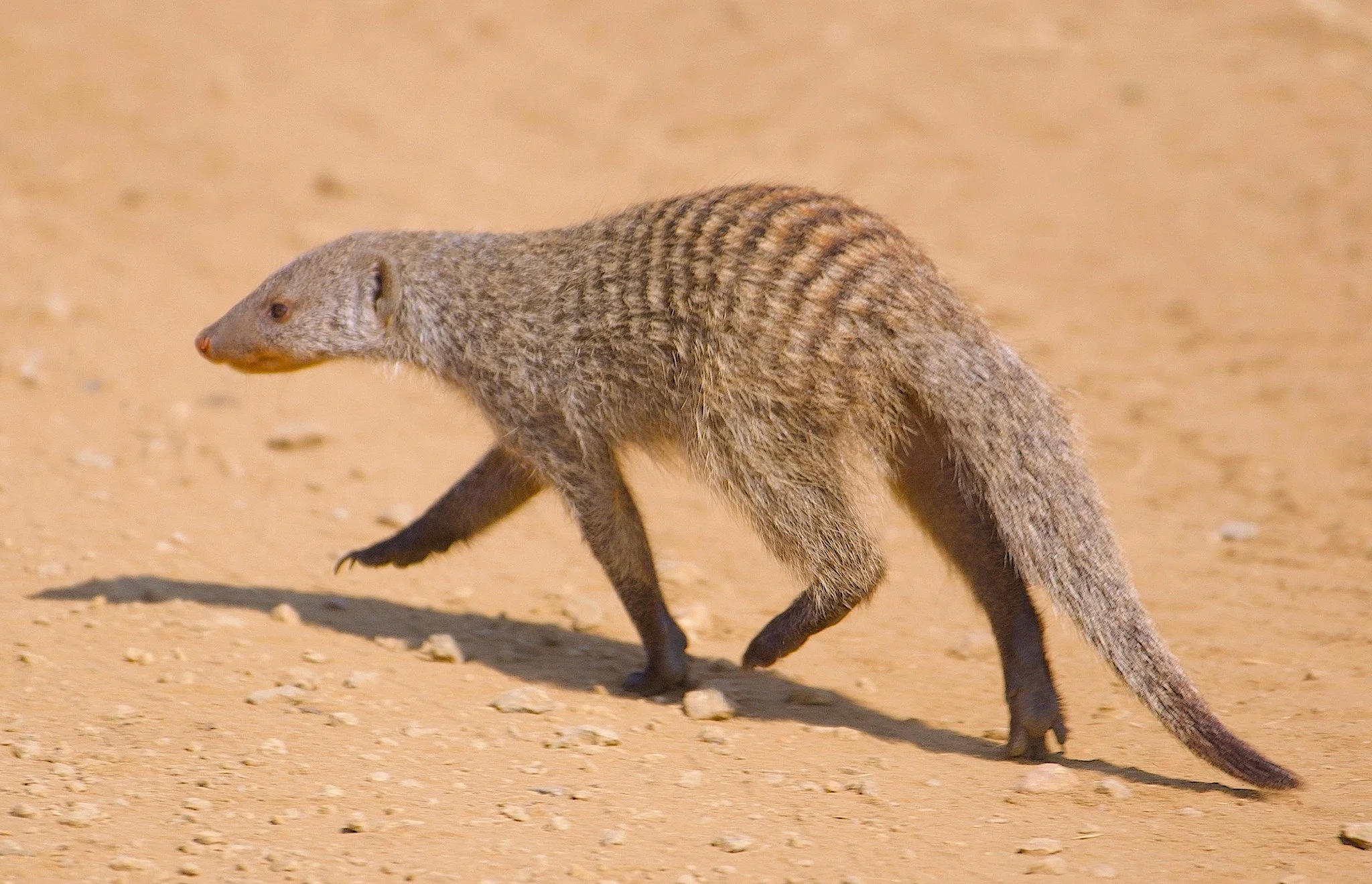
A pack of banded mongooses (Mungos mungo) crossed the track in front of our vehicle. There were probably twenty or thirty of these feisty individuals scurrying from one termite mound to another. These little guys eat about anything in their path including bugs and birds and (as every Kipling reader knows) snakes!
The banded mongoose--named for the backside stripes-- is found throughout sub-Saharan Africa.
Some believe it is mentioned in Leviticus 11:30 (Heb. koach) in a list of "unclean animals."
Unexpected Beauty
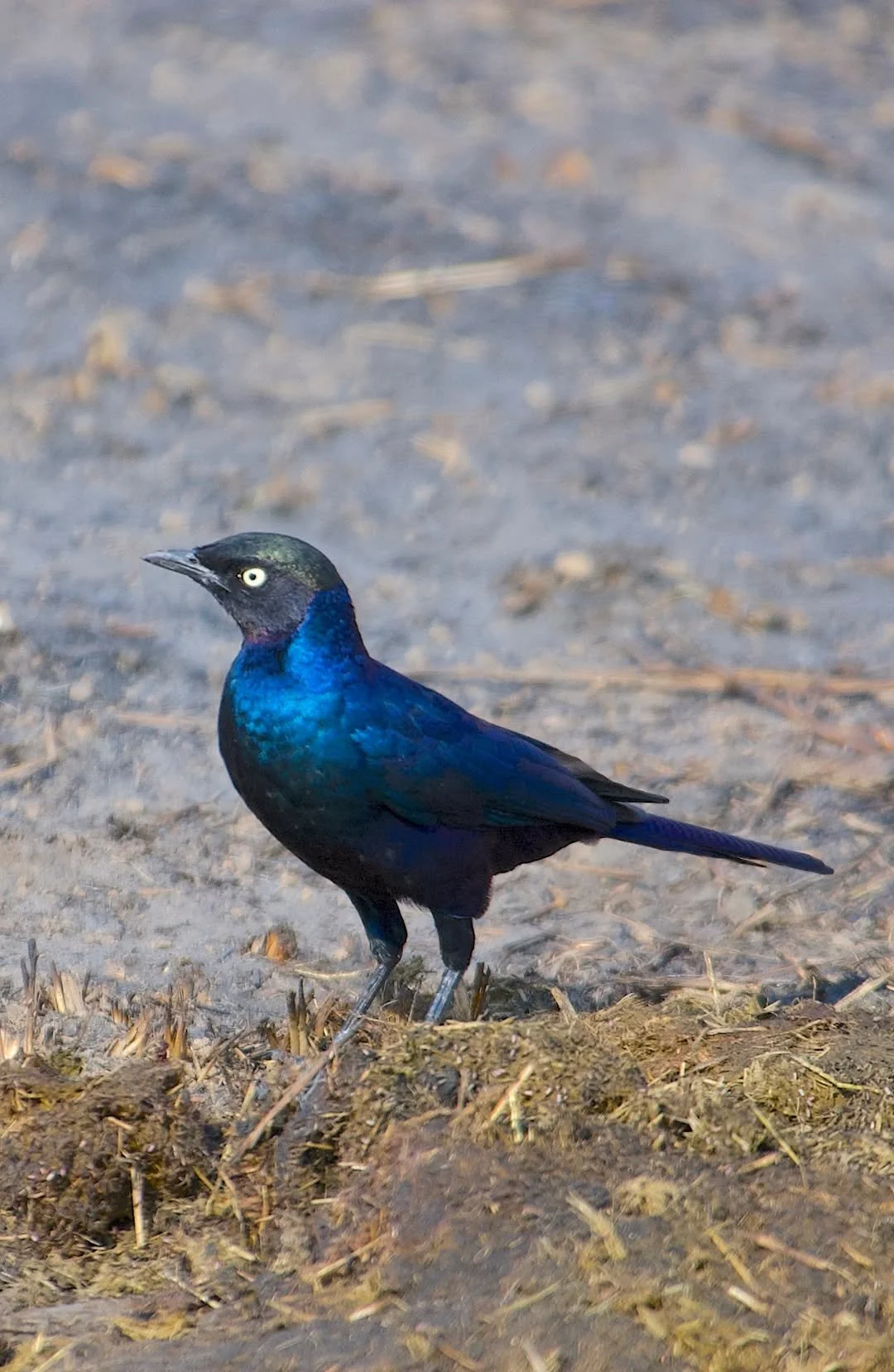
Bird in poo: another unexpected beauty.
Look at the iridescent color of Rüppell's glossy-starling (Lamprotornis purpuroptera). Isn't he magnificent?
I believe that finding joy in the extravagance of creation is an aspect of worship. Do you agree?
Special Gland
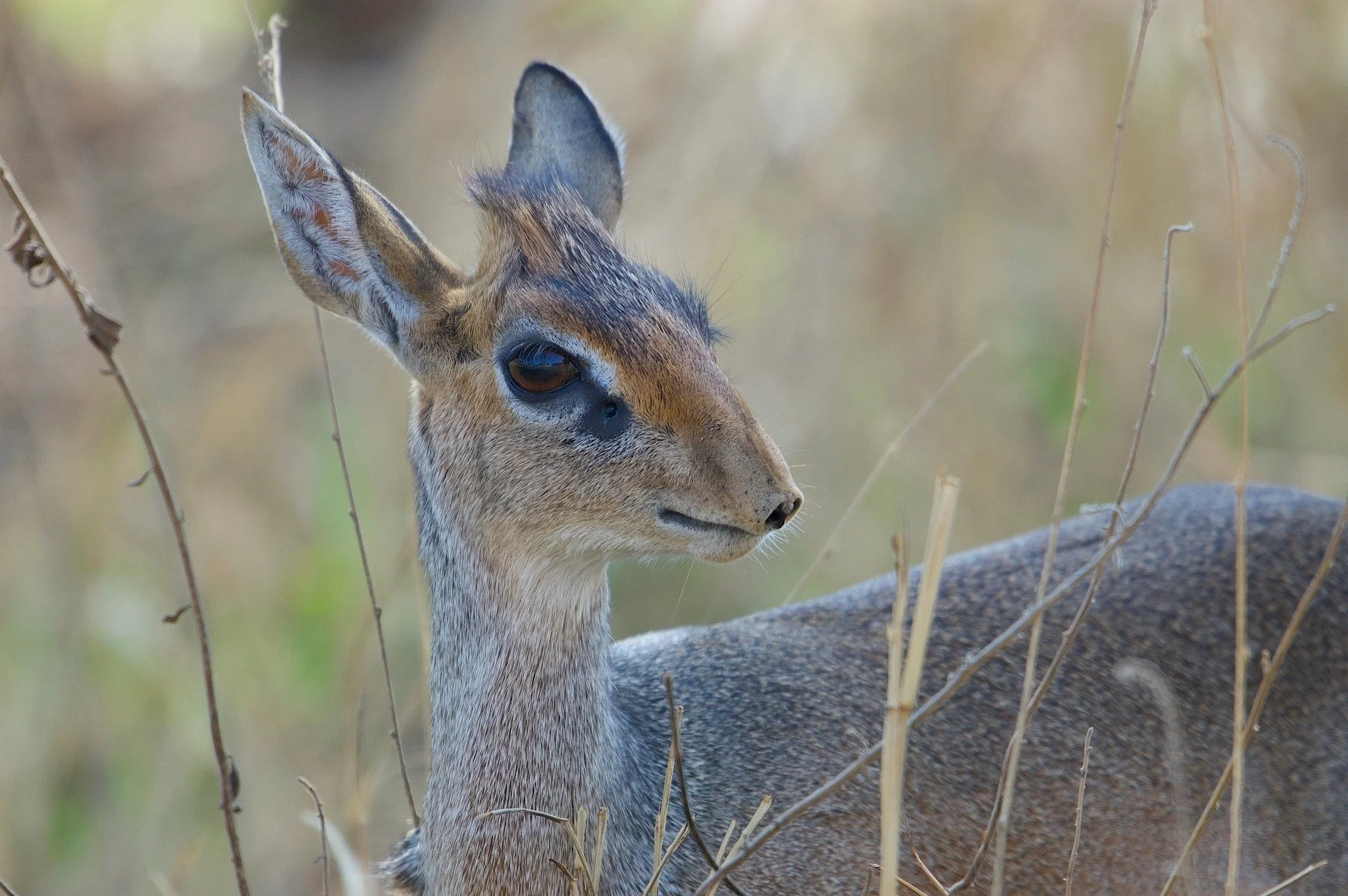
The Did-dik is a tiny antelope, maybe 12" at the shoulder. It is uniquely built for life in the African savannah. It has a nose that functions like a bellows, cooling the blood as it circulates. It has huge eyes and excellent vision to spot approaching predators. It even has a special gland just below its eye that secretes a sticky substance used to scent-mark territory.
I think this one is Kirk's Dik-dik (Madoqua kirkii). He found us in the central Serengeti (Tanzania).
Mom and Them
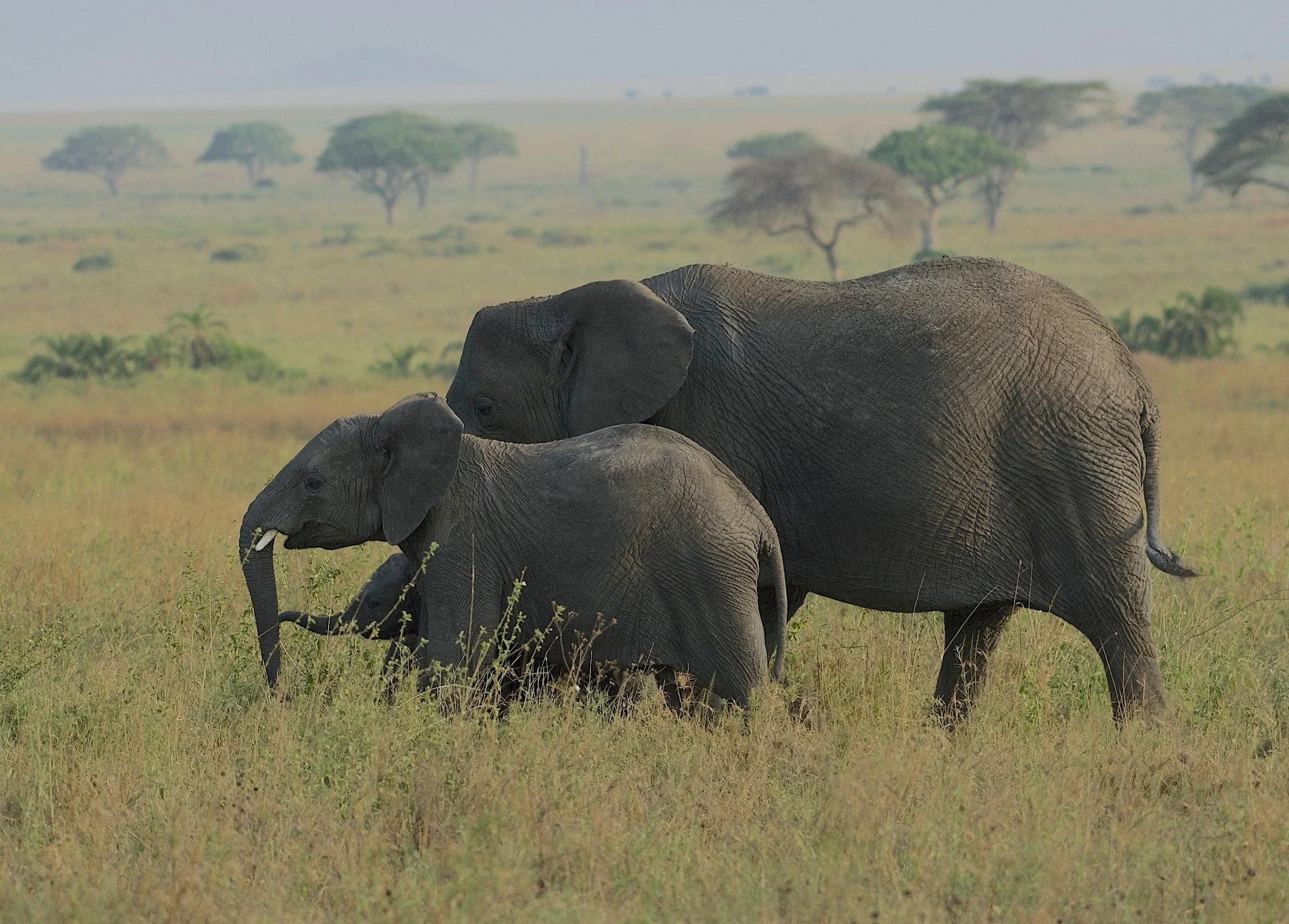
Mom and them (see the littlest one?).
Since African bush elephants (Loxodonta africana) are the largest land animal on earth, it shouldn't surprise you that they also have the longest gestation period of any creature: almost two years!
How do you say "Ngorongoro"?
Hard to say; easy to love!
Topi
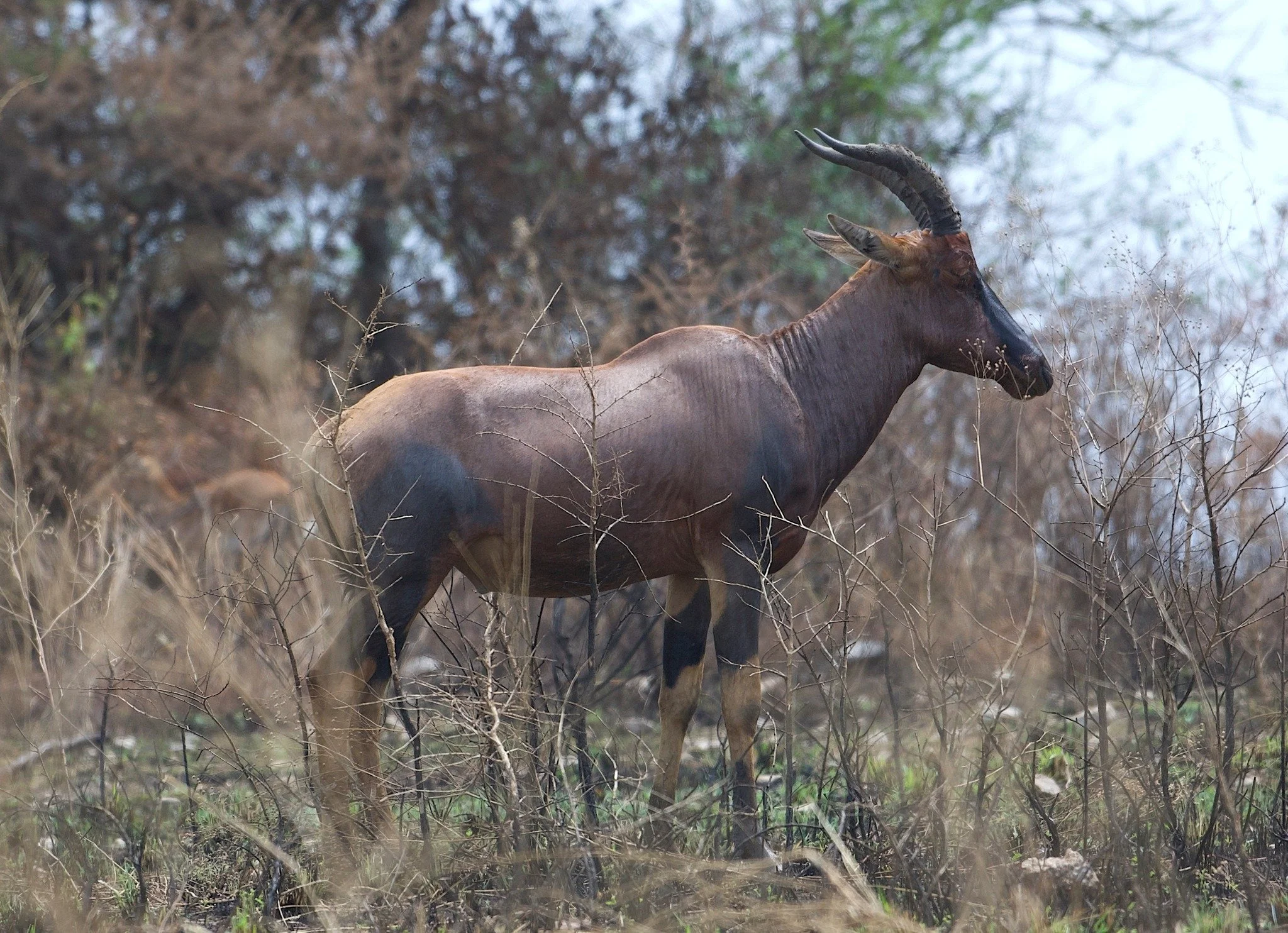
Many names have been given to this majestic antelope of the Serengeti. The one that has stuck is the topi. Damaliscus lunatus has patches of blue-black and yellow on its legs and flank, making it easy to identify.
Sadly, one-fourth of antelope species in the world today are threatened with extinction. This includes the African topi.